Follow us
FADA hopes Tesla will embrace dealership model for India entry
Tesla has chosen to sell directly to customers since its launch around a decade ago and has been relatively successful at that, despite the stiff opposition from the dealership community.
 15 Apr 2024
 8079 Views
Share -
8079 Views
Share -


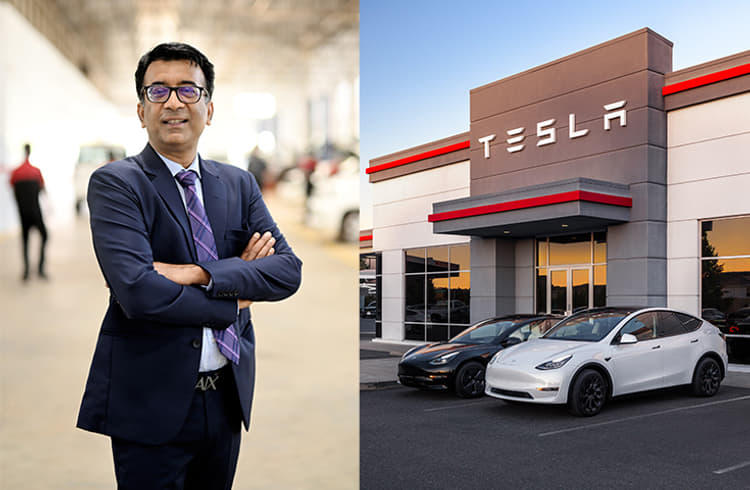
Manish Raj Singhania, President of the Federation of Automobile Dealers Associations (FADA), is of the opinion that Tesla Inc. will need to adapt its Direct-to-Consumer (DTC) sales model for the Indian market.
Singhania argues that established dealerships offer a crucial "local connect" with customers, fostering brand loyalty and driving sales. He cites the example of another unnamed automaker that initially adopted a DTC strategy but ultimately resorted to opening experience centres—a move akin to dealerships, according to Singhania, but lacking the personal touch dealerships offer.
"None of the other original equipment manufacturers (OEMs) opted for this DTC kind of model," Singhania said. "In fact, 99% of OEMs still continue to have business based on dealerships, because they understand their importance."
Founded in 1964, the Federation of Automobile Dealers Associations (FADA), is the apex national body of the automobile retail industry in India, engaged in the sale, service, and spares of 2 and 3-wheelers, passenger cars, UVs, commercial vehicles (including buses and trucks), and tractors. FADA India represents over 15,000 automobile dealerships with over 30,000 dealership outlets, including multiple associations of automobile dealers at the regional, state, and city levels, representing the entire auto retail industry. Together, it employ 4.5 million people at dealerships and service centres.
Singhania expressed hope that Tesla will recognise the Indian auto market's specific needs and forgo its global DTC model. "I hope Tesla also understands that we have a deeper connection with people," he added.
The remarks by Singhania should be seen in light of the Indian government's recent decision to ease Tesla's entry into the world's third-largest automobile market. Tesla owner, Elon Musk is going to visit India this month to meet with Prime Minister Narendra Modi and discuss his car company's entry into the country as well as his other businesses, such as satellite linked telecom services.
Tesla has chosen to sell directly to customers since its launch around a decade ago, and has been relatively successful at that, despite the stiff opposition from the dealership community.
Some of Tesla's rivals, such as Rivian, Polestar, and Lucid, followed a somewhat similar model to some extent. In India, Bengaluru based Ola Electric has been working with the D2C model.
Autocar Professional reported on April 7 that the Transport Corporation of India (TCI), one of India's largest logistic carriers, is witnessing increasing demand for D2C supply of vehicles, particularly in the electric two-wheeler startup space. The legacy vehicle manufacturers, while toying with the idea, have never jumped onto it.

RELATED ARTICLES

Petronet LNG and Gruner Renewable Energy Enter JV to Build CBG Plants
 Dev Vadchhedia
22 Oct 2026
Dev Vadchhedia
22 Oct 2026
The State-run LNG importer signs binding term sheet for 50:50 joint venture to establish 10 compressed biogas units wort...


Rajratan Global Wire Q2 Net Profit Rises 17 Percent to Rs 24.14 Crore
Dev Vadchhedia
22 Oct 2026
The tyre bead wire maker records 26 percent revenue growth driven by export demand and operational turnaround at its Che...

Tata Passenger Electric Mobility Crosses 1,000 Fast-Charging Points Across India
Dev Vadchhedia
22 Oct 2026
Tata Motors-led EV network energizes 180 highway corridors and installs 40 MW of total charging capacity.