Follow us
India Yamaha Dispatches 92 EC-06 Electric Scooters in First Month of Sale
India Yamaha Motor’s first EV, priced at Rs 167,600 and sold at premium Blue Square showrooms in only a few cities, gets off to a tepid start. Combined factory dispatches (wholesales) of Yamaha, Suzuki and Honda in February were 824 units, with Suzuki contributing 732 units and Honda zero.
 13911 Views


India Yamaha Motor (IYM), the last of the three Japanese two-wheeler OEMs to enter the electric mobility market, registered wholesales (factory dispatches to showrooms) of 92 units of the Yamaha EC-06 electric scooter in February 2026, its first month of sale.
IYM revealed the EC-06 e-scooter, its first EV for the domestic market, in early November 2025 and then kicked off production on January 12, 2026 as part of a contract manufacturing programme at the River Mobility plant in Hoskote, Karnataka. Three weeks later, on February 2, the company launched the EC-06 priced at Rs 167,600 (ex-showroom, Delhi) and made it available in select cities in three states – Karnataka, Tamil Nadu and Maharashtra – through Yamaha’s premium Blue Square showrooms. This, probably, explains the tepid two-digit dispatches last month. Going forward, as the EC-06 network and availability expands, it’s likely monthly sales will rise for the premium e-scooter.
Targeted at the Urban Rider
The Yamaha EC-06 has been co-developed with Bengaluru-based start-up River Mobility in which Yamaha invested in January 2024 as a strategic move to have a footprint in India’s fast-growing e-2W market. Based on the same platform as the River Indie e-scooter albeit with some key differences, the Yamaha EC-06 essentially is a joint development project between Yamaha’s engineering teams in Japan, the US, and Europe, and the River Mobility team. While Yamaha retains product ownership, River has been entrusted with full execution responsibilities — from R&D and battery integration to engineering and manufacturing.
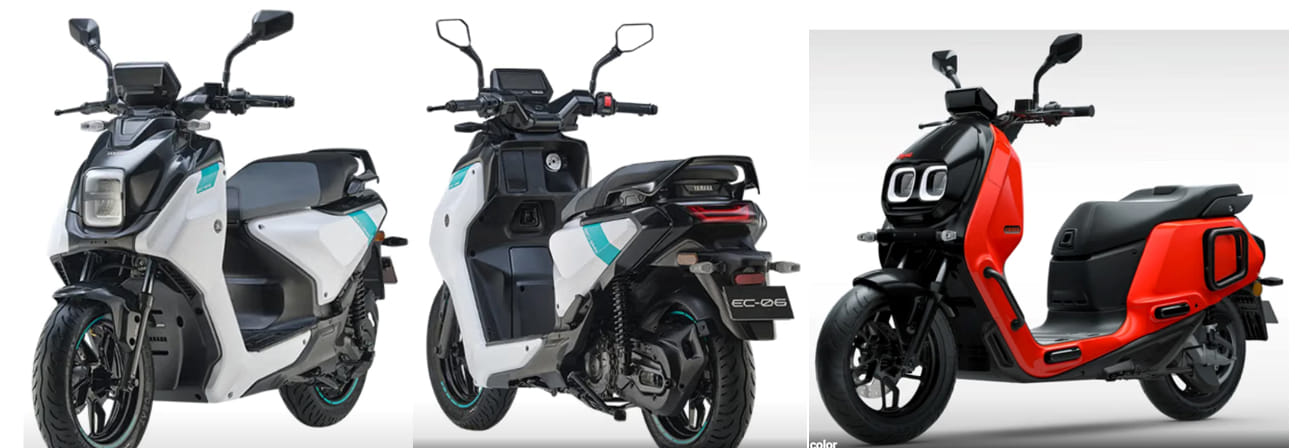 While the Yamaha EC-06 is based on the same platform as the River Indie (right), it has some notable differences in its styling and features. The EC-06 costs Rs 21,601 more than the Indie.
Common to the Yamaha EC-06 and the River Indie are the 4kWh battery, peak power of 6.7 kW (9hp) and maximum torque of 26 Nm. What’s different is the EC-06’s 79kph top speed compared to the River Indie’s 90kph, and a range of 169km versus the Indie’s 163km on a single charge. Under-seat storage is 24.5 litres compared to the Indie’s cavernous 43 litres. At Rs 167,600, the Yamaha EC-06 costs Rs 21,601 more than the River Indie (Rs 145,999, ex-showroom Delhi) which is currently sold in nearly 40 cities across Karnataka, Tamil Nadu, Maharashtra, Andhra Pradesh, Telangana, Gujarat and Rajasthan. In February, River Mobility delivered 2,303 units of the lower-priced Indie to its customers, as per Vahan stats.
Targeted at the growing band of urban riders in the country, the Yamaha EC-06 has three riding modes – Eco, Standard, and Power – allowing riders to optimise efficiency, performance, or acceleration. Like the River Indie, a convenient Reverse Mode simplifies manoeuvring in tight spaces, while ride and handling benefits from a telescopic front suspension with hydraulic dampers and rear coil spring suspension. The EC-06 integrates the Yamaha Motor Connect R app, enabling real-time data access and smart features for a connected riding experience.
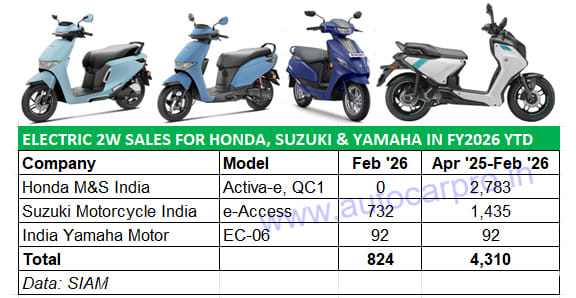
February the first month to see all three major Japanese OEMs. While Honda has sold 2,783 Activa-e and QC1s in the past 11 months, Suzuki sold 1,435 e-Access over 2 months, Yamaha 92 EC-06s.
Japanese OEMs Sell 824 E-Scooters in February
Compared to their Indian counterparts and legacy players like Bajaj Auto, TVS Motor Co and Hero MotoCorp, Japanese OEMs have been rather late in entering the e-2W market. February 2026 is the first month to have all the three major Japanese two-wheeler OEMs in the fray. Combined sales of Honda Motorcycle & Scooter India (HMSI), Suzuki Motorcycle India and India Yamaha Motor in February 2026, according to apex industry body SIAM, were 824 units. In comparison, the TVS-Bajaj-Hero combine registered wholesales of 80,378 units.
Honda Motorcycle & Scooter India, which launched its Activa E and QC1 in February 2025, did not produce single unit or dispatch a single EV to its showrooms last month. As a result, its cumulative 11-month FY2026 sales are 2,783 units and total sales since launch 5,445 units.
Suzuki India, which commenced sale of its e-Access in January 2026 with 703 units, and has manufactured 2,136 units till end-February, registered factory dispatches of 732 units which takes its two-month total to 1,435 units. Retail sales (customer deliveries) in January-February are 534 units.
Like India Yamaha, which sold 93 units of the EC-02 in its first month, the slower-than-expected offtake of the premium Suzuki e-Access can be attributed to its stiff pricing. At Rs 188,490 (ex-showroom Delhi), the zero-emission avatar of Suzuki’s popular ICE Access 125 scooter costs substantially more than the top two best-selling e-2Ws in India. While the top-spec TVS iQube ST 5.3kWh costs Rs 158,000 (Rs 30,000 less), the top-end Bajaj Chetak 350 has a sticker price of Rs 123,000 (Rs 65,000 less). The comparable Ather Rizta Z 3.7kWh costs Rs 153,000 (Rs 35,000 less). Pricing-wise Suzuki e-Access costs Rs 20,890 more than the Yamaha EC-06 (Rs 167,600) and slots in between the recently launched Simple One Gen 2 (Rs 170,000) and the Ather 450 Apex (Rs 190,000).
In a market, where demand remains strong for affordable e-2Ws (below Rs 100,000), it remains to be seen whether Yamaha’s premium-product-pricing strategy clicks with the value-conscious EV buyer. Yamaha has another EV in the offing for India. The Aerox-E, the zero-emission avatar of the petrol-powered Aerox 155, will be manufactured by India Yamaha and is in line with its premium segment strategy for the ASEAN region and emerging markets.
In FY2025, India Yamaha (295,728 units) was the fourth largest two-wheeler exporter after Bajaj, TVS and Honda. In the first 11 months of FY2026, IYM has already exported 318,030 bikes and scooters, up 19% YoY. The EC-06 and Aerox-E could soon join the list of made-in-India Yamaha two-wheelers to be shipped overseas. Watch this space for regular updates on zero-emission vehicle sales on two and more wheels.
ALSO READ: TVS surpasses Yamaha to become third-largest global 2W OEM

RELATED ARTICLES

Electric CV Sales Jump 155% to 23,540 Units, Tata Motors Tops but Euler Motors Shines
 Ajit Dalvi
 14 Sep 2026
Adoption of electric mobility for both freight and passenger transport is growing rapidly with volumes driven by surging...


Maruti Ertiga Crosses 1.5 Million Sales Milestone
Ajit Dalvi
12 Sep 2026
India’s highest-selling MPV and Maruti Suzuki’s first crack at the people-mover segment has sold 15,13,574 units in the ...

Maruti Suzuki on Track for 2 Million Domestic Market Annual Sales for the First Time in CY2026
Ajit Dalvi
11 Sep 2026
Having sold 1.40 million passenger vehicles with 22% YoY growth in the first eight months of this year, market leader Ma...