Follow us
Honda Sells 5,445 Activa-e and QC1 e-Scooters in 12 Months
Since February 2025, Honda Motorcycle & Scooter India has produced 11,168 e-scooters, dispatched 5,445 units to its dealers, and delivered 3,723 units to customers. The resulting high level of inventory means that the company has not produced either of these two models in the past six months.
 16 Feb 2026
 8435 Views
Share -
8435 Views
Share -


The first of the three Japanese two-wheeler manufacturers to plug into the Indian electric 2-wheeler market has had an underwhelming first year. As per apex industry body SIAM production and wholesales data, Honda Motorcycle & Scooter India (HMSI) manufactured a total of 11,168 units of the Activa e and QC1 electric scooters.
Dispatches to dealers (wholesales) over the past 12 months from February 2025 to January 2026 were 5,445 units, with 3,723 units being delivered to customers. Two units were exported in February 2025. This leaves a sizeable level of e-2W model inventory at the end of January 2026.
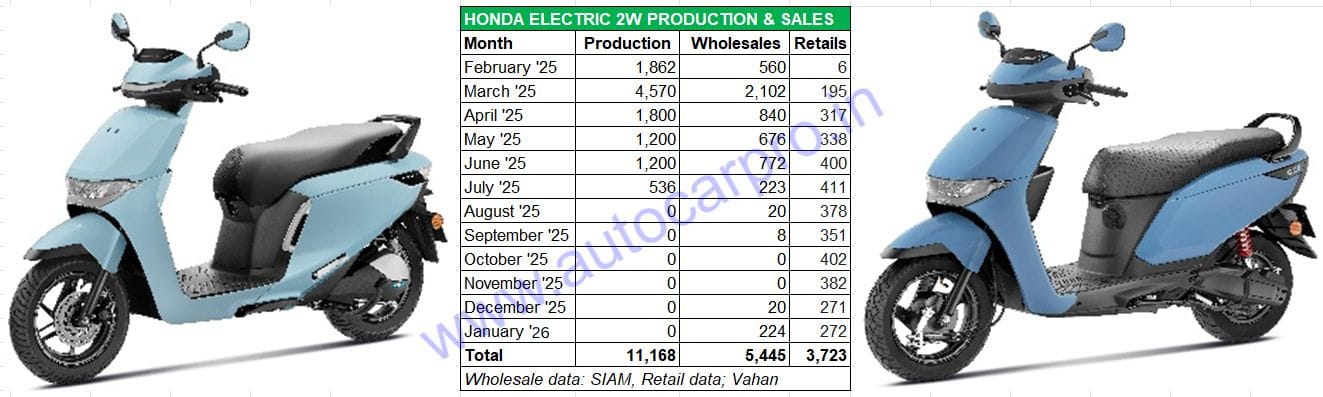
Of the 11,168 e-scooters manufactured at HMSI’s Narasapura plant over the past year, 5,445 units were dispatched to EV showrooms, and 3,723 units were delivered to customers.
Deliveries of HMSI’s two electric scooters – the Activa e and QC1 – commenced in March 2025. As the cumulative 12-month data (given above) reveals, the highest monthly production of the two models, which roll out from the company’s Narasapura plant in Karnataka, was in March 2025 (4,570 units).
The highest monthly wholesales (vehicle dispatches to dealers) was also in the same month: 2,102 units. Production dropped to 1,800 units in April, then to a similar 1,200 units in May and June, and to 536 units in July, taking total production of the Honda e-2Ws to 11,168 units. Between August 2025 and January 2026, as per SIAM, there has been zero production of these two EVs. It is likely that this is the result of high inventory levels at company dealers.
On the retail front, as per the Vahan portal, HMSI has delivered 3,723 units (including a high of 411 units in July 2025) comprising both models to customers over 12 months. This paints a tepid market response from the IC engine scooter market leader at a time when most leading legacy Indian 2W OEMs, which have diversified into EVs, have been successful with their zero-emission products.
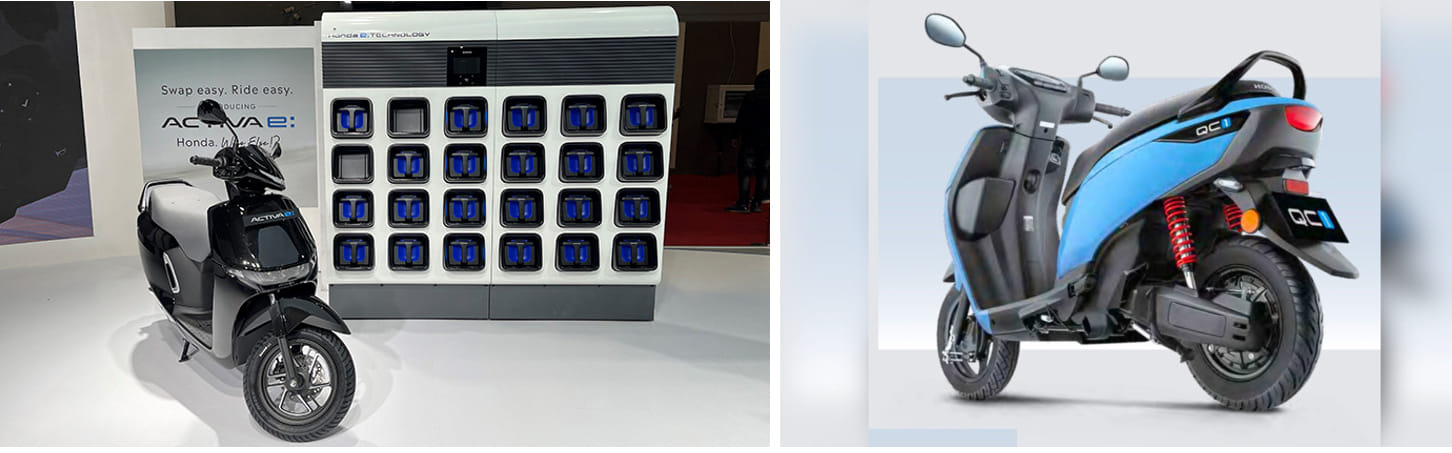 While the Activa e is powered by two swappable 1.5 kWh batteries and has to be ‘juiced up’ at a Honda swapping station, the Honda QC1, with a single 1.5 kWh fixed battery, can be charged at home.
Compared to its ICE rivals TVS Motor Co, Bajaj Auto, or Hero MotoCorp, which are all having a stellar run in the e-2W market, Honda has found the going tough for its two electric commuter scooters.
First revealed in November 2024, the Activa e and QC1 are the 12th and 13th models, respectively, in Honda’s target to launch 30 electric models globally by 2030. While the Honda Activa e, which is equivalent to a 110cc internal combustion engine model, comes with two Honda Mobile Power Pack swappable batteries as its power source and is meant primarily for personal commuting, the Honda QC1 (equipped with a fixed battery) is targeted at gig-worker operations and is more of an affordable urban runabout.
The Activa e, which looks far more stylish than its ICE sibling, which is India’s longstanding best-selling scooter, has two variants: standard (Rs 119,447, ex-showroom Delhi) and RoadSync Duo (Rs 152,000). It has a 102km claimed IDC range, does the 0-60kph sprint in 7.3 seconds, and reaches a top speed of 80kph.
The Activa e is sold through Honda Red Wing dealers, with a ‘shop-in-shop’ concept as part of a phased rollout, with Concept Stores opening in some cities. There are over 80 Honda Power Pack e- battery-swapping stations in Bengaluru, which was the first market where the Activa e was launched, and they have been introduced in Delhi and Mumbai as well.
The QC1, Honda’s more budget-friendly EV and essentially an eco-friendly urban runabout, has a claimed top speed of 50kph, does the 0-40kph sprint in 9.7 seconds, and delivers a claimed IDC range of 80km.
The QC1 is priced at Rs 90,022, which is lower than the market-leading TVS iQube but costs Rs 3,000 more than the most affordable Bajaj Chetak – the recently launched C2501 (Rs 87,100). Nevertheless, compared to the higher-priced premium offerings from Suzuki (e-Access: Rs 188,000) and Yamaha (EC-06: Rs 167,000), the Honda QC1 is the most affordable Japanese electric scooter in India.
User-Friendly QC1 Accounts for the Bulk of Honda e-2W Sales
It is understood that the QC1, thanks to its user-friendliness when it comes to charging at home, outsells the Activa e, which has to bank on Honda swapping stations to be ‘juiced up’. Furthermore, while the Activa e is currently available in only a few cities, including Bengaluru, which have the Honda swapping network, the QC1’s availability is more widespread.
While swapping the Activa e’s depleted battery packs with two new fresh ones at a Honda swapping station is a smooth affair and takes less than two minutes, there is no provision to charge them at home, which is an EV-specific convenience factor that e-2W users are now comfortable with. This probably reflects the slow customer demand for the Activa e. Ease of use will, therefore, be reliant on the number of Honda battery-swapping stations in each city where the product is on sale.
What’s clear after the first full year of sales in India is that the customer response to Honda’s first e-2Ws has been very tepid. While the stylish Activa e seems to be a product ahead of its time, with sales dependent on how fast Honda expands its swappable battery network, the no-frills QC1 is a rather affordable Japanese EV, but it comes with some obvious compromises.
Meanwhile, Suzuki Motorcycle India, which launched its e-Access in January 2026, dispatched 703 units to its dealers and delivered 201 units of the high-priced model to customers last month. India Yamaha Motor is the most recent of these Japanese OEMs to plug into the e-2W market with its EC-06.
HMSI’s two-wheeled EV market performance is in stark contrast to its ICE scooter sales. The longstanding market leader has sold 25,88,233 scooters, comprising the Activa and Dio, in the first 10 months of FY2026, up 6% YoY (April 2024–January 2025: 24,45,137 units). This gives Honda a scooter market share of 39%, ahead of TVS Motor Co, which has 28 percent.
New e-scooter in the Pipeline
Honda is understood to be working on an all-new electric scooter for the Indian market, aimed at catering to just what customers want and addressing the shortcomings of the Activa e and QC1 models. The new model is expected to have comparable riding range numbers and features like the market-leading e-scooters from TVS Motor, Bajaj Auto, and Ather Energy. To ensure new EV’s pricing is competitive, the new Honda e-scooter will be heavily localised to keep costs down. However, not much is known as to when Honda plans to launch its new e-scooter in India.
With inputs from Rishaad Mody & Dinshaw Magol, Autocar India

RELATED ARTICLES

TVS Orbiter Sells 14,641 Units for 25% Share of TVS E-scooter Dispatches in August
 Ajit Dalvi
24 Sep 2026
Ajit Dalvi
24 Sep 2026
TVS registered its second-highest monthly e-scooter wholesales of 57,523 units in August, with every fourth model sold b...


Renault Duster and Nissan Tekton Post Their Lowest Monthly Sales in August
Ajit Dalvi
19 Sep 2026
New Renault Duster and Nissan Tekton, based on the CMF-B platform and sharing turbo-petrol powertrains, sold 406 and 491...

Bgauss Auto sells 10,000 e-scooters in two months, will new C12 MaxR spur demand?
Ajit Dalvi
18 Sep 2026
Mumbai-based EV start-up, which has surpassed 5,000-unit retails two months in a row and also surpassed cumulative sales...