


Google patents 'sticky bonnet' for pedestrian impacts
Technology uses adhesive layer on bonnet to bind to impacted pedestrians, preventing them from being flung back onto the road.
 24 May 2016
 6588 Views
Share -
6588 Views
Share -


Google has patented the creation of an innovative ‘sticky’ car bonnet, which is designed to prevent a person from being flung off or back onto the road in the event of a pedestrian collision.
The system targets this ‘secondary stage’ of a pedestrian impact, where most fatalities occur, suggesting it could drastically reduce the number of pedestrian deaths if it were to be successfully integrated into vehicles.
The patent has been published by the USPTO (United States Patent and Trademark Office), revealing its technical details. It shows that a car’s bonnet is covered in an adhesive layer, finished with an outer shell that can be painted to match the rest of the body. The outer shell prevents debris from sticking to the adhesive, but in the event of a pedestrian hitting the surface, this outer shell breaks to allow the person to bind to the adhesive below.
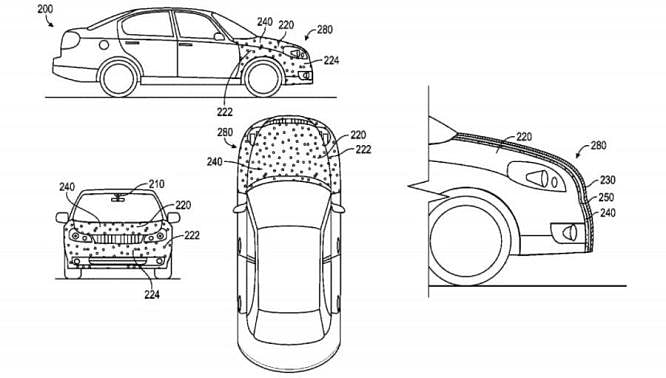
The technology is primarily designed for use on driverless vehicles – of which Google is a key player in advancing automotive technology with its fleet of autonomous vehicles – but it could have the potential to be adapted for use with other automotive platforms. Some reports even suggest the system could be adapted to cater for collisions with other road hazards including bikes and animals.
Google hasn’t released any official information about the technology at this stage, so we’re yet to find out if it will ever be used on a production level. However, the level of detail and research demonstrated in the patent application confirm it’s something the technology giant has clearly invested time and money into.
Google isn’t the only company researching to advance pedestrian safety, Both Volvo and Jaguar have also shown an interest in improving road safety in this way, with Volvo’s external airbags – mounted to the car’s windscreen – being one example of the systems they’ve developed.
Also read:
- Fiat Chrysler likely to produce first autonomous car with Google
RELATED ARTICLES

Autoliv Plans JV for Advanced Safety Electronics With China’s HSAE
 Ajit Dalvi
11 Oct 2025
Ajit Dalvi
11 Oct 2025
The new joint venture, which is to be located strategically near Shanghai and close to several existing Autoliv sites in...


JLR to Restart Production Over a Month After September Hacking
Ajit Dalvi
07 Oct 2025
Manufacturing operations at the Tata Group-owned British luxury car and SUV manufacturer were shut down following a cybe...

BYD UK Sales Jump 880% in September to 11,271 units
Ajit Dalvi
07 Oct 2025
Sales record sets the UK apart as the largest international market for BYD outside of China for the first time. The Seal...