

 Follow us
EDAG’s contribution in Mercedes-Benz’s latest GLC F-cell SUV
EDAG, the name that made the world’s first electric and hydrogen powered SUV, on what went behind the project.
 By Autocar Professional Bureau
 6251 Views


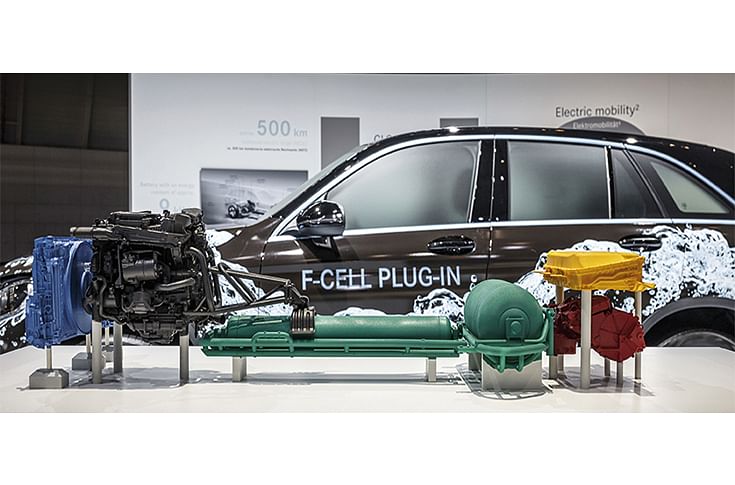
EDAG, a Germany-based independent engineering vehicle and production specialists, have successfully completed integration development of the fuel cell drive system for the Mercedes GLC F-Cell SUV. The independent automotive development service providers were commissioned with the integration development of the fuel cell drive system for the Mercedes GLC at the end of 2015. The series production of the fuel cell version of the GLC is said to have started in Germany.
In addition to the electrification of vehicles with batteries, fuel cell technology offers a promising technology for the alternative drive of the future. Daimler considers technology as an integral part of its drive strategy. Daimler is now pushing forward with the Mercedes-Benz GLC F-CELL, combining the fuel cell and battery technology as a plug-in hybrid in a small series for the first time. The intelligent interaction between battery and fuel cell is said to provide high mileage performance and short refuelling times, thus, making the GLC F CELL an everyday purely electric companion for short and long distances.
In the project, the EDAG Group conducted the development, validation and procurement - including sampling - of the fuel cell-specific body shell, exterior and interior components as well as the implementation of a specific low-voltage cable set. In addition, the EDAG development team was responsible for the integration of the new, alternative Daimler drive version with the “HVAC and cooling system” and large parts of the overall vehicle protection.
More than 100 EDAG engineers worked at the Sindelfingen, Böblingen, Fulda and the newly established Bremen production site in a cross-disciplinary development team for Daimler’s future project during the peak times of the project. Since January 2017, a team, consisting of 40 members from the ‘EDAG Vehicle Prepare Center’, has been supporting Daimler in the construction of prototypes, pre-series vehicles and small-series production in the Hanseatic city.
“We are very happy that our end-to-end competence in engineering has convinced our customer Daimler right up to the hardware realisation. We were happy to take on this project task in order to proactively shape the vehicle transformation process with our expertise and innovative power,” explains Cosimo De Carlo, CEO of the EDAG Group.
After the market introduction of GLC F-Cell SUV, the EDAG Group will also implement and ensure the supply of vehicle-specific spare parts for the after-sales market. With the project, EDAG claims to have further expanded its expertise in the area of H2 safety and hydrogen refuelling and qualified as a responsible engineering partner for this future-oriented drive technology.
Also read: Mercedes-Benz launches GLC F-Cell SUV that runs on hydrogen and electricity


RELATED ARTICLES

Eicher Bets ‘De-Skilling’ Diagnostics Will Hook India’s Small Truck Fleets
 Shahkar Abidi
 14 Oct 2026
Commercial vehicle maker aims to double parts revenue to Rs 5,000 crore by automating diagnostic and warehouse operation...


One Year on its Own: Tata Motors Builds on a Record Run, Gears Up for Expansion
 Ketan Thakkar
14 Oct 2026
Ketan Thakkar
14 Oct 2026
Domestic sales rose 35% to 7.44 lakh units during October 2025–September 2026, following the GST cut. Nexon and Punch le...

India a Blueprint for Hyundai's Global Expansion Strategy: CEO José Muñoz
 Darshan Nakhwa
13 Oct 2026
Darshan Nakhwa
13 Oct 2026
Hyundai Motor Company is drawing on its experience of localisation in India to strengthen its global operations, as the ...