Follow us
Hero, Honda, TVS, Bajaj and Royal Enfield Target India’s Nascent Electric Motorcycle Market
Even as scooters dominate the electric 2W market, legacy ICE motorcycle OEMs are already pushing the innovation and R&D envelope on zero-emission motorcycles to capture demand in this nascent segment which could see big numbers if a fraction of the 12-million-plus annual ICE bike buyers in India make the shift to e-mobility.
 3378 Views


India’s electric 2-wheeler market, which is populated with electric scooter OEMs and only a handful of electric motorcycle manufacturers, could see a fair amount of action on the zero-emission motorcycle front in the coming years. The top four legacy ICE 2W players – Hero MotoCorp, Honda Motorcycle & Scooter India, Bajaj Auto and TVS Motor Co – which have diversified into electric scooters are looking to advance their e-2W game into electric motorcycles. There’s also Royal Enfield, the midsize motorcycle market leader which is betting big on its Flying Flea sub-brand to deliver a strong ride in an electrified future.
With the e-scooter segment already populated by leading OEMs and startups, each of these five legacy ICE bike makers will be looking to latch onto the remaining ‘white space’ of electric motorcycles which remains unexploited due to technological constraints vis-à-vis e-scooters, high battery costs, limited range and a paucity of affordable products at present. Even a small percentage of the high-volume ICE motorcycle segment, which clocked sales of 12.25 million units in FY2025 and 12.48 million units in CY2025, would result in big numbers. In CY2025, motorcycles accounted for 61% of India’s 20-million-strong two-wheeler (CY2025) market in CY2025, leaving the rest to scooters (37%) and a minuscule 2% to the humble moped.
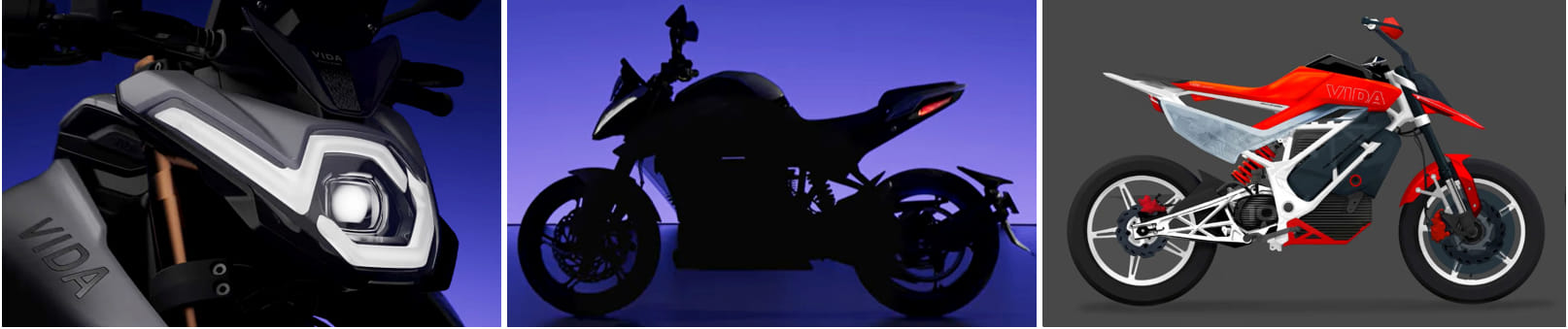
Left and centre: Vida VXZ, developed with Zero Motorcycles, reveals Hero’s intent to target performance-oriented EV territory. Right: Ubex concept is for a city-focused electric motorcycle.
HERO PARTNERS ZERO, WALKS THE VIDA TALK
Hero MotoCorp, the world’s largest 2W OEM for the 25th consecutive year with dispatches of 6.1 million in CY2025, will be along with Royal Enfield the first OEM with multiple e-motorcycles in its e-2W stable in the coming 18 months. While it has already made a splash in the e-scooter market with the Vida brand, the Hero-Zero collaboration is expected to deliver seriously good e-motorcycles.
In September 2022, Hero invested and partnered with Zero Motorcycles of the USA, a manufacturer of premium electric motorcycles and powertrains. The collaboration essentially combines the expertise of the California-based Zero Motorcycles in developing powertrains and electric motorcycles with the scale of manufacturing, sourcing and marketing prowess of Hero MotoCorp. The Hero-Zero EV platform will spawn four products – two high-performance motorcycles and two mid- to high-performance green bikes. The first product to come of this Indo-US partnership is the Vida VXZ street-naked motorcycle revealed at EICMA 2025 in Milan and slated for launch later this year.
At the Milan expo last November, Hero MotoCorp also showcased the Vida Ubex concept. The Ubex, a precis of ‘Urbex’ or urban exploration, will fructify into a city-focused electric motorcycle that prioritises ride comfort and agility, making it ideal for navigating dense urban traffic while retaining a sporty edge. As is known, Hero has already launched the Dirt.E K3, a children’s electric dirt bike designed for young riders between 4 and 10 years old.
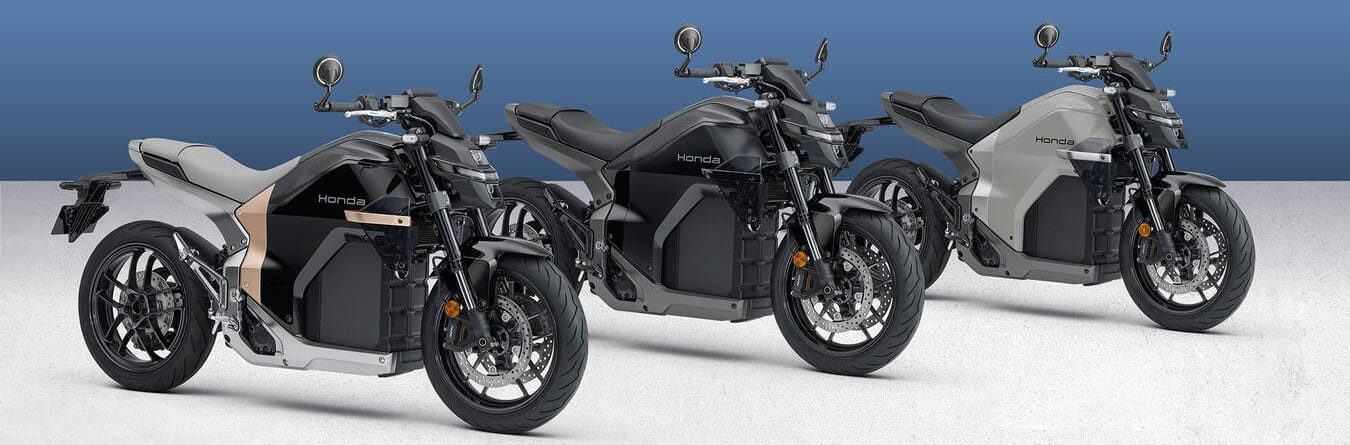
Honda unveiled its first electric motorcycle, the WN7, at EICMA 2025. The WN7, with a 9.3 kWh fixed lithium-ion battery develops 50 kW, equivalent to a 600cc ICE bike, and torque of 100 Nm, comparable to a 1000cc ICE bike.
HONDA’S E-MOTORCYCLE PLANT IN INDIA TO GO ON STREAM IN CY2028
Japanese major Honda, whose first two EVs for India – the Activa e and QC1 e scooters – have received a tepid response, and understood to be working on an all-new electric scooter has unveiled plans for setting up of a dedicated electric motorcycle plant in India.
Honda’s ‘Corporate Update Report 2025’ reveals that the Japanese major is “planning to establish a new factory dedicated to electric motorcycles, which is scheduled to start operations in 2028. At the factory, by adopting modularization technology and other measures, we aim to create a flexible and highly efficient production system by reducing the length of the assembly line by about 40% compared to the conventional setup. We will continue to reduce costs by improving production efficiency through automation and labour saving, and by promoting local production and consumption, in order to provide electric motorcycles at competitive prices.”
This would mean Honda believes the Indian e-2W market has plenty of untapped potential and wants to take the lead in electric motorcycles. Last November, Honda unveiled its first electric motorcycle – the WN7 naked model. Unlike conventional motorcycles that use a frame connecting the front and rear of the body, the WN7 adopts a frameless structure in which the centrally positioned aluminium battery case forms part of the main frame. A newly developed, compact and lightweight water-cooled motor with an integrated inverter powers the WN7. It delivers a maximum output of 50 kW, equivalent to a 600cc ICE motorcycle, and maximum torque of 100 Nm, comparable to a 1000cc class ICE motorcycle. The WN7 is equipped with a newly developed 9.3 kWh fixed lithium-ion battery. With a fast charger, the battery can be charged from 20% to 80% in approximately 30 minutes. The WN7 will be produced at Honda’s Kumamoto Factory, the company’s global hub for motorcycle production. Honda will introduce the model sequentially to global markets where electrification shift is advancing, as the company accelerates electrification of motorcycles on a global scale.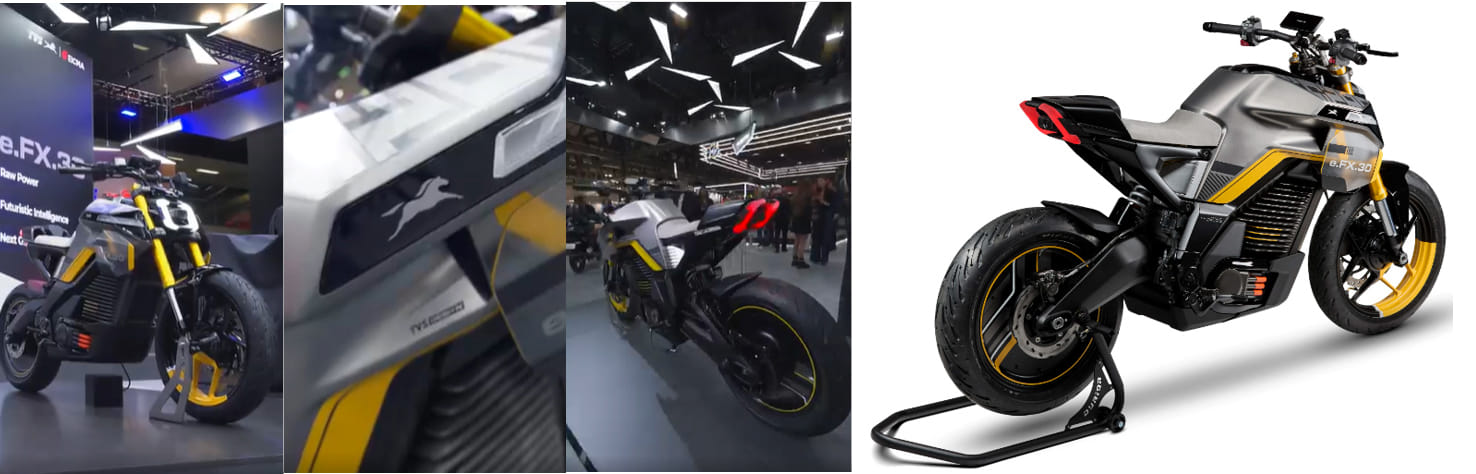 TVS has registered a design patent in India for its eFX 30 electric motorcycle concept, which had its global reveal at EICMA 2025 in Milan last November
TVS DEVELOPING MASS-MARKET AND PREMIUM E-MOTORCYCLES
TVS Motor Co, the electric 2W market leader with its iQube and Orbiter e-scooters, is also looking to enhance its zero-emission footprint with electrified motorcycles. Interestingly, the company is strategically working on products at both ends of the price spectrum.
At its first-ever EICMA outing last year, TVS took the covers off a high-performance electric naked motorcycle concept – the e.FX.30. The e.FX.30 electric motorcycle concept reimagines the electric motorcycle performance with a next-gen powertrain targeted at the modern urban rider and engineered to set new benchmarks in street motorcycling. It is learnt that TVS has registered a design patent in India for the eFX 30, which indicates the concept could see fruition into production reality.
The company is also reportedly working on a zero-emission motorcycle for the African market. This could essentially mean a mass-market affordable market which could have a connect with India.
BAJAJ AUTO ALSO PUSHING THE E-BIKE R&D ENVELOPE
It would be unwise to discount Bajaj Auto which has a very vigorous R&D effort going on for the development of electric motorcycles. Replying to an analyst’s query about the likely penetration level of electric bikes in the near-term, after the company’s Q2 FY2026 results, Rakesh Sharma, executive director, Bajaj Auto said: “There are some use cases, both in the entry-level and high-end sporting things in India and globally. But these are very difficult to predict. But we are in this game. We are very clear that we must have options which serve these use cases. Of course, nobody can say for certainty that it will be a bull’s eye or whatever. But I think there is a greater loss from missing out an opportunity than investing in something and that opportunity doesn't realize. So, therefore, we have a very vigorous R&D effort going on for development of electric motorcycles.”
While it can be surmised that Bajaj Auto’s in-house R&D team will be pushing the envelope on e-motorcycles, given that the company owns KTM, Husqvarna and GasGas, one could expect it to orchestrate a global R&D exercise to develop an electric motorcycle vehicle programme for India spanning entry level commuters through to high-performance machines as well as off-road EVs.
Some years ago, KTM developed the e-Duke Concept, the zero-emission avatar of the Duke series, powered by a 10kW motor and equipped with a 5.5kWh battery pack. Husqvarna, which plugged into e-mobility in April 2021 with the E-Pilen Concept inspired by the Vitpilen and Svartpilen road machines. With a power output of 8 kW and a range of 100km, the E-Pilen Concept (with a modular swappable battery system) is targeted at the urban commuter and leisure rider. Both the KTM e-Duke and Husqvarna e-Pilen Concepts haven't been seen in production form yet. They were being developed with Bajaj Auto, so should see the light of day in the future.
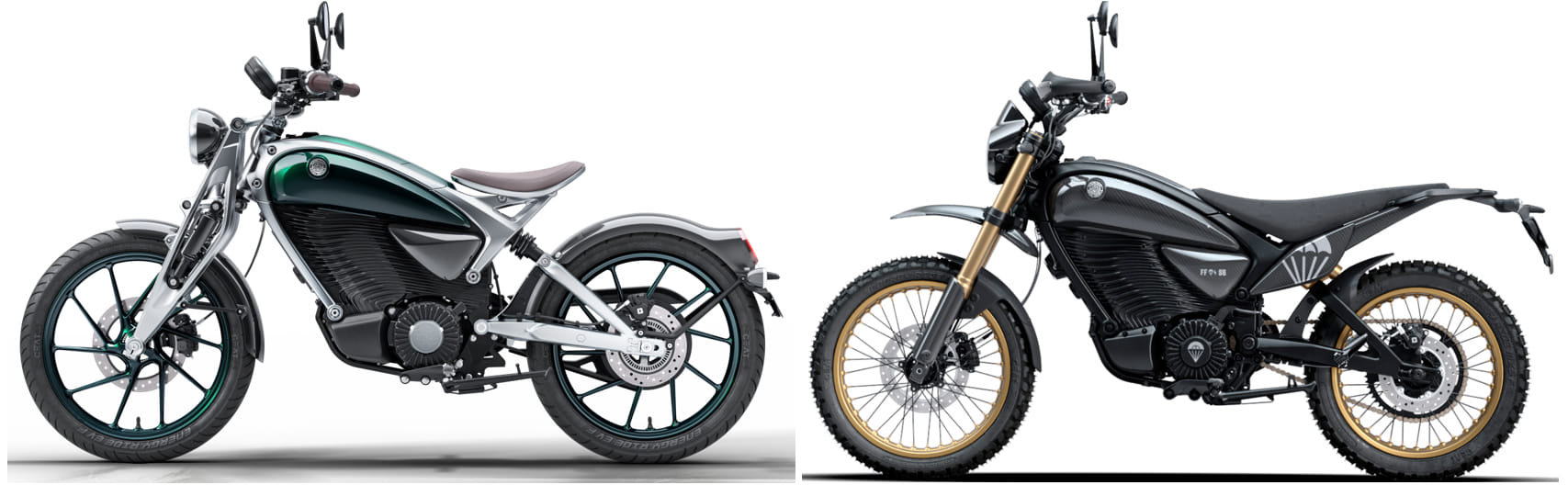
While Royal Enfield’s Flying Flea C6 is essentially an urban electric commuter, the S6 is a scrambler based on the C6. Both are expected to go on sale later this year.
ROYAL ENFIELD AIMS TO MAKE A MARK WITH FLYING FLEA
In November 2024, the 124-year-old midsize motorcycle (250-750cc) major Royal Enfield announced its entry into the EV world with the Flying Flea sub-brand, inspired by the Royal Enfield Flying Flea motorcycle of the 1940s. This strategic move came two years after Royal Enfield had acquired a 10% stake (for 50 million euros) in Stark Future, a Spanish e-2W OEM with specific focus in the area of performance electric motorcycles.
Royal Enfield’s aim is to produce one of the advanced electric two-wheelers and has developed the first two models ground up, hardware and software, marrying distinctive style with cutting-edge technology. The first two models are the Flying Flea C6 and S6. While the Flying Flea C6 is essentially an urban electric commuter, the S6 is a scrambler based on the C6. According to the company, all aspects of the connected electric motorcycles, including product strategy and development, technical components like motor, battery, BMS, custom software, and our retail and market strategy have been developed in-house by our dedicated technical and commercial teams.
Royal Enfield, which has filed more than 45 EV technology and connected application patent applications, plans to manufacture its EVs at a dedicated facility within its existing plant at Vallam Vadagal in Tamil Nadu. The Flying Flea motorcycles, which target what the company terms ‘city+ mobility markets’, are expected to go on sale this year.
ATHER ENERGY: THE DARK-HORSE STARTUP IN E-MOTORCYLES
The past two years have seen legacy ICE scooter makers like TVS, Bajaj Auto and Hero MotoCorp turn the tables on their startup rivals with quality products, better marketing and aftersales. At present, the e-motorcycle segment in India has only a smattering of startups including Revolt Motors, TVS-backed Ultraviolette, Ola Electric, Oben EV, KLB Komaki, Matter Motor Works, Okaya EV and Wardwizard Innovations. Some of the startups sell rebadged Chinese bikes.
Revolt Motors, which launched its first e-bike in August 2019, has sold 51,216 units to date and currently has five models in its portfolio. While Ultraviolette has crossed cumulative sales of 2,500 units four years after entering the market in 2022, Oben EV has sold a little over 3,000 units since March 2024. Ola Electric’s three-model Roadster model series has been in the market since August 2024.
The startup with the highest potential for success in e-motorcycles is Ather Energy. The Bengaluru-based OEM, which is now the firm No. 3 in e-scooters after TVS and Bajaj, has outlined a strategic future growth programme which includes e-motorcycles. Along with the new EL e-scooter platform, Ather is developing the Zenith platform which will spawn electric 2Ws which target the 125-300cc motorcycle segments. Work on an Ather e-bike is in early stages but the company is already setting up a plant. Ather already has the largest fast-charging network for electric 2Ws in the country, with the total network size reaching 5,000 charging points as of December 31, 2025. And it is ensuring it won’t be strapped for capacity in the future. Current annual e-scooter manufacturing capacity from its two plants – one each for e-2W assembly and battery production – is 420,000 units. A third plant in Maharashtra, with annual capacity of a million units, will expand capacity to 1.42 million units. This first phase of this upcoming high-tech facility is slated to go on stream in the second half of CY2026.
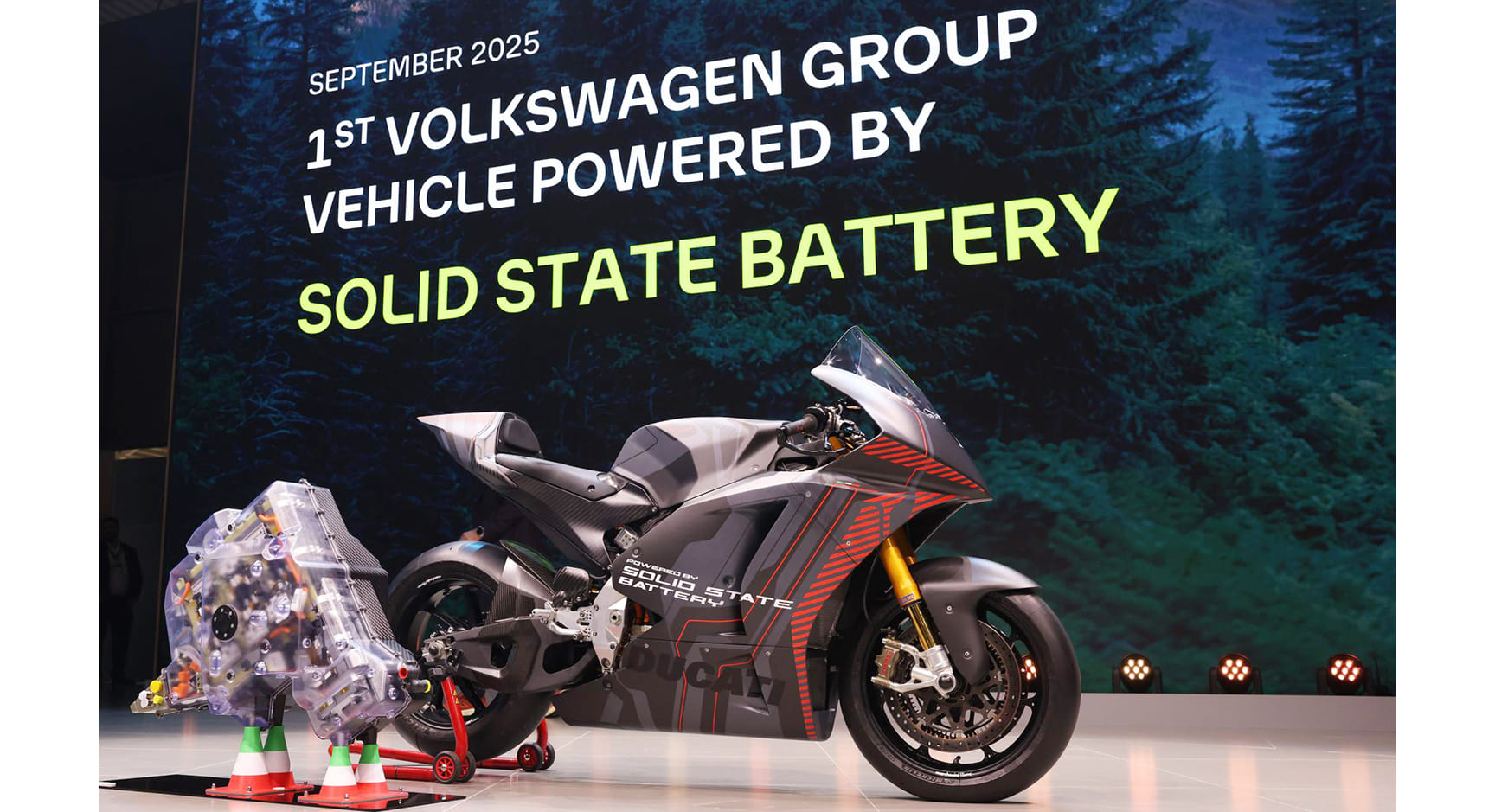
This e-motorcycle technology demonstrator developed by the Volkswagen Group using QuantumScape's groundbreaking solid-state battery, offers a glimpse of the future of e-mobility with even longer ranges and shorter charging times.
ELECTRIC MOTORCYCLES: THE NEXT FRONTIER FOR E-2Ws IN INDIA?
India, which registered total EV retail sales of a record 2.27 million units in CY2025, up 16% YoY, had an EV penetration level of 8.04% (CY2025 India Auto Inc sales: 2,82,53,131 vehicles), a marginal improvement over the 7.47% in CY2024 and 6.38% in CY2023. Nevertheless, CY2025 numbers are still a considerable distance away from the targeted and ambitious level of 30% EV penetration by CY2030.
In CY2025, e-2-wheelers, which are the largest volume sub-segment, accounted for 56% of the 2.27 million EVs while e-3Ws contributed 35% (797,654 units), e-PVs 8% (177,910 units) and e-CVs 1 percent. If the Indian EV industry has to get near the 30% EV penetration target over the next five years, the only way is can do so is by ensuring that e-2W retail sales consistently achieve high double-digit growth. This sub-segment, which is mainly populated by e-scooters, has been impacted by GST 2.0 which, while delivering a booster shot to ICE automobile sales, has increased the ICE-to-EV price differential. This, in many cases, has led to the potential e-2W buyers either deferring purchase or buying ICE scooters or motorcycles.
The e-2W industry needs a growth booster shot from within, which could come from affordable electric motorcycles but that is easier said than done. According to Rishaad Mody, editor (bikes), Autocar India, while the e-2W market and consumers have accepted the 20% upwards price variation in e-scooters compared to their petrol-engined siblings, “the sweet spot for electric motorcycles would be achieving a similar price range, if not lower, than existing e-scooters. Technology challenges (for e-motorcycles) largely come down to battery capacity and price.” Motorcycle riders also typically ride twice the distance every day as do scooter riders which would call for around 150km range on a single charge. Larger batteries would also result in higher cost.
The technological challenge is also what Niti Aayog, India’s premier policy think tank, has pointed out in a recent white paper. According to the Business Standard which reported on the study, electrification of motorcycles is fraught with a challenging affair what with value-conscious bike buyers seeking high performance and long riding range at ICE-comparable costs. “The R&D for motorcycles is much more complex. To provide both high power and range, similar to an ICE vehicle, the batteries need to be bigger and need more space, which is a constraint in motorcycle chassis,” it described as mentioned in the document.
Electric motorcycles is where startups have stolen a march over their legacy OEM rivals in India. Tork Motors, once a promising startup later acquired by Bharat Forge, unveiled India’s first e-motorcycle – the Tork T6X – nearly a decade ago in September 2016. Three years later, Revolt Motors plugged into this segment and recently became the first Indian e-bike maker to surpass 50,000 retail sales, having expanded its portfolio to five models. Subsequently, a few others including Ola Electric entered this market but the overall number of e-motorcycle OEMs at present is minuscule.
Legacy ICE players like TVS Motor Co, Bajaj Auto and Hero MotoCorp, which have witnessed a high level of success in e-scooters, are now consciously exploring what could be the next frontier in e-2Ws more so with evolving technology to offer more range at a wallet-friendly price. If they are able to convert a fraction of the 12 million motorcycle buyers, including 7.5 million who buy up to 150cc bikes each year, India EV Inc could be looking at some serious growth . . . this time from a sub-segment other than e-scooters.
(With inputs from Rishaad Mody, Autocar India)
ALSO READ: Volkswagen Group pushes e2W envelope with world-first solid-state battery electric motorcycle

RELATED ARTICLES

September a Mega Month for Scooter Industry with Highest Monthly Sales of 995,576 Units
 Ajit Dalvi
 15 Oct 2026
Scooter makers in India opened the festive season with record monthly dispatches of nearly one million units including 1...


Tesla Sales in India Cross 1,000 Units, 550 Model Ys Delivered Since July
Ajit Dalvi
03 Oct 2026
American EV maker clocks retail sales milestone with a stellar performance in September when it sold 291 units to outsel...

Tata, Vinfast, Kia, Toyota, Tesla Clock Best-Ever EV Sales in Record-Setting September
Ajit Dalvi
02 Oct 2026
Retail sales of electric passenger vehicles hit a new monthly high of 35,995 units in September. While market leader Tat...