Follow us
Stellantis To Invest €60 Billion By 2030, North America Gets Biggest Share
The automaker will invest heavily in global platforms, software, AI and multi-energy powertrains while prioritising North America for growth and profitability.
 By Darshan Nakhwa
 761 Views


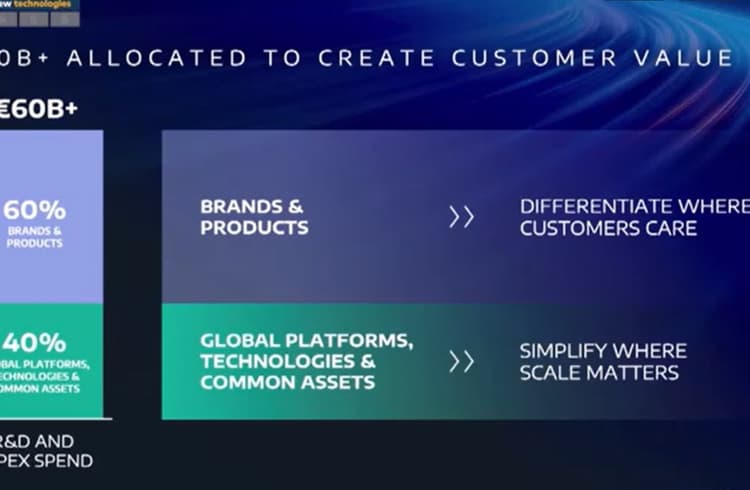
Stellantis plans to invest more than €60 billion by 2030 as part of its Fastlane 2030 turnaround strategy, with North America emerging as the biggest beneficiary of future product investments as the automaker attempts to rebuild profitability and competitiveness after a difficult 2025.
Chief Executive Officer Antonio Filosa said around 60% of Stellantis’ overall investment allocation would be directed toward brands and products, while the remaining 40% would be spent on global platforms, software technologies, common assets and powertrain development.
Within the brands-and-products allocation, nearly 60% of the spending will go toward North America, while the remaining 40% will be distributed across other global regions.
“This reflects where we see the strongest combination of market opportunity, brand strength and attractive returns,” Filosa said during Stellantis Investor Day 2026.
The company also said around 70% of brand and product investments would be concentrated on reinforcing core businesses, while about 30% would be used to expand market coverage and enter newer segments.
Focus On Platforms, AI And Multi-Energy Technologies
Stellantis said this investment programme would support more than 60 new product launches and 50 major model refreshes planned by 2030. The company also plans to increasingly standardise vehicle architectures through three global platforms that are expected to account for around 50% of annual production volumes by the end of the decade.
The automaker will also focus on global powertrain integration, with around half of annual volumes expected to use cross-regional powertrain systems spanning hybrid, battery-electric and highly efficient combustion-engine technologies.
Filosa said Stellantis would continue pursuing a “multi-energy” strategy because electrification trends remain uneven across regions. “Europe is moving faster into electrification while the US is easing the CO2 trajectory,” Filosa said. “We need flexibility in every market.”
The company also plans aggressive investments in software-defined vehicle (SDV) systems, AI-enabled technologies and autonomous-driving capabilities under the STLA Brain, STLA SmartCockpit and STLA AutoDrive architecture brands.
Stellantis said around 35% of annual volumes are expected to feature at least one of these next-generation software technologies by 2030.
Core Brands To Lead Growth
The investment strategy will prioritise four global brands — Jeep, Ram, Peugeot and Fiat — which Stellantis views as its strongest global profit generators.
The company said these brands would become the first adopters of future global platforms, technologies and powertrains.
At the same time, Stellantis will continue supporting regional brands including Chrysler, Dodge, Alfa Romeo, Citroën and Opel with market-specific positioning.
Luxury brand Maserati will also remain part of the group’s future plans, with Stellantis confirming two new E-segment vehicles are under development.

RELATED ARTICLES

India's Automotive AI Race Will Be Won on Data
 Autocar Professional Bureau
 17 Oct 2026
As connected vehicles, AI and supply-chain pressures reshape India’s automotive industry, the ability to unify data acro...


Mahindra & Mahindra’s stake in New Democratic Electoral Trust Falls to 49.63%
 Arunima Pal
17 Oct 2026
Arunima Pal
17 Oct 2026
NDET ceases to be a step-down subsidiary after an equity share allotment reduces the Mahindra group’s aggregate holding ...

Renault India CEO Says Hybrids, CNG Could Account for 50% of Sales in 2-3 Years
Autocar Professional Bureau
17 Oct 2026
CEO Stéphane Deblaise says the company is betting on hybrid technology as an alternative to diesel, while targeting €2 b...