Follow us
India’s EV Component Market Seen Crossing ₹3 Lakh Crore by 2032: Report
IESA report values the market at ₹41,000 crore in 2025 and expects batteries, motors and power electronics to drive its expansion.
 13 Jul 2026
 952 Views
Share -
952 Views
Share -


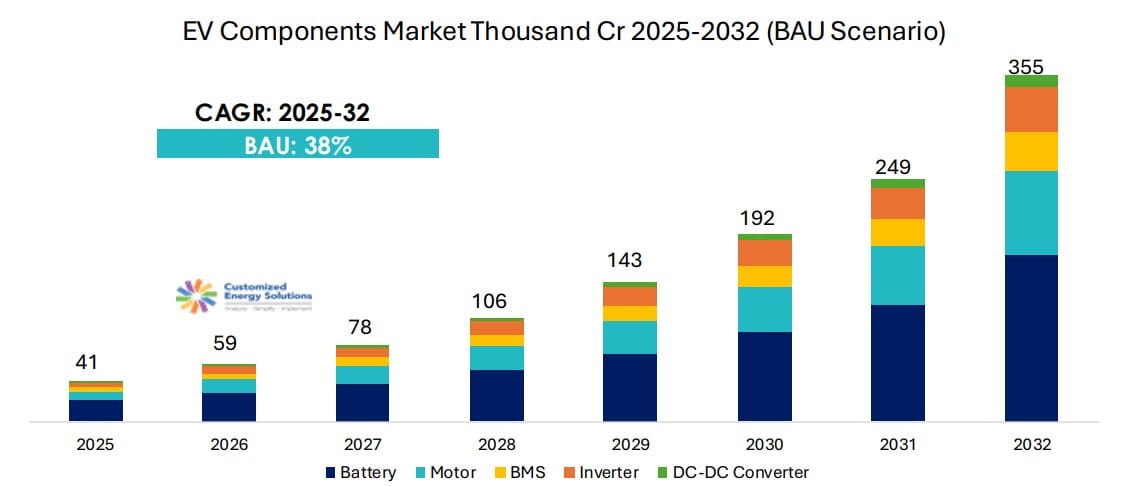
India’s electric vehicle component market could grow more than sevenfold to ₹3.02 lakh crore by 2032, from an estimated ₹41,000 crore in 2025, according to a report by the India Energy Storage Alliance.
The projection is based on a business-as-usual scenario and represents a compound annual growth rate of about 38% between 2025 and 2032, the India Electric Vehicle & Components Market Overview Report said.
The expansion will be supported by higher electric vehicle sales, rising battery demand, and increased use of motors and power electronics across vehicle categories.
Battery packs accounted for about 52% of the EV component market in 2025, making them the largest part of the value chain. Motors contributed 22%, followed by inverters at 12%, battery management systems at 11%, and DC-DC converters at 3%, the report said.
Battery packs remain the costliest EV component and have a direct impact on vehicle range, performance, and pricing. This has led several manufacturers to invest in battery technology, pack assembly, and vertical integration.
However, the report expects the share of motors, inverters, and battery management systems in the overall component market to increase as EV powertrains become more advanced.
Localisation remains low
The growth opportunity comes with a major localisation challenge.
India currently has limited domestic capability across several high-value EV components, according to the report. Localisation of battery packs was estimated at only 10%–20% in 2025, while inverter localisation stood at about 22%. DC-DC converters had localisation of around 25%, followed by battery management systems at 28% and traction motors at 35%.
The report said India remained heavily dependent on imports for battery cells, power semiconductors, and rare-earth-based parts. These are among the most critical inputs used in batteries, motors, and power electronics.
As a result, a large part of the economic value generated by rising EV sales may continue to flow outside India unless local manufacturing increases.
Batteries and power electronics together account for around 50%–60% of an EV’s cost. Low domestic production could therefore affect vehicle pricing, supplier margins, and the ability of manufacturers to manage supply disruptions, the report said.
It could also leave Indian companies exposed to movements in international raw material prices and changes in global trade policies.
Domestic suppliers expand EV portfolios
Several Indian component makers are expanding into electric powertrain systems to capture this opportunity.
Bharat Forge, Bosch India, Uno Minda, and Tata AutoComp are among the companies building capabilities in areas such as e-axles, power electronics, battery systems, and other EV subsystems.
However, the scale of manufacturing and technology capabilities remains uneven across the domestic supplier ecosystem, the report said.
Companies that establish local manufacturing in power electronics and integrated electric drivetrains before demand accelerates could benefit the most from the additional ₹2.61 lakh crore market opportunity, the report added.
EV demand to support component growth
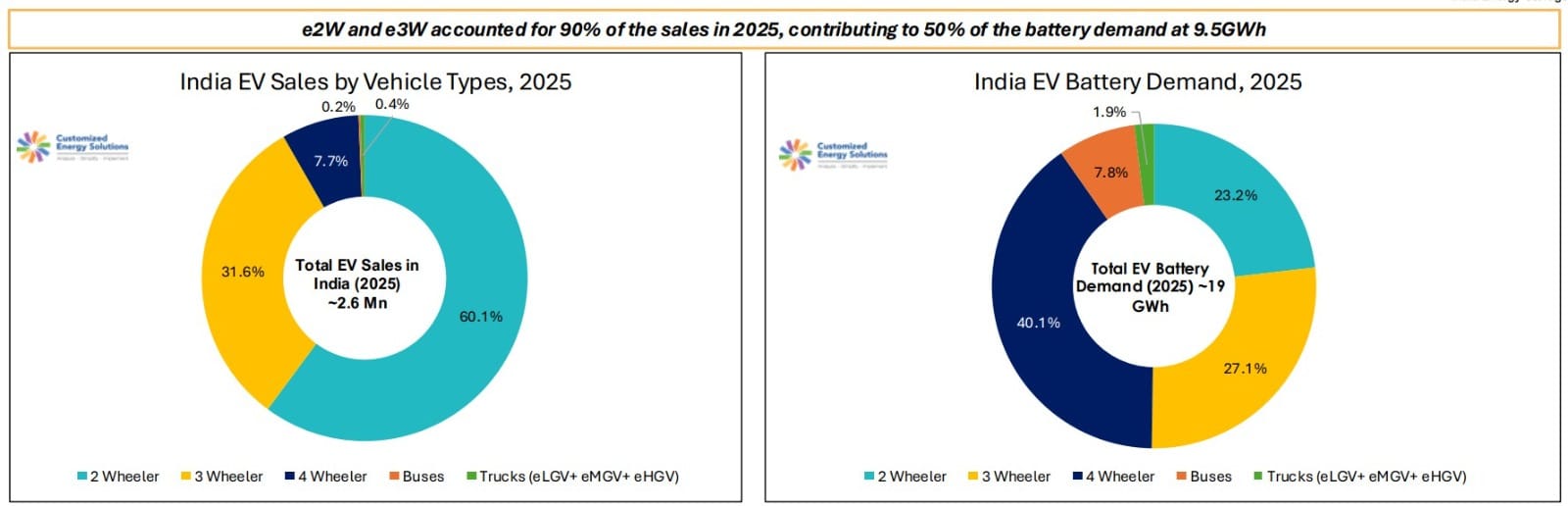
India sold around 2.6 million electric vehicles in 2025, according to the report. Two-wheelers and three-wheelers accounted for more than 90% of volumes.
Under the business-as-usual scenario, annual EV sales could increase to 17.2 million units by 2032. Under a higher-growth scenario based on the achievement of national electrification targets, sales could reach 30.4 million units.
Annual battery demand could also rise from around 19 GWh in 2025 to 229 GWh under the business-as-usual case and 362 GWh under the national-target scenario by 2032.
The report said the pace of growth would depend on battery price reductions, charging infrastructure, government incentives, and the expansion of local manufacturing.
The depth of India’s domestic component ecosystem will be important in deciding whether the country captures a larger share of the value created by rising EV adoption or remains dependent on imported core technologies.

RELATED ARTICLES

Volvo Plans 13 New Models by 2030 in Largest Product Expansion in Company History
 Angitha Suresh
19 Sep 2026
Angitha Suresh
19 Sep 2026
The Swedish automaker will split its line-up between Western and Chinese markets, offer both electric and hybrid powertr...


Kolkata Police Adds 183 Ultraviolette Electric Motorcycles to Its Fleet
Angitha Suresh
19 Sep 2026
The Kolkata Police has taken delivery of 183 units of the Ultraviolette X-47 Skyforce, a dedicated law-enforcement varia...

Mahindra Last Mile Mobility Named Finalist for 2026 Earthshot Prize
Angitha Suresh
19 Sep 2026
The Indian electric vehicle manufacturer is the only automotive company among 15 global finalists, with Mumbai set to ho...