Follow us
Delhi's EV Ban to Add 600,000 Electric Two-Wheelers on India's Roads: CRISIL
Crisil said the draft Delhi EV Policy 2026-2030 would push pan-India electric two-wheeler penetration to 21-23% by fiscal 2029.
 By Arunima Pal
 5801 Views


Research firm Crisil Intelligence estimates that Delhi's proposed ban on new petrol two-wheelers and three-wheelers could add nearly 600,000 electric two-wheelers and 11,500 electric three-wheelers to national sales, meaningfully lifting India's overall EV penetration even though Delhi is a small slice of the country's vehicle market.
In an impact note released Tuesday, Crisil said the draft Delhi EV Policy 2026-2030, which proposes banning new ICE three-wheelers from January 2027 and two-wheelers from April 2028, would push pan-India electric two-wheeler penetration to 21-23% by fiscal 2029, compared with 18-20% without the policy. For three-wheelers, penetration could reach 40-42% versus 38-40%.
The firm noted that the lifetime cost of ownership for electric two and three-wheelers already favours buyers over petrol alternatives, and Delhi's incentive framework would tilt the economics further. However, Crisil flagged that school bus operators stand outside the subsidies available to state transport undertakings, and warned the policy may need targeted relief for that segment to be viable.
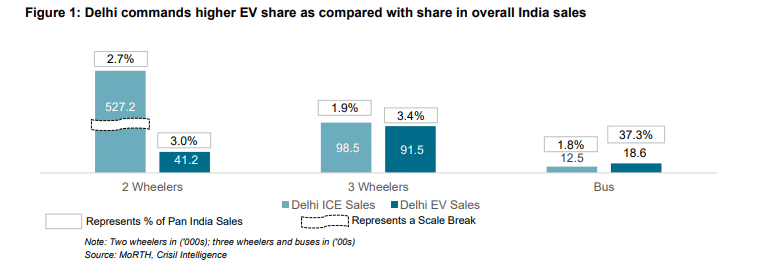 The bigger signal, Crisil argued, is what Delhi's move could trigger nationally — with 66 of the world's 100 most polluted cities in India, similar mandates from larger states could sharply accelerate the EV transition, forcing automakers to raise electrification investments and compelling faster localisation of batteries and charging infrastructure.
The policy itself was triggered by Delhi being ranked the world's most polluted capital city in the IQAir 2025 World Air Quality Report. Vehicular emissions account for roughly 23% of the city's winter pollution, with two-wheelers making up nearly 67% of Delhi's registered vehicle stock. Beyond the registration bans, the draft mandates fully electric NDTC and Transport Department bus fleets and targets 30% electrification of school buses by 2030. It also lays out a framework of financial incentives and tax benefits to ease the transition for buyers and operators. The draft is open for public feedback until May 10, after which it will be formally notified.

RELATED ARTICLES

India-EU FTA to Allow Import of 1 Lakh Cars to India Initially at Lower Tariff
 Kiran Murali
 12 Sep 2026
Cars priced between 15,000-35,000 euros (around Rs 16.6- 38.8 lakh) will attract a 35% import duty in the first year, wh...


Tools & Equipment Expo 2026 To Bring 300+ Exhibitors To Delhi
Eshisha Java
12 Sep 2026
Tools & Equipment Expo 2026 will feature 300+ exhibitors, 2,000+ products and 150+ launches at Bharat Mandapam, New Delh...

JSW Combat: Jetour T2-based SUV expected to launch this festive season
Autocar India
12 Sep 2026
JSW Motors’ first model will be a five-seat plug-in hybrid SUV, expected to be priced between Rs 30 lakh and Rs 50 lakh....