



 Follow us
Q2 surge powers electric car, SUV sales past 192,000 units in first-half FY2027
Four straight months of 32,000-plus retail sales including a record 36,904 units in September have boosted deliveries of electric passenger vehicles to 192,012 units in H1 FY2027. At this pace, India e-PV Inc could even breach the 400,000 milestone this fiscal.
 1 Views


India’s electric vehicle growth story is really charged up this year. After the first six months of FY2027, total retail sales of 18,10,163 million EVs across the e-2W, e-3W, e-passenger and e-commercial vehicle segments have risen 60% YoY (H1 FY2025: 11,34,054 units) and are already 71% of FY2026’s record 2.54 million EVs.
In tandem with the other three sub-segments, the electric passenger vehicle (cars, SUVs and MPVs) category is also registering strong growth and will scale a new fiscal year high in FY2027. As per Vahan, retail sales (EV customer deliveries) of 192,012 units are an 89% YoY increase (H1 FY2026: 101,398 units) and translate into an additional 90,614 units.
 While sales in Q1 FY2027 (April-June 2026) at 88,003 units jumped 93% YoY, the big surge came in Q2 (April-September) – 104,009 units – and accounted for 54% of the 192,012 EVs sold in H1 FY2027.
The accelerated growth in the first half of FY2027 is reflected both in the monthly sales data (see table above) and in the Q1 (April-June 2026) and Q2 (July-September) splits. Q1 FY2027 sales of 88,003 units were a 97% YoY increase (Q1 FY2026: 44,763 units), with 33,617 units in June being the highest.
Sales accelerated in Q2 FY2027 – 104,009 units and up 84% (Q2 FY2026: 56,635 units) with September (36,904 units) setting a new monthly retail benchmark.
Given the current strong momentum for the EV industry with motorists having to contend with high petrol, diesel and CNG prices, it would not be surprising if this segment breaches the 400,000 retail sales milestone in FY2027 and mark 80% YoY growth over FY2026 (195,804 e-PVs).
Let’s take a quick look at the OEM-wise performance.
Tata and M&M command 63% of the EV market, Vinfast snaps up a 6% share
Market leader Tata Motors has delivered 76,745 electric cars and SUVs with handsome 103% YoY growth (H1 FY2026: 37,862 units). This is already 90% of its FY2026 sales of 85,573 units, which reflects just how strong demand has been for the company’s seven models comprising the Tiago EV, Nexon EV, Punch EV, Harrier EV, Curvv EV, Tigor EV/Xpres-T (for fleet buyers), and the recently launched Sierra EV. The gains in market share are there to be seen: 40% vs 37% a year ago.
Mahindra & Mahindra has moved up one rank to No. 2 position YoY in the current fiscal, going ahead of JSW MG Motor India. The 44,051 e-SUVs M&M retailed are, like Tata, a similar 103% YoY increase (H1 FY2026: 21,675 units) and give it a 23% e-PV share, improving upon the 21% in H1 FY2026. The company’s e-SUV portfolio comprises the three Electric Origin SUVs (BE 6, XEV 9e, XEV 9S and XUV 3XO EV). In FY2026, M&M had sold 47,758 EVs which means it is just 3,707 units away from that score with H2 FY2027 to follow.
In third position is JSW MG Motor India with 33,456 units, up 12% YoY (H1 FY2026: 29,819 units) and 56% of its FY2026 sales (59,366 EVs). The much slower rate of growth compared to both Tata and Mahindra and fresh new competition from Vinfast, Maruti Suzuki and Toyota has meant that its e-PV share has fallen substantially to 17% from 29% in H1 FY2026 when it was ranked second after Tata. While the Windsor EV continues to be MG’s bestselling model, monthly sales could get a boost following the recent launch of the Hector Tomahawk EV.
Vinfast India, which has been in the EV market for 13 months since its September 2025 launch, has already grabbed fourth spot and a 6% market share in H1 FY2027 with its three-model portfolio comprising the VF6 and VF7 e-SUVs and the VF MPV 7, as its name suggests, is an e-MPV. The Vietnamese OEM sold 10,861 units in H1 FY2027.
Overall PV market leader Maruti Suzuki takes No. 5 rank and 5% market share with 9,319 e-Vitara e-SUVs delivered to customers. Its highest monthly sales were in July (1,668 units). Until now, domestic e-Vitara sales were restricted as a larger share of production was allocated for exports. This is expected to change with the start of production on Maruti’s new manufacturing line at its Hansalpur plant in Gujarat.
Chinese EV maker BYD’s 4,506 units (up 25% YoY) give it a 2% share of the e-PV market. BYD India’s current line-up includes the Atto 3, eMax 7, Seal and Sealion 7. The company has confirmed that it will launch the Seal U later this year. BYD’s e-PV market share at 2% is down on the 4% it had a year ago. In FY2026, BYD India had clocked total sales of 6,418 EVs.
Three hundred and twenty EVs behind BYD is seventh-ranked Kia India with 4,186 units. This constitutes a 223% YoY increase (H1 FY2026: 1,297 units), having benefited from the launch of the Syros EV in August. In the mass-market space, Kia also sells the Carens Clavis EV. Meanwhile, the EV6 and EV9 come to India as fully imported models. In FY2026, Kia had sold 4,287 EVs.
Hyundai Motor India, which has only two EVs in the Creta Electric and Ioniq 5, sold 3,679 units in H1 FY2027, down 7% YoY (H1 FY2026: 3,951 units). Hyundai, along with Stellantis India, are the only two mass-market OEMs to register a YoY decline in H1 FY2027. As a result of its sales decline, Hyundai EV share is down to 2% from 4% a year ago.
Toyota Kirloskar Motor, the last of the mainstream manufacturers to plug into the EV industry in India, delivered 547 units of the Urban Cruiser Ebella and is ranked 12th. The Toyota Ebella is the badge-engineered version of the Maruti e-Vitara and also rivals the Mahindra BE 6, Vinfast VF6, MG ZS EV, Hyundai Creta Electric and Tata Curvv EV. The Ebella is currently sold in three variants (E1, E2 and E3), albeit priced at a considerable premium over its Maruti cousin.
Stellantis India, which markets the Citroen and Jeep brands, clocked retail sales of 239 Citroen e-C3 hatchbacks, down 50% YoY (H1 FY2026: 478 units) to be ranked 13th among the 19 e-PV manufacturers.
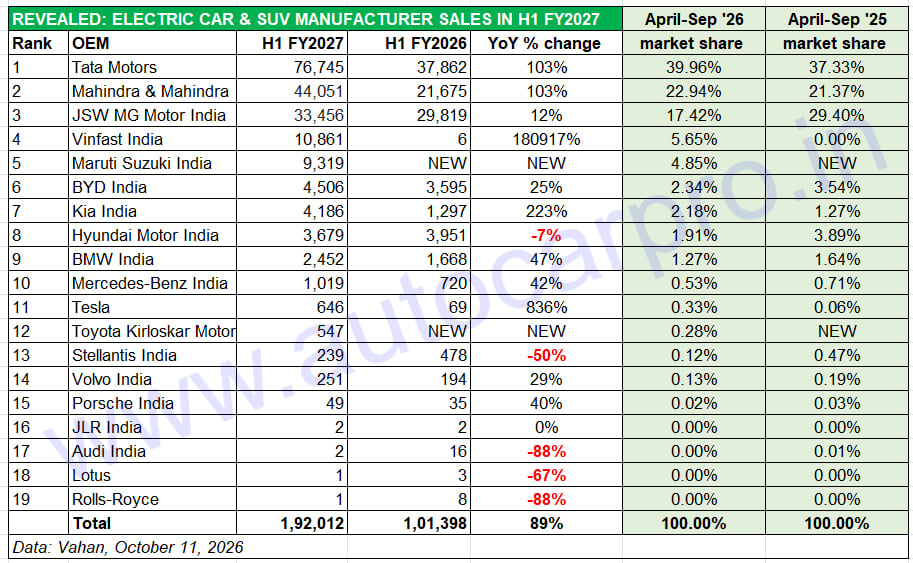 If the 89% YoY growth in first-half FY2027 continues in the second half of this fiscal, the Indian electric passenger vehicle industry could even achieve 400,000 retail EV sales for the first time.
Luxury carmakers sell 4,423 EVs in H1 FY2027, Tesla share jumps to 15%
In tandem with the mainstream EV manufacturers, luxury car and SUV OEMs have also registered high double-digit growth this year. As per Vahan retail sales data, the nine OEMs in this sub-segment have sold 4,423 units in H1 FY2027 to mark 63% YoY growth (H1 FY2026: 2,715 units). This places them well on track to cross 9,000 sales in FY2027, well ahead of the 6,110 units they sold in FY2026.
Segment leader BMW India (2,452 units, up 47% YoY) maintains its grip on the luxury e-PV market albeit its share has reduced to 55% from 61% a year ago, mainly due to the advance of Tesla which has also impacted Mercedes’ e-PV share. Mercedes-Benz India (1,019 units, up 42% YoY) held onto its second rank. In September, Tesla (296 Model Ys) outsold Mercedes (128 e-PVs) for the first time and won second rank for the month in this segment.
American EV maker Tesla (646 Model Y e-SUVs, up 836% YoY) went past Volvo to be ranked No. 3 on the luxury e-PV podium. This is mainly due to its highest monthly sales in September (296 units), when it outsold Mercedes-Benz India (128 e-PVs) and also surpassed the 1,000-units sales milestone 13 months since its market entry.
The sales surge is due to the massive Rs 900,000 price cut in the Model Y pricing. This strategic move sees Tesla India’s e-PV share jump to 15% from 2% in H1 FY2026.
Volvo Auto India clocked retail sales of 205 units in the past six months, down 3% YoY (H1 2025: 211 units), which sees its share reduce to 5% from 9% a year ago.
German sports car manufacturer Porsche, with 251 units, posted a 29% YoY increase and maintained its 1% share of the luxury e-PV market. Of the remaining four OEMs, Audi India and JLR sold two EVs each and Rolls-Royce and Lotus one each.
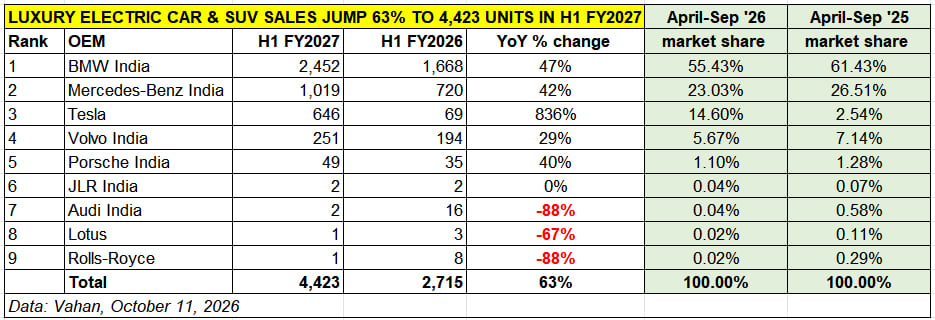 While BMW and Mercedes-Benz maintain their 1-2 ranking, Tesla with 646 units of the Model Y e-SUV has risen to No. 3 and pushed Volvo India to fourth.

RELATED ARTICLES

Tata Motors EV sales exceed 100,000 units in first 9 months of the year
 Ajit Dalvi
 12 Oct 2026
Electric passenger vehicle market leader dispatched 108,548 EVs in January-September and retailed 101,484 units, giving ...


Record 207,850 e-2W sales in September power H1 FY027’s 1.12 million units
Ajit Dalvi
09 Oct 2026
Demand for electric 2-wheelers soared to a new monthly high of 207,850 units in September with Bajaj Auto and Hero Vida ...

TVS NTorq Surpasses 2.5 Million Sales, Last 500,000 Units Sold in 15 Months
Ajit Dalvi
07 Oct 2026
The TVS NTorq, launched in February 2018 as the company’s first 125cc scooter and then joined by its feature-laden 150cc...