


 Follow us
India's EV Push Is About Energy Security, Not Just Clean Transport, Says Exponent Energy CEO
Arun Vinayak argues that electrifying commercial vehicles—which consume nearly 70% of India's on-road energy—is both an economic and strategic priority for the country.
 545 Views


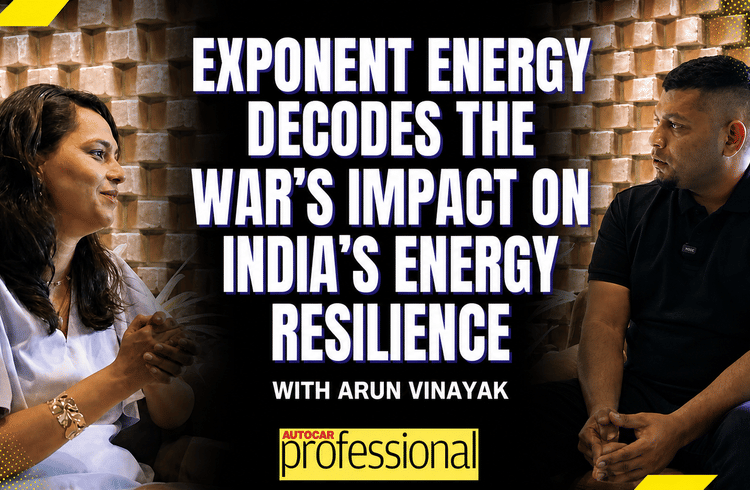
India's electric vehicle transition is less a clean energy story and more a question of national energy resilience, according to Arun Vinayak, Founder and CEO of Exponent Energy. Speaking in an interview with journalist Prerna Lidhoo, Vinayak made the case that India must treat EV adoption as a strategic imperative, particularly in the commercial vehicle segment.
Commercial vehicles, Vinayak noted, account for close to 70% of on-road energy consumption in India. Electrifying this segment, he argued, should take precedence over the passenger vehicle market, given the economic weight it carries and the fuel import exposure it represents.
The West Asia crisis, he said, had already demonstrated the geopolitical risks embedded in India's dependence on oil imports, and had driven a measurable surge in demand for electric alternatives. The disruption, in his view, underscored the urgency of localising EV supply chains rather than replicating the import dependencies that currently exist in fossil fuel markets.
Central to Exponent Energy's approach is ultra-fast charging, which Vinayak positioned as a prerequisite for commercial viability in the fleet and logistics sector, where vehicle downtime directly affects operator revenue. He also pointed to retrofitting—converting existing internal combustion engine vehicles to electric—as a practical tool to accelerate adoption without waiting for full fleet turnover cycles.
Standardisation, however, remains a significant obstacle. Vinayak identified the proliferation of competing technology pathways as a factor undermining investor confidence, with financiers reluctant to commit capital in the absence of clear, uniform technical standards across the sector.
On the commercial opportunity, Vinayak put the addressable market for commercial EV energy in India at $90 billion. Realising that potential, he said, would require closer collaboration between EV companies and financial institutions to structure products that make electric fleets accessible to fleet operators.
Exponent Energy is also preparing to extend its focus to intercity electric buses, a segment Vinayak sees as a natural next step given the scale of inter-city freight and passenger movement in India.
Exponent Energy was founded to develop energy systems for commercial electric vehicles, with a focus on fast-charging infrastructure. The company operates in a market where electric penetration in the commercial segment remains low relative to passenger vehicles, even as government policy has increasingly prioritised fleet electrification through schemes such as the PM e-Bus Sewa programme.
VIDEO:

RELATED ARTICLES

VIDEO: How Tata Power Is Scaling EV Charging in India | Virendra Goyal, Tata Power
 Ketan Thakkar
 21 Sep 2026
Virendra Goyal, head of the EV charging business at Tata Power, talks about how India's charging infrastructure has evol...


Chinese Car Brands Move Into India's Premium and Luxury Segments
 Autocar Professional Bureau
19 Sep 2026
Autocar Professional Bureau
19 Sep 2026
Regulatory restrictions on Chinese investment are pushing brands like BYD and JSW-Chery to enter India through high-end ...

Video: ZF Group Plans to Scale Its India Business by 3X
Prerna Lidhoo
18 Sep 2026
India is emerging as a key growth engine for ZF as the company broadens its role from a component supplier to a mobility...