Follow us
Yamaha Motor considering airbags for motorcycle riders
In a bid to achieve zero fatal traffic accidents by 2050, Japanese auto major Yamaha Motor is mulling to develop airbags for motorcycles that will be helpful in minimizing the number of road accidents.
 15 Nov 2022
 7678 Views
Share -
7678 Views
Share -


Taking a holistic approach to motorcycle rider safety, Iwata, Japan-based Yamaha Motor Co, manufacturers of motorcycles and scooters has realised that there’s no single solution that can prevent rider/passenger injuries in a crash situation.
During Yamaha Motor Safety Vision and Technology Briefing, the company has identified key safety systems such as radar-linked unified brake system, advanced motorcycle stability-assist system and cooperative intelligent transport system where the company is working actively to improve advanced safety systems in two-wheelers.
“Yes, we are considering airbags for motorcycles. Already some companies have made announcements and several others are getting together for this development. I believe that some are already in the market, and we are also developing this as well. But we are unable to make a roadmap of its launch now,” Heiji Maruyama, Chief General Manager of Technical Research & Development Centre told Autocar Professional. Often referred to as a standard safety device for passenger cars, the airbag is designed to prevent vehicle occupants from hitting interior objects and therefore minimize the severity of injuries.
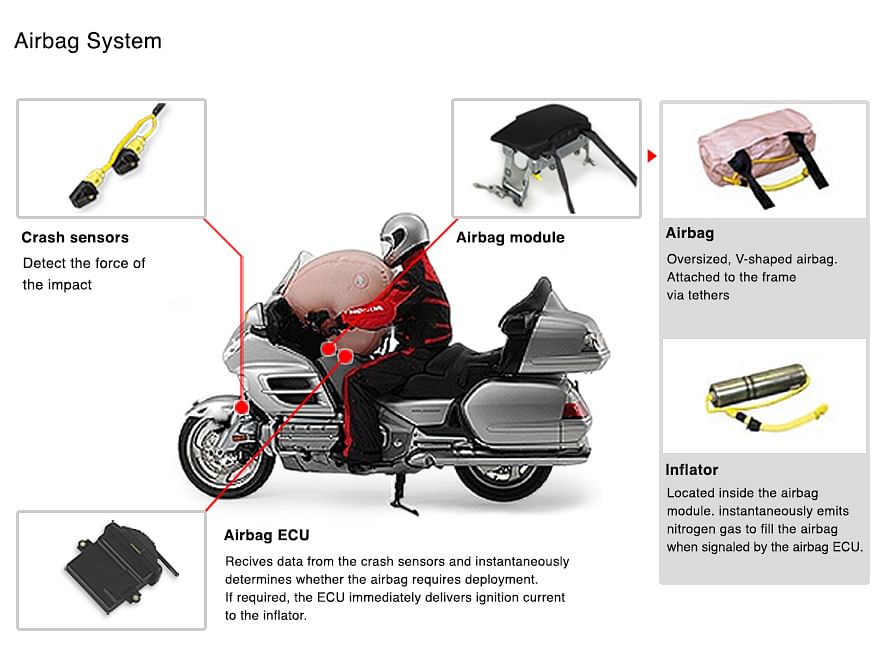 At present, the Honda’s Goldwing model is the only motorcycle with a standard airbag feature. Honda finished developing this motorcycle airbag system in late 2005 and integrated it for the first time on its 2006 Goldwing model.
Explaining further Maruyama said, for the four-wheelers the driver has seat belts which attach the passengers to the seats along with airbags, but it is altogether a different scenario when it comes to motorcycles. “In two-wheelers if there is an accident the rider may be blown away even if you have the airbag as riders are less likely to be in a fixed location with respect to the airbag at the point of impact. I believe we need a combination of all three safety systems to reduce and eliminate accidents. So, in all the technologies that are necessary, we will be making efforts to develop them. And it is our hope that by 2050 we can reduce accidents to zero," Maruyama added.
According to the company, one of the major constraints in accommodating airbag features in two-wheelers is size. Mounted airbags only consider frontal collisions for airbag deployment decisions and do not provide safety during roll out and slippage crash types. "Motorcycles are small in size as compared to passenger cars. This poses a challenge for manufacturers to integrate technology in a small body. Our goal is to integrate the technology into a small machine and technically speaking, we have come to a very mature stage," Maruyama said.
Besides, Yamaha is also a core member of Connected Motorcycle Consortium where it has joined hands with Honda, BMW, and KTM to establish a set of basic specifications for a “Cooperative Intelligent Transport System” (C-ITS) in 2016, allowing motorcycles to communicate with other vehicles and even with roadside infrastructure in a network. “This cooperative intelligent transport system is still in the research and development stage. But it is proceeding with the aim of commercializing in the future,” Maruyama added

RELATED ARTICLES

Samvardhana Motherson Issues Rs 200 Crore Commercial Paper
 Dev Vadchhedia
30 Sep 2026
Dev Vadchhedia
30 Sep 2026
Samvardhana Motherson lists 83-day unsecured short-term debt instrument to Kotak Mahindra Bank.


CAFE III Eases Small-Car Burden Through Flatter Target Curve
 Darshan Nakhwa
30 Sep 2026
Darshan Nakhwa
30 Sep 2026
Final norms drop the earlier 3g/km concession for sub-909kg cars but give lighter vehicles relatively softer targets, ju...

e-SPRINTO to Launch Consumer Electric Scooter in October
 Angitha Suresh
30 Sep 2026
Angitha Suresh
30 Sep 2026
e-SPRINTO, which has so far served business customers, plans to launch a consumer electric scooter in October with a cla...