


 Follow us
PV Dealers Set For 10-12% Growth On Demand, Premiumisation
Passenger vehicle dealers are expected to see 10-12% growth this fiscal as volumes, premiumisation and ancillary income support realisations and margins.
 By Eshisha Java
 674 Views


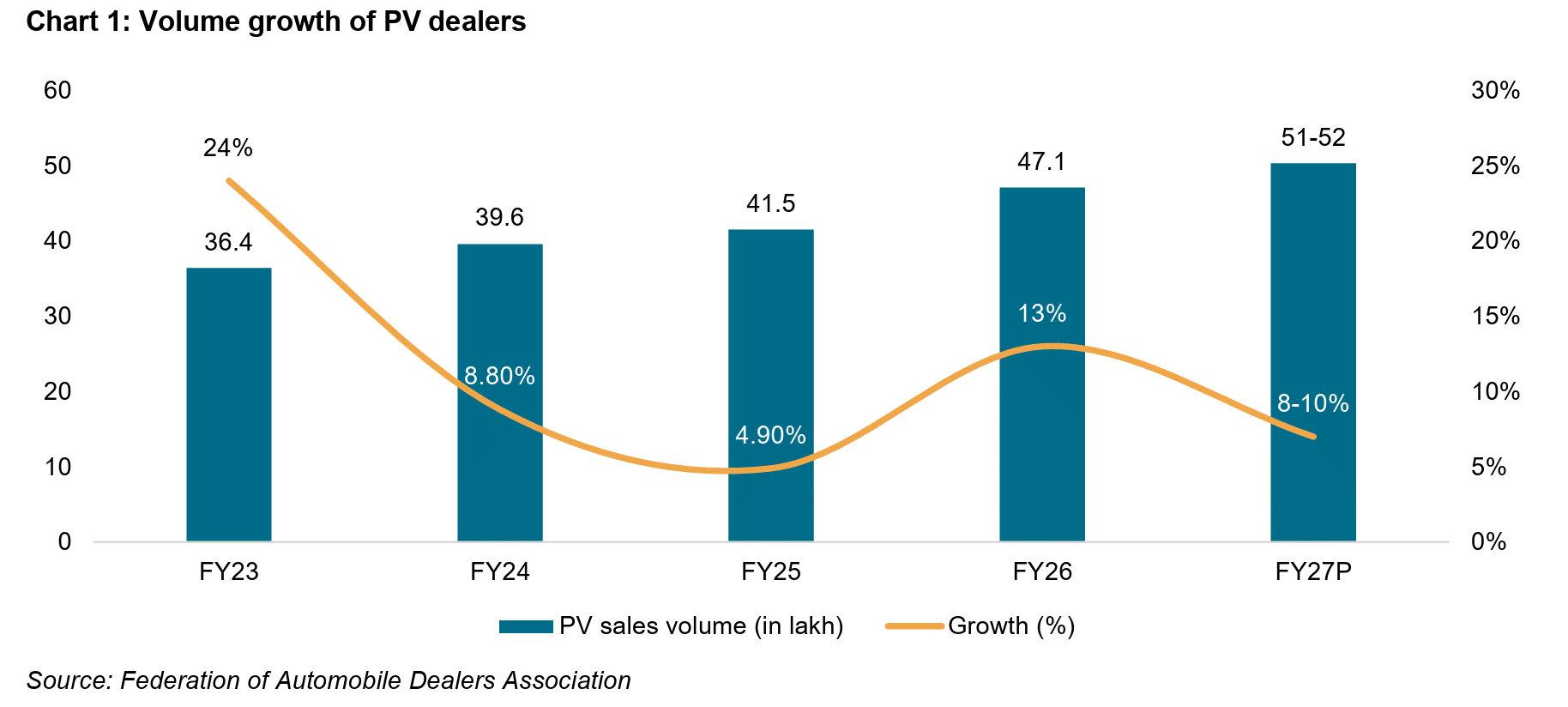
Domestic passenger vehicle (PV) dealers are expected to register 10-12% growth this fiscal, supported by healthy demand, premiumisation and periodic price increases by original equipment manufacturers (OEMs), according to an analysis of 102 dealers by Crisil Ratings. The sector recorded 13% growth last fiscal, with volumes recovering in the second half after a slower first half.
PV volumes are projected to grow 8-10% in fiscal 2027, supported by rising disposable incomes, improving road infrastructure, lower interest rates, increasing vehicle penetration and multiple-vehicle ownership. Rural demand could moderate in the second half due to the potential impact of El Niño and higher fuel prices linked to geopolitical tensions in West Asia, although Crisil Ratings expects structural demand drivers to outweigh these headwinds this fiscal.
Consumer preference for sport utility vehicles and larger vehicles with more features is also contributing to premiumisation. Along with periodic OEM price hikes, this is expected to increase dealer realisations by 2-3% this fiscal.
PV Dealer Margins To Benefit From Ancillary Income
The earnings mix of PV dealers is expected to improve as higher vehicle sales expand ancillary revenue from insurance, accessories, spares and servicing. Crisil Ratings said ancillary income increased its share of dealer revenues by around 200 basis points over the past three years to approximately 16% in fiscal 2026. The share is expected to rise to 17-18% over the medium term.
Operating margins are projected to reach 3.5-3.7% this fiscal, compared with an improvement of around 20 basis points in the previous fiscal.
PV Dealer Capex To Rise With Showroom And EV Expansion
Dealers are planning debt-funded capital expenditure over the next two to three fiscals to expand showroom networks and develop electric vehicle (EV) capabilities. Capex intensity, measured against EBITDA, is expected to rise to 40-42% this fiscal from an average of 38% over the previous three fiscals.
Despite the higher investment, stronger cash generation and lower inventory requirements are expected to limit funding pressure. Inventory levels declined to 30-35 days as of March 31, 2026, from 50-55 days a year earlier, and are expected to remain around 30 days at the end of fiscal 2027.
PV Dealer Credit Metrics Expected To Improve
Crisil Ratings expects dealer financial metrics to improve in fiscal 2027. Gearing is projected at 1.0-1.1 times and interest coverage at 3.4-3.5 times, compared with 1.15 times and 3.0 times, respectively, in the previous fiscal.
The outlook remains dependent on sustained PV demand, with urban demand and weather-related disruptions affecting rural incomes identified as key monitorables.

RELATED ARTICLES

Petronet LNG and Gruner Renewable Energy Enter JV to Build CBG Plants
 Dev Vadchhedia
 22 Oct 2026
The State-run LNG importer signs binding term sheet for 50:50 joint venture to establish 10 compressed biogas units wort...


Rajratan Global Wire Q2 Net Profit Rises 17 Percent to Rs 24.14 Crore
Dev Vadchhedia
22 Oct 2026
The tyre bead wire maker records 26 percent revenue growth driven by export demand and operational turnaround at its Che...

Tata Passenger Electric Mobility Crosses 1,000 Fast-Charging Points Across India
Dev Vadchhedia
22 Oct 2026
Tata Motors-led EV network energizes 180 highway corridors and installs 40 MW of total charging capacity.