

 Follow us
Hyundai to Launch First India-Designed, Built Electric SUV by 2027, Says CEO Munoz
Hyundai will launch its first India-designed and built electric SUV by 2027, marking a major localisation push as it gears up to make over half its 2030 lineup eco-friendly.
 By Ketan Thakkar & Darshan Nakhwa
 15 Oct 2025
 3596 Views
Share -
3596 Views
Share -


Hyundai Motor India will launch its first fully locally designed, engineered, and manufactured electric SUV in India by 2027, marking a major strategic shift for the Korean carmaker as it deepens its localisation push and prepares for a rapid transition to electrified mobility in one of the world’s fastest-growing automotive markets.
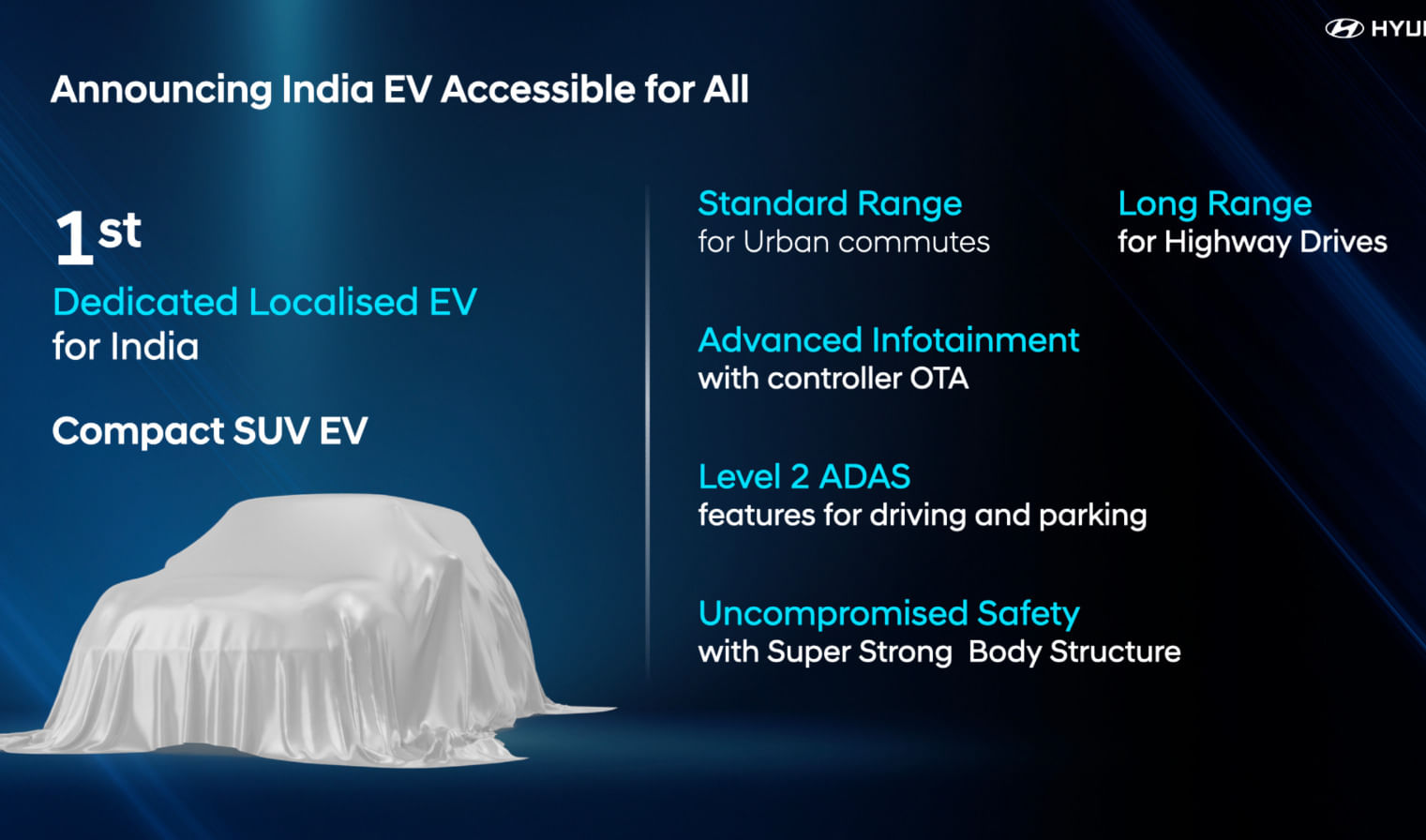
“India will have its first locally manufactured dedicated electric SUV by 2027. Designed, engineered, and built in India for Indian customers,” said José Muñoz, President and CEO, Hyundai Motor Company, at the company’s Investor Day 2025. The model, he added, will form a cornerstone of Hyundai’s broader plan to make India a global hub for sustainable mobility solutions.
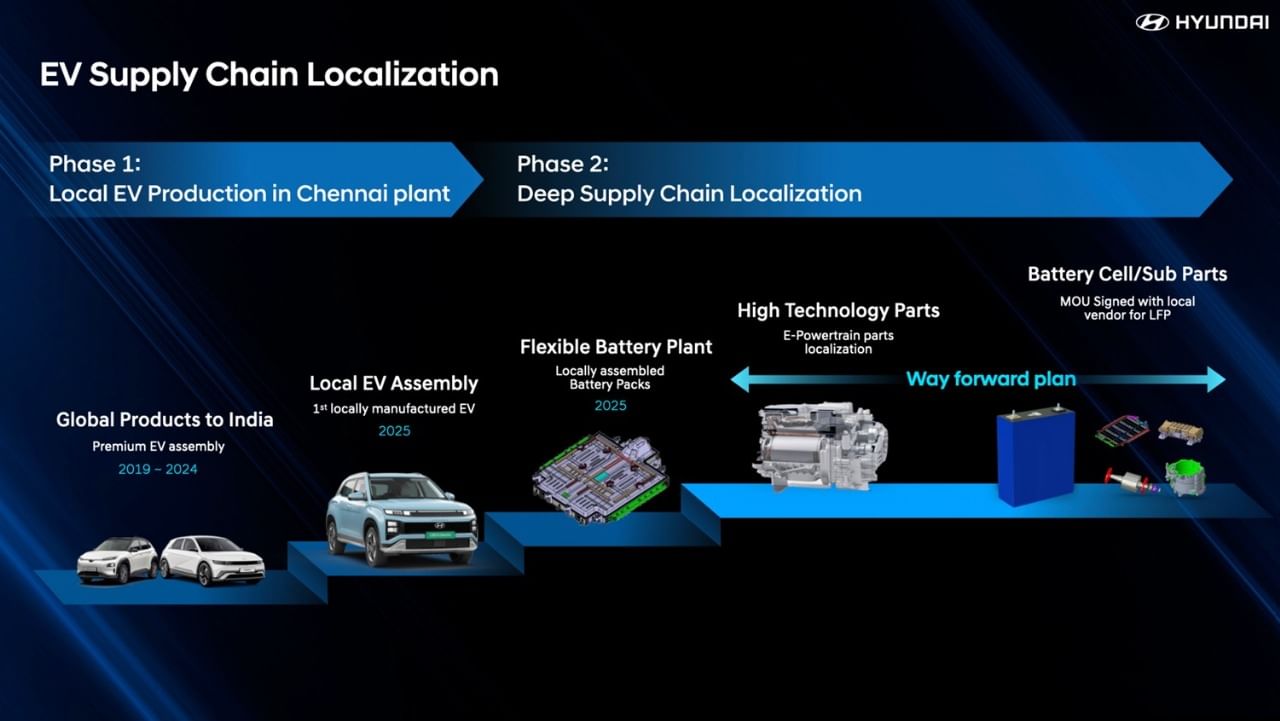
Hyundai’s EV roadmap for India is structured in two phases. Phase 1, already underway, focuses on local vehicle assembly at the company’s Chennai plant–the automaker launched Creta EV earlier this year. Alongside, it is establishing a flexible battery manufacturing plant, which will begin assembling battery packs locally this year.
Phase 2 will focus on deep localisation of the EV supply chain, including high-technology e-powertrain components and local sourcing of battery cells and sub-parts in collaboration with Indian suppliers.
“This deep-dive localisation strategy isn’t just good for business,” Muñoz said. “It is our commitment to building a sustainable, self-reliant automotive ecosystem in India.”
Hyundai is planning to launch 26 new vehicles in India by 2030, with more than 50% of its portfolio comprising eco-friendly vehicles, underlining its ambition to lead the country’s transition to sustainable mobility. The roadmap includes four launches over the next year, eight in FY2027 and FY2028, and 14 between FY2029 and FY2030.
Breaking this down, Hyundai will roll out seven all-new nameplates designed specifically for India, six full-model changes, six derivative models, and seven product enhancements over the next five years.
By the end of the decade, Hyundai’s Indian lineup will comprise 13 ICE models, five EVs, eight hybrids, and six CNG models, reflecting a balanced product mix aimed at addressing diverse customer needs while steering the market toward cleaner technologies.
Hyundai is also embedding localisation into its operational backbone. “With a 100% localisation ratio and expanding EV supply chains, our embedded functions in sales, design and supply chain management respond to local market demands with agility,” he added.
Hyundai’s Punch EV Challenger
Facing intensifying competition from Tata Motors and Mahindra, Hyundai is gearing up to challenge the homegrown leaders in the mass EV segment over the next two years. According to information obtained by Autocar Professional, Hyundai’s Korean headquarters has cleared plans for a direct rival to the Tata Punch EV, scheduled for launch in 2026.
Codenamed HE1i, the compact electric SUV will be heavily based on the Inster EV unveiled at the Busan Auto Show and will be manufactured at Hyundai’s Sriperumbudur plant with localised battery packs sourced from Exide. The model is expected to offer two battery pack options, similar to the Inster’s 42 kWh standard and 49 kWh long-range variants, which deliver 300 km and 355 km WLTP-certified range, respectively.
At 3,825 mm in length, the Inster is slightly shorter than the Tata Punch EV (3,857 mm) and will be offered with 97 hp and 115 hp motor options, both generating 147 Nm of torque. It is also set to feature a comprehensive equipment list, including dual 10.25-inch displays, ADAS, auto climate control, and a 360-degree camera with blind spot monitoring — premium touches Hyundai hopes will help it stand out in a segment where Tata currently faces little direct competition.
Hyundai is pursuing a dual EV strategy in India: combining ICE-derived electric models such as the Creta EV with born-electric vehicles built on the E-GMP (K) platform, like the HE1i. Together, the Creta EV and the compact SUV are expected to deliver a combined annual output of about 90,000 units, with a significant share earmarked for exports.
The company has committed ₹20,000 crore towards EV development in India over the next eight years and plans to launch four new electric vehicles, including a mass-market model, as part of its calibrated strategy aligned with evolving market demand. Beyond the Creta EV and the upcoming compact SUV, Hyundai is also evaluating electric versions of the Venue and Grand i10 Nios, underscoring its intent to mount a strong challenge to Tata Motors’ expanding EV portfolio.
Hyundai’s manufacturing presence in India is also set to expand significantly. Its Chennai plant, which has been operational for over 25 years, remains central to its operations. Later this year, Hyundai will inaugurate its new facility in Pune, with an annual capacity of 250,000 units. This multi-model plant will showcase software-defined manufacturing, allowing the company to respond swiftly to market trends and technological shifts.
“Localization goes deeper,” Muñoz said. “We are localizing the entire EV supply chain, working with tier-1 to tier-3 suppliers. This creates jobs, builds capability and gives us a cost structure to compete and win.”
Hyundai continues to hold a strong position in India’s internal combustion engine (ICE) market, which still represents the bulk of industry profit pools. In FY25, the company held approximately 14% market share in the ICE car segment and 18% in the ICE SUV segment. It has also carved out a 6% share in the growing EV SUV space, laying the foundation for its future electric portfolio.
“Today, internal combustion engines on SUVs and cars represent the majority of India’s automotive profit pools,” Muñoz noted. “As we look towards 2030, not only will the overall profit pool grow, but the most dramatic growth will be in electrified vehicles.”
Hyundai projects that between 2025 and 2030, BEV SUVs will grow by 500%, hybrid SUVs by 600%, hybrid cars by 2,300%, and MPV EVs by 15,000%. Despite this exponential growth, ICE vehicles are expected to continue contributing nearly half of the industry’s profits.

RELATED ARTICLES

BharatBenz Expands North India Network with Gorakhpur 3S Facility
 Arunima Pal
29 Sep 2026
Arunima Pal
29 Sep 2026
The 75,000 sq ft facility has 11 bays and an annual servicing capacity of 4,100 vehicles.


Mercedes-Benz GLC Electric to Launch in India on November 4
Ketan Thakkar
29 Sep 2026
The locally assembled GLC Electric 400 4Matic will get a 94kWh battery, dual motors and a claimed WLTP range of 715km.

Uno Minda Launches Compact 4-Channel Amplifier
Arunima Pal
29 Sep 2026
The new amplifier delivers up to 150W per channel and can be installed in space-constrained areas such as under the seat...