

 Follow us
Hyundai Capital to Enter India by 2026, Bolstering Hyundai’s Integrated Mobility and Finance Ecosystem
With Hyundai Capital India, the carmaker eyes stronger rural reach, higher dealer profitability and a seamless ownership experience across touchpoints.
 By Ketan Thakkar & Darshan Nakhwa
 15 Oct 2025
 3975 Views
Share -
3975 Views
Share -


Hyundai Motor India (HMI) is set to strengthen its presence across the automotive value chain with the launch of Hyundai Capital India in 2026, marking the South Korean carmaker’s formal entry into auto financing, leasing and mobility services in one of its fastest-growing global markets.
The announcement was made by José Muñoz, Global COO, Hyundai Motor Company and President & CEO, Hyundai Motor North America, during HMI’s first-ever CEO Investment Day in Mumbai, where the company outlined its Vision 2030 roadmap for India.
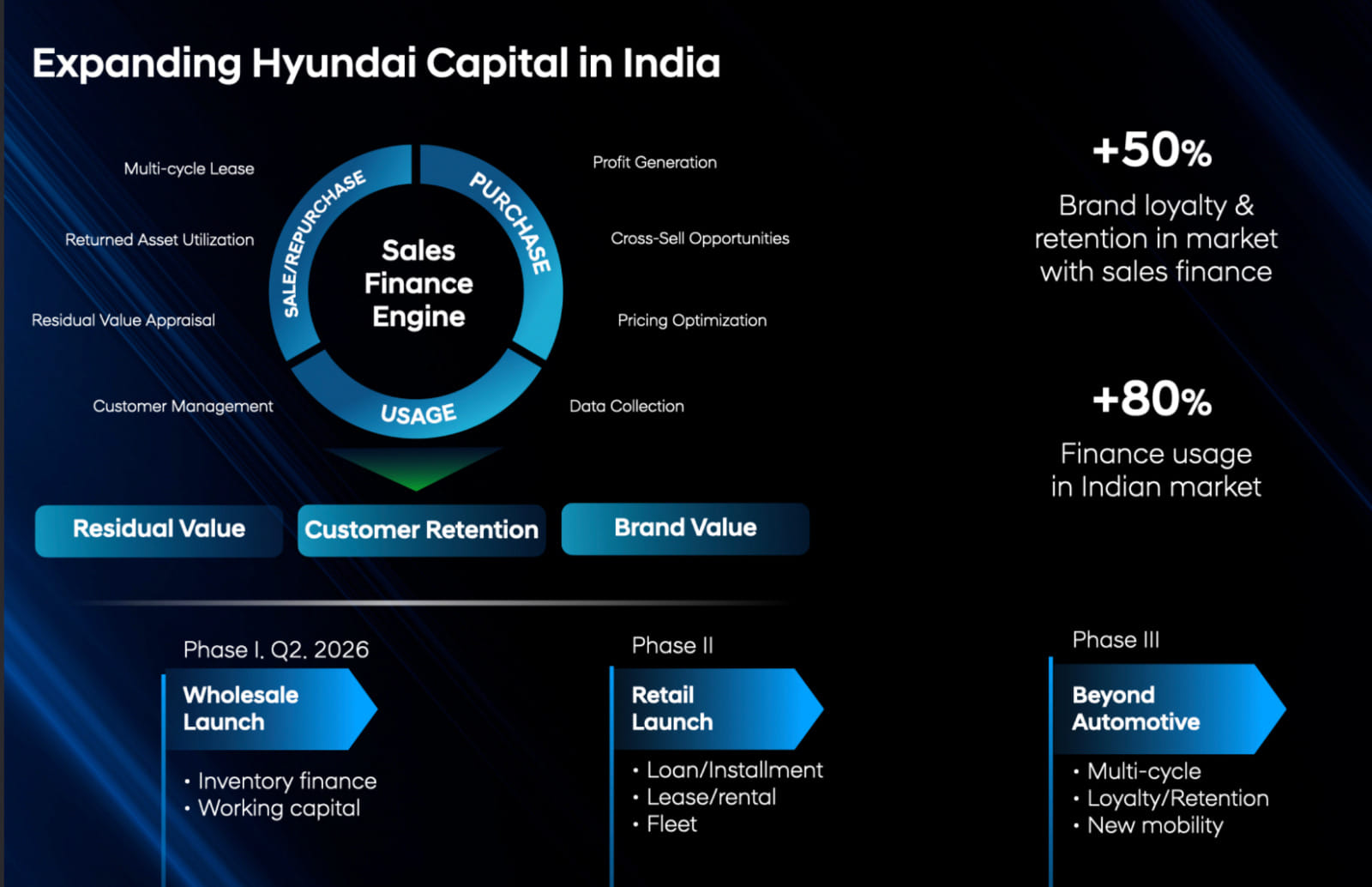
Phased Market Entry
The financial arm will enter the country through a three-phase rollout designed to support dealers, customers and future mobility operators.
Phase 1 (Q2 2026): Launch of inventory financing and working capital solutions to strengthen liquidity for Hyundai’s nationwide dealer network.
Phase 2: Expansion into retail loans, leases, rentals and fleet finance to offer customers a wider choice of flexible ownership models.
Phase 3: Introduction of multi-cycle finance and new-mobility products, such as subscriptions and shared-mobility financing, to align with emerging ownership trends.
“This isn’t just about lending — it’s about enabling sustainable growth, customer retention and brand trust,” said Muñoz. “Sales finance drives residual value and strengthens the brand ecosystem.”
Strategic Leverage in a Growing Market
With auto finance penetration already above 80 percent in India, Hyundai sees strong potential for a captive finance arm that can enhance dealer profitability, accelerate vehicle turnover, and deepen customer loyalty. Globally, Hyundai Capital operations have improved repeat-purchase and retention rates by up to 50 percent, underscoring the business case for a local presence.
The move also complements Hyundai’s rapid network expansion — from over 3,600 touchpoints today to 85 percent district coverage by 2030, including a strong rural focus. Hyundai aims to generate 30 percent of domestic sales from rural India, supported by easier access to retail finance and after-sales credit solutions.
Creating a Full-Stack Ownership Ecosystem
The financial services plan integrates seamlessly with Hyundai India Insurance Broking, which has already issued five million policies and assisted 1.3 million claims, using AI-driven pre-inspection and claims processing. Together, Hyundai Capital and Hyundai Insurance will offer a comprehensive “ownership lifecycle” platform — spanning purchase, protection, and upgrade.
Additionally, Hyundai is exploring micro-mobility finance in collaboration with TBS Motor, to support advanced three-wheelers for urban shared-mobility applications.
Hyundai Capital’s India debut will coincide with the company’s broader Vision 2030 strategy — which projects India to become the second-largest region for Hyundai Motor Company globally, behind only North America.
As part of this roadmap, Hyundai plans 26 new model launches by 2030, half of which will be electrified, and a fully localised EV supply chain anchored by its upcoming Pune facility and enhanced Chennai operations.
“India is no longer just a key market — it’s an integrated pillar of Hyundai Motor Company’s global operations,” said Muñoz. “With Hyundai Capital, we are embedding the financial backbone needed to power our next decade of growth.”

RELATED ARTICLES

BMW Expands MINI Retail Network in Navi Mumbai with Integrated Showroom
 Dev Vadchhedia
29 Sep 2026
Dev Vadchhedia
29 Sep 2026
Dealer partner Infinity Cars to integrate BMW, MINI, and pre-owned BMW Premium Selection into a single Retail.NEXT showr...


FlixBus and Tourism Ministry Partner to Deploy Co-Branded Coaches and Promote Regional Travel
Dev Vadchhedia
29 Sep 2026
FlixBus signs pact to integrate Incredible India branding, launch destination portal, and initiate responsible travel ca...

Tata Motors Subsidiary Acquires 26% Stake in Hyderabad e-mobility Firm
 Shruti Shiraguppi
29 Sep 2026
Shruti Shiraguppi
29 Sep 2026
TML Smart City Mobility Solutions invested ₹2.6 lakh in Mateshwari E-Smart Mobility (Hyderabad), which became an associa...