

 Follow us
How India’s Tax Gridlock Paralysis May Paralyze Volkswagen’s Local Alliance Search
A technical reset in the Bombay High Court forces VW to re-argue its 'life or death' customs case, casting a long shadow over its consolidation strategy in India.
 By Shahkar Abidi
 10102 Views


In a major setback to the automotive industry, Skoda Auto Volkswagen India Private Limited (SAVWIPL) has been forced to return to the starting line in its Rs 11,526 crore ($1.4 billion) customs tax dispute in India. On August 25, 2026, a division bench of the Bombay High Court consisting of Justices B. P. Colabawalla and Firdosh Pooniwalla formally released the matter without delivering a verdict, despite having reserved their judgment about 18 months earlier on February 26, 2025.
According to reports published by Moneycontrol and other media outlets, the judges summoned the litigating parties' counsel to their chambers and explained that they were releasing the petition "due to the exigency of work." This unusual procedural step is directly tied to the Supreme Court of India's strict judicial guidelines, which dictate that a reserved judgment should ideally be pronounced within three to six months to prevent the judicial record from going stale. Having failed to deliver a verdict within 18 months, the bench chose to step aside rather than violate these procedural guardrails. Consequently, the case must now be placed before a new, regular bench to be argued afresh from scratch, rendering years of extensive legal arguments and judicial preparation completely redundant.
Behind the Dispute: The 12-Year Import Contradiction
 The cause of this record-breaking tax battle, the largest import-related tax demand in Indian automotive history, is a fundamental disagreement over how vehicle components are classified and taxed under the country's Customs Law.
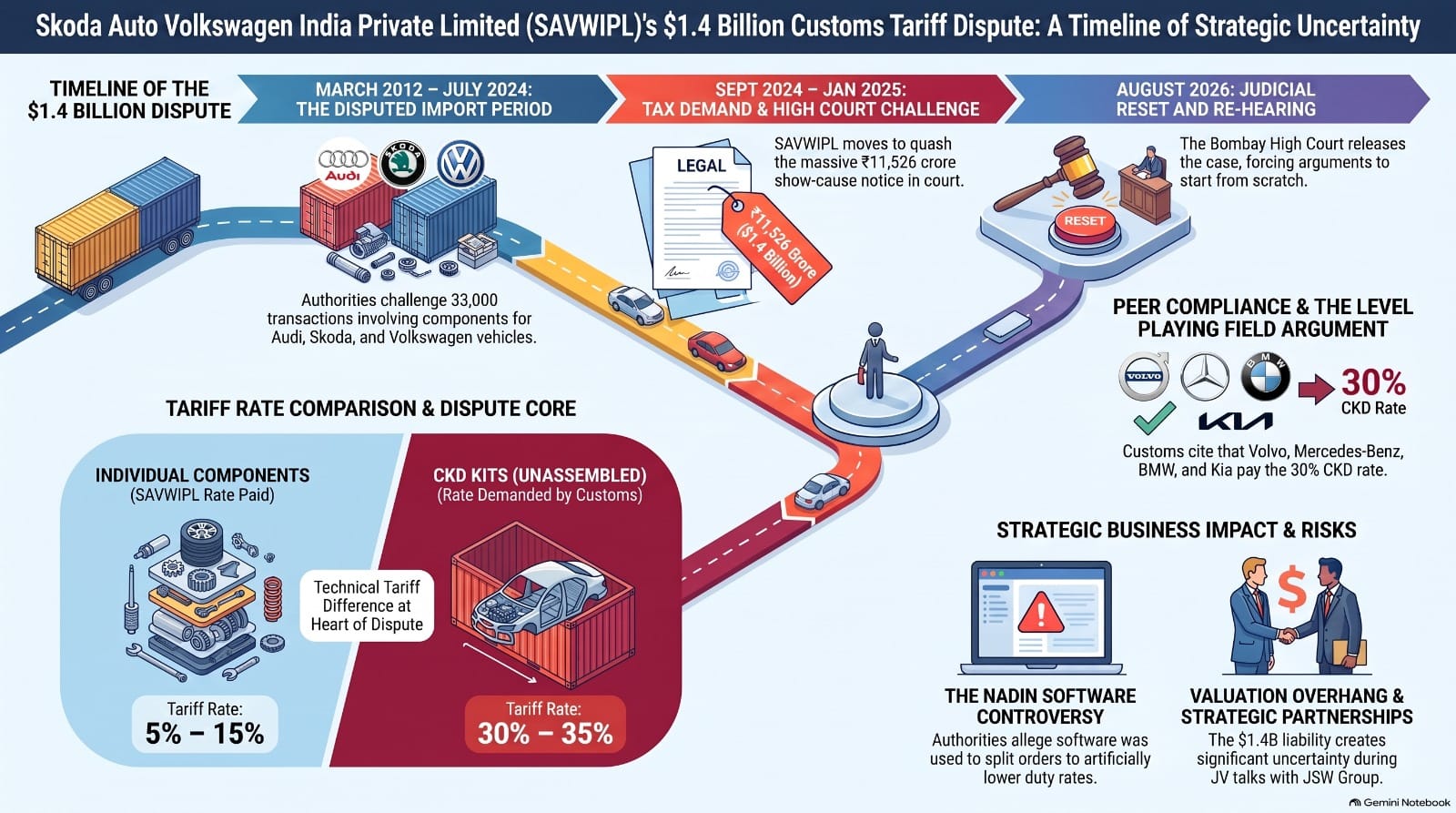
Indian customs authorities allege that for a 12-year period between March 2012 and July 2024, Volkswagen’s Indian subsidiary deliberately misclassified imports destined for its Aurangabad assembly plant (which produces luxury and volume models for the Audi, Skoda, and Volkswagen brands). The government asserts that the company imported "completely knocked down" (CKD) kits, which are essentially unassembled, fully functional vehicles, but declared them as individual auto components in fragmented, separate shipments.
Under Indian tariff schedules, CKD kits attract a steep basic customs duty of 30% to 35% (and historically up to 60%). On the other hand, individual auto components imported separately are taxed at a much lower rate of 5% to 15%.
The Customs Department has scrutinised over 33,000 import transactions, alleging that the automaker used sophisticated logistics software to split car orders among hundreds of overseas suppliers to create the appearance of independent component shipments, thereby evading the higher CKD tariff.
Volkswagen has fiercely defended its practices, pointing to a 2011 Revenue Department clarification that explicitly supported its part-by-part import strategy. The automaker maintains that it did not import unified "kits" and that the retroactive Rs 11,526 crore notice represents an abrupt, unjust policy reversal that violates established regulatory guidelines.
The Step-by-Step Chronology (March 2012 – August 2026):
[March 2012 – July 2024]
SAVWIPL imports vehicle components for its Aurangabad facility, declaring them as individual parts under the 5% to 15% duty bracket.
[September 30, 2024]
Indian Customs Department issues a massive Rs 11,526 crore (~$1.4 billion) show-cause notice alleging deliberate tax evasion through CKD misclassification.
[January 29, 2025]
SAVWIPL files a writ petition in the Bombay High Court, challenging the notice and labeling the demand an "impossibly enormous" threat to its Indian operations.
[February 2025]
The Bombay High Court conducts intensive hearings over six days. The bench limits its scope to deciding if the customs notices are "barred by limitation" (time-barred).
[February 26, 2025]
Justices B. P. Colabawalla and Firdosh Pooniwalla officially reserve their judgment.
[February 2025 – August 2026]
The judgment remains reserved for 1.5 years due to heavy judicial workloads.
[August 25, 2026]
The bench releases the case without a verdict, citing "exigency of work" and Supreme Court timeline guidelines. A 4-week status quo is granted to find a new bench.
The Cost of Delays: Impact on Volkswagen and the Case
The 18-month delay and the subsequent judicial reset carry devastating consequences for both the corporate entity and the broader litigation.
This legal limbo comes at a highly delicate time. Volkswagen Group has been in active, advanced negotiations with potential local partners (including the JSW Group) to sell a stake in its Indian operations. A lingering, unresolved $1.4 billion liability makes asset valuation and deal-structuring incredibly difficult, acting as a massive deterrent to domestic partners and stalling crucial local expansion plans.
The CKD Battleground: Precedents and Competitors
This technical tax battle is far from an isolated incident; rather, it represents a long-running, systematic friction point between the Indian government's "Make in India" localization pushes and global carmakers' global supply chains.
During the High Court proceedings, the customs authorities, heavily defended the massive tax demand by pointing directly to Volkswagen’s luxury peers to argue that the rules are being applied uniformly. The government revealed that competitors such as Volvo, Mercedes-Benz, BMW, and Kia have consistently complied with the regulations, paying the full 30% CKD import duty on their vehicle assembly kits. Specifically, the state highlighted that Volvo paid Rs 2,395 crore in CKD duties. Likewise, Mercedes-Benz paid Rs 2,213 crore, Maruti Suzuki paid Rs 11,163 crore and BMW paid Rs 532 crore.
This technical interpretation treats incomplete or unassembled articles as finished goods if they exhibit the "essential character" of the complete product is a long-standing battleground.
FDI and Policy Predictability: The Broader Policy Implications
For foreign direct investors, the resetting of Volkswagen's case is a reminder of the structural bottlenecks that continue to plague India’s regulatory and legal ecosystems. While the Indian government has made admirable strides in improving its global "Ease of Doing Business" rankings and aggressively promoting local manufacturing, the reality on ground threatens to undermine these achievements.

RELATED ARTICLES

Moving Tech Innovations Plans to Expand Open Mobility Model in Europe
 Arunima Pal
 15 Oct 2026
The Bengaluru-based company presented its approach to locally governed public mobility infrastructure at the World Econo...


Jindal Stainless Deploys 10 Electric Trucks for Finished Goods Transportation
Arunima Pal
15 Oct 2026
The company expects its electric, LNG and CNG vehicle fleet to reduce carbon dioxide emissions by around 71 tonnes per m...

Auto Sales up 18.2% in July-Sept, PV Sales Rise 30.7%
Arunima Pal
15 Oct 2026
Total domestic sales across categories were 83,87,938 units in the quarter, up 18.2% from 70,98,111 a year earlier.