Follow us
Exclusive - Toyota India Revenue Grows Faster than Global Business, Crosses Rs 70,000 Cr in FY26
Indian business delivers stronger revenue growth and a higher reported operating margin than Toyota globally, although net profit declined 8% as costs increased.
 By Ketan Thakkar
 4098 Views


Total income increased 3.6 times between FY22 and FY26
Toyota Kirloskar Motor’s consolidated revenue from operations grew 8.8% to Rs 70,577.8 crore in FY2025-26, ahead of the 5.1% growth reported by Toyota Motor Corporation’s global automotive business during the same period.
On reported numbers, Toyota Kirloskar delivered a 10.3% operating margin, against Toyota’s global consolidated margin of 7.4%. The comparison is indicative because the Indian figure relates to one operating company, while Toyota’s global and regional numbers consolidate several businesses.
The Indian company’s consolidated net profit declined 7.9% to Rs 5,224.8 crore as expenses grew faster than revenue, according to financial statements accessed through private-market intelligence platform Tracxn.
Chart 1: Toyota Kirloskar’s revenue more than triples in four years
|
Financial year |
Total income |
Year-on-year change |
|
FY2021-22 |
Rs 19,765.2 crore |
|
|
FY2022-23 |
Rs 34,021.8 crore |
72.1% |
|
FY2023-24 |
Rs 56,443.7 crore |
65.9% |
|
FY2024-25 |
Rs 65,567.1 crore |
16.2% |
|
FY2025-26 |
Rs 71,037.6 crore |
8.3% |
Total income rose 8.3% to Rs 71,037.6 crore. Profit before tax, including the share of loss from an associate, declined 5.2% to Rs 7,208.5 crore. Earnings before interest and tax fell 4.2% to Rs 7,340.1 crore.
The operating margin narrowed from 11.7% in FY25, while the net profit margin declined to 7.4% from 8.7%.
Toyota Kirloskar Posts Record FY26 Sales, Exports Surge
Toyota Kirloskar recorded its highest-ever fiscal-year sales of 4,06,081 vehicles in FY2025-26, an increase of 20% from 3,37,148 units in the previous year. Domestic sales rose 19% to 3,67,107 units, while exports increased 41% to 38,974 units.
The performance helped India retain its position as Toyota Motor Corporation’s fourth-largest market globally for the second consecutive year in 2025, behind the US, China and Japan. India first entered Toyota’s top four in 2024 after overtaking Canada, Indonesia and Thailand. It was also Toyota’s fastest-growing major market by volume that year.
“During this year, your company recorded its highest highest sales, domestic and export, since the company’s start of operations in India,” Toyota Kirloskar said in its directors’ report.
The company also started direct vehicle exports to the Middle East and Africa. Export earnings from vehicles stood at Rs 4,344.9 crore. Transmissions and spare parts accounted for a further Rs 1,609.3 crore.
India Among Toyota’s Stronger Operations
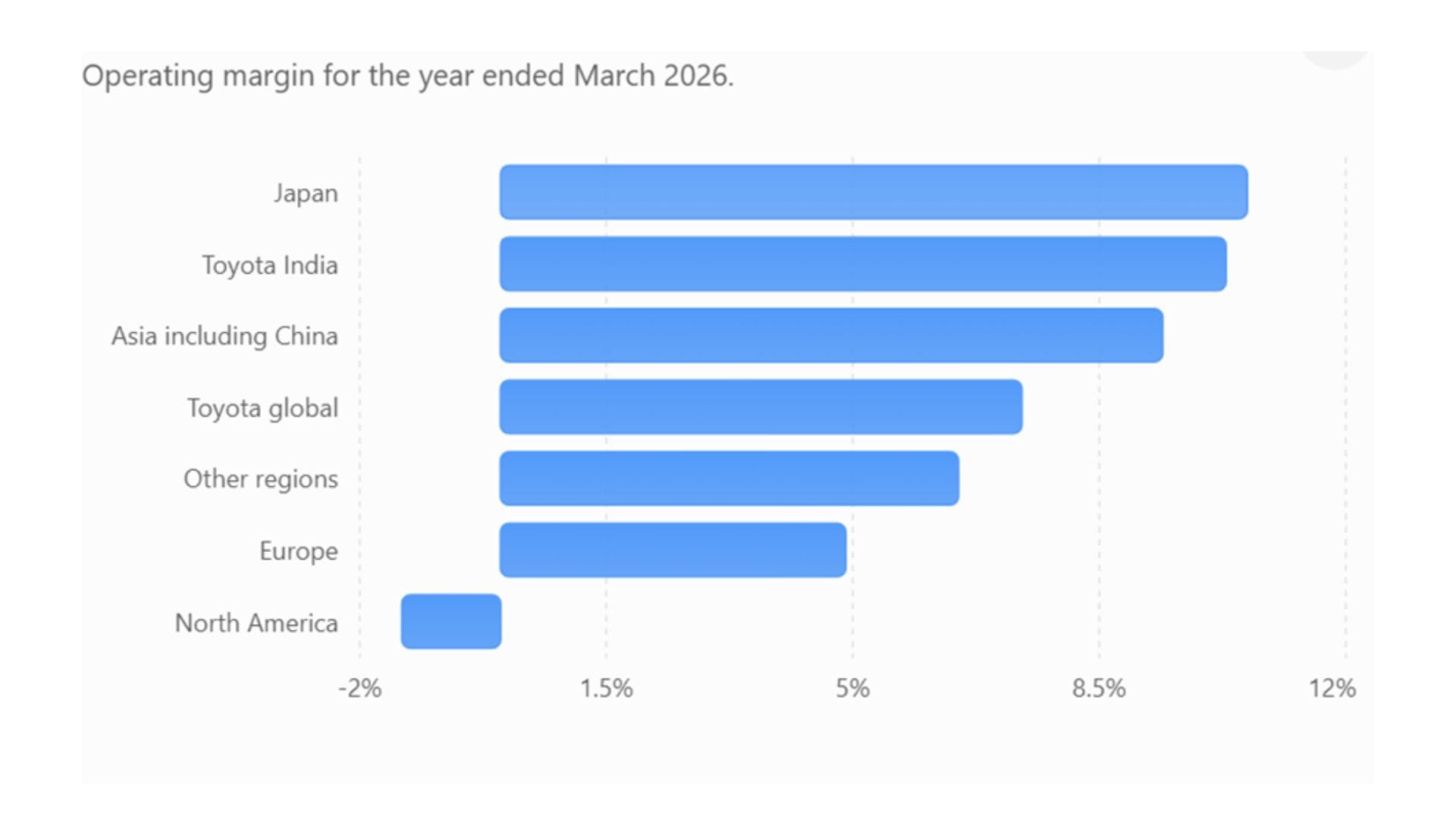
Japan reported an operating margin of 10.6% during the year, marginally higher than Toyota Kirloskar’s 10.3%. Toyota’s Asian operations, including China, recorded a margin of 9.4%.
The corresponding margins stood at 6.5% across Toyota’s other international markets and 4.9% in Europe. North America recorded an operating loss following the impact of US tariffs.
Toyota’s global automotive operating income declined 29.5% in the year ended March 2026, compared with a 4.2% reduction in earnings before interest and tax at Toyota Kirloskar.
While the accounting perimeter differs, the numbers indicate that India recorded stronger revenue growth and retained more of its operating profitability than most of Toyota’s major regions in FY26.
MPVs and SUVs Anchor Volumes
Toyota’s growth was led by a portfolio concentrated around MPVs, SUVs and crossovers. The Innova Hycross and Innova Crysta remained Toyota’s principal volume anchors, with the Innova family averaging about 9,500-10,000 units a month. Rumion volumes also rose sharply towards the end of FY26.
The Urban Cruiser Hyryder was Toyota’s main mass-market SUV contributor, averaging around 7,000-9,000 units a month. The Urban Cruiser Taisor added volumes at the more accessible end of the portfolio.
Toyota said the Fortuner continued to lead its segment across the country. The Glanza provided a steady hatchback base of about 3,500-5,000 units a month. Toyota’s premium models, including the Camry, Vellfire and Land Cruiser 300, remained relatively small in volume terms. The Vellfire and Land Cruiser recorded growth from low bases.
Rising Costs and Working Capital Pressure Squeeze Margins
Toyota Kirloskar’s total expenses increased 10.1% to Rs 63,826 crore in FY26. Employee expenses rose 23.6% to Rs 2,340.1 crore, while advertising and promotional expenditure increased 44.9% to Rs 854.7 crore. Royalty expenses grew 23% to Rs 2,112.6 crore. Finance costs more than doubled to Rs 128.5 crore.
Inventory increased 85% to Rs 5,598.1 crore at the end of March 2026. Trade receivables rose 27% to Rs 1,275.2 crore. The higher working-capital requirement contributed to a 32.5% decline in cash flow from operating activities to Rs 3,804.6 crore.
Strong demand led Toyota Kirloskar to introduce a third production shift at Plant 2 in Bidadi, Karnataka. The company also began supplying the Toyota Hybrid System to Maruti Suzuki India under the next phase of the global Toyota-Suzuki alliance.
Purchases of property, plant and equipment increased to Rs 2,339.3 crore from Rs 810.3 crore in FY25. Capital work-in-progress rose to Rs 2,107 crore from Rs 212.6 crore.
The company started land-levelling work for Plant 1 of its proposed manufacturing complex at Bidkin in Chhatrapati Sambhajinagar, Maharashtra.
Cash and cash equivalents declined 45% to Rs 4,134.1 crore. Toyota Kirloskar also paid a dividend of Rs 5,652.4 crore during the year against FY25 earnings. No dividend has been declared for FY26.
The company’s sales and service network expanded to 927 touch points. Lexus had 21 touch points across 17 cities.
With a third shift at Bidadi and a new plant planned in Maharashtra, Toyota is building capacity for further domestic growth. Direct exports and hybrid-system supplies to Maruti Suzuki give the Indian operation a larger role in Toyota’s regional manufacturing network.

RELATED ARTICLES

Exponent ONE Launches Pay-per-Km Energy Plan for Montra Electric 3Ws
 Arunima Pal
 15 Oct 2026
ONE Pass combines battery usage and charging costs at ₹3.20 per km, with no upfront battery cost and a lifetime battery ...


Moving Tech Innovations Plans to Expand Open Mobility Model in Europe
Arunima Pal
15 Oct 2026
The Bengaluru-based company presented its approach to locally governed public mobility infrastructure at the World Econo...

Jindal Stainless Deploys 10 Electric Trucks for Finished Goods Transportation
Arunima Pal
15 Oct 2026
The company expects its electric, LNG and CNG vehicle fleet to reduce carbon dioxide emissions by around 71 tonnes per m...