

 Follow us
Ashok Leyland to spend 'normal' capex of Rs 600-750 crore in FY24 after two years of tightening
According to Shenu Agarwal, the development should be viewed in the context of the industry's volume growth trends, which will now necessitate some debottlenecking to improve operational efficiency.
 23 May 2023
 5141 Views
Share -
5141 Views
Share -


Chennai-based Ashok Leyland, a flagship company of Hinduja Group, hopes to return to its 'normal' capex spending of around Rs 600–Rs 750 crore in FY24, as opposed to the rather tightening done in FY23 and FY22, when the company incurred Rs 500 crore and Rs 400 crore, respectively. The company's corresponding capex was Rs 617 crore in FY21 and Rs 1292 crore in FY21 and FY20.
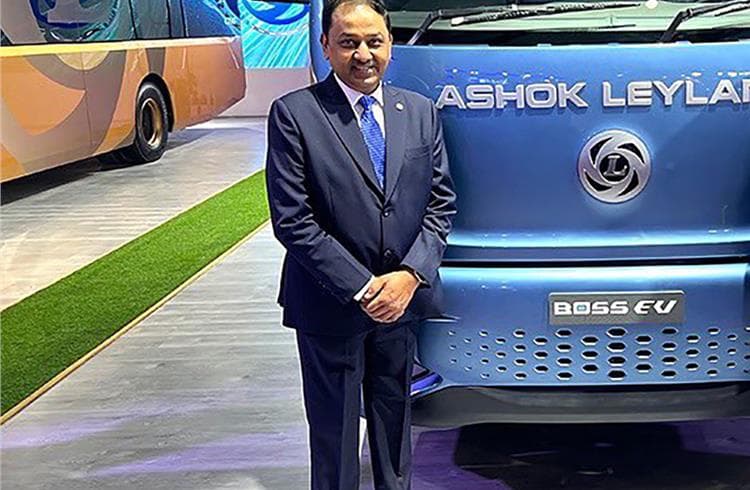
According to Shenu Agarwal, Managing Director and CEO of Ashok Leyland, the company has sufficient capacity visibility for the next 2-3 years, so a significant portion of the capex would be spent on debottlenecking in addition to other necessary activities. According to him, the development should be viewed in the context of the industry's volume growth trends, which will now necessitate some debottlenecking to improve operational efficiency.
During a post-results conference call, he stated, "There will be no large chunk of investment," before adding that the company's capacity utilisation in Q4FY23 was between 80 and 85%. "It will primarily be capacity augmentation, and we have a reasonably large manufacturing footprint. As a result, there will be some routine capex."
As per the available data, Ashok Leyland’s truck market share for Q4 FY23 has improved to 32.7 % compared to 30.6 % in Q4 FY22. Likewise, the bus market share for Q4 FY23 has improved to 27.1 % as against 26.4 % for the same period last year. Similarly, the company's domestic LCV (light commercial vehicle) volumes grew by 18% in Q4 FY23 to 18,840 units.
Offering a glimpse of the company's growth during FY23, management emphasised that the growth was "wholesome," meaning that it occurred across geographies and product portfolios. Even in areas where the company has traditionally lagged, such as northern or eastern India, growth has been rapid, with its market share reaching nearly 25%, up from 19–20% previously.
Concerning the improvement in demand for CNG-powered vehicles, Agarwal stated that last year, the price differential between CNG and diesel was not significant, resulting in a tapering of demand. Though the situation has improved in recent months as a result of new regulatory interventions, it must be monitored to see how demand develops in the coming months, he signed off.

RELATED ARTICLES

Tsuyo Partners With China's LvKON to Produce Electric CV Powertrains in India
 Dev Vadchhedia
23 Oct 2026
Dev Vadchhedia
23 Oct 2026
Tsuyo plans 24-acre greenfield plant as five-year technical association expands into heavy-duty commercial drive systems...


JK Tyre Reports Rs 60 Cr Profit on Revenue of Rs 4,850 Cr in Q2 FY27
Dev Vadchhedia
23 Oct 2026
The tyre maker posts 20 percent year-on-year revenue growth driven by OEM demand and domestic sales momentum.

Youdha Launches ePod G Electric Three-Wheeler Cargo Vehicle
Dev Vadchhedia
23 Oct 2026
The E-CV maker expands its ePod platform into goods transportation with 545 kg payload and 180 km range.