
 Follow us
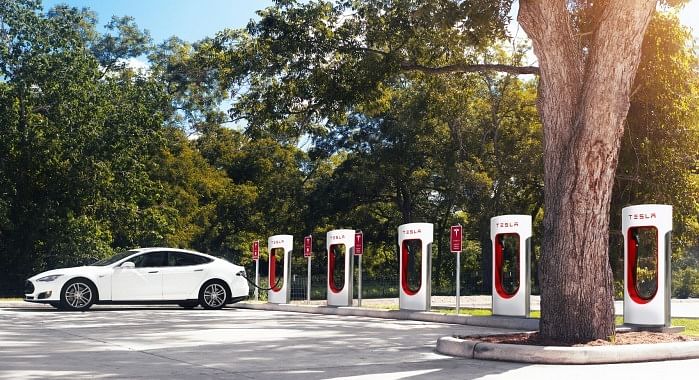
Tesla Model 3 owners will have to pay to use Superchargers
Buyers of Tesla’s first ‘affordable’ all-electric model won’t be eligible for free electricity like Model S and Model X owners.
 03 Jun 2016
 3999 Views
Share -
3999 Views
Share -


Elon Musk revealed at the annual Tesla shareholders meeting that buyers of the Model 3 won’t be eligible for free use of the brand’s Superchargers, because Tesla “can’t figure out how to make it less expensive”.
Musk’s remarks come in relation to the Model 3’s comparatively low starting price compared to the Model S and Model X, both of which come with a lifetime of free use of Superchargers.
He said that due to the 3’s low sale price, Tesla can’t afford to offer free electricity if it wants to remain profitable.
Given that the Model 3 is expected to cost around £35,000 (Rs 34.45 lakh) in the UK, which is close to half the price of the Model X (pictured below) and about £22,000 (Rs 21.65 lakh) less than a Model S, and that it’s been ordered by more than half a million buyers (more than 10 times the number of pre-orders received for the Model X), this is understandable.
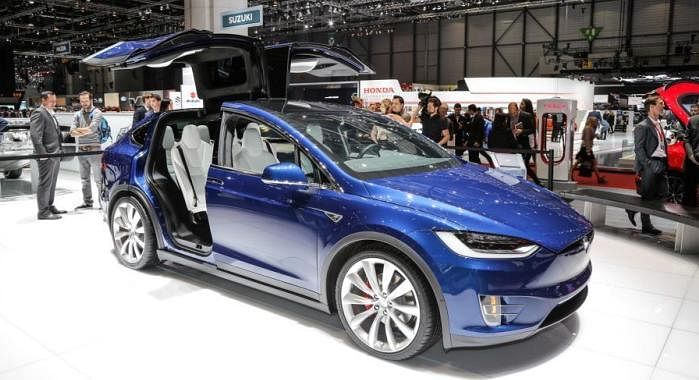
Nevertheless, Tesla is considering offering Model 3 buyers the chance to upgrade to a lifetime of free Supercharger electricity for an extra purchase cost. “But it will not be free long-distance charging for life unless you purchase that package,” added Musk.
Musk claimed that Tesla is making cars at the lowest cost it can, stating: “The Tesla price is based on a roughly 20-25% mark-up on our cost of production. The price is based on what our car is costing. Then we aspire to add roughly 25%, which has to cover all of our sales costs, and the overhead and the engineering and the R&D and investment for future product.”
Nevertheless, Musk did suggest that prices could come down in the near future, thanks to reducing costs for the extraction and processing of lithium-ion -- a key ingredient in Tesla batteries.
“The nice thing about lithium is it’s extremely abundant on Earth,” he said. “There’s lithium in salt form virtually everywhere; there are definitely no supply issues with lithium.”
Musk added that while some industry insiders had claimed lithium supplies could struggle to meet demand, he believed its pricing wasn’t a big factor to overall battery cost. “The actual percentage of lithium in a lithium-ion cell is approximately 2%,” he said. “Technically our cells should be called nickel-graphite, because the primary substance is nickel. So nickel has a bigger effect on price.”
RELATED ARTICLES

Horse Powertrain develops ‘all-in-one’ powertrain for hybridizing BEV platforms
 Ajit Dalvi
20 Apr 2026
Ajit Dalvi
20 Apr 2026
X-Range C15 Direct Drive is an ‘all-in-one’ hybrid powertrain that allows BEV platforms to serve as foundations for HEVs...


Autoliv Plans JV for Advanced Safety Electronics With China’s HSAE
Ajit Dalvi
11 Oct 2025
The new joint venture, which is to be located strategically near Shanghai and close to several existing Autoliv sites in...

JLR to Restart Production Over a Month After September Hacking
Ajit Dalvi
07 Oct 2025
Manufacturing operations at the Tata Group-owned British luxury car and SUV manufacturer were shut down following a cybe...