Follow us
Exclusive: Bentley Targets 100 Cars per Year Milestone in India, Banks on New Set-up to Accelerate Sales
Bentley is recalibrating its India strategy with a new sales structure and pricing focus to push annual volumes towards the 100-unit milestone.
 By Hormazd Sorabjee
 2769 Views


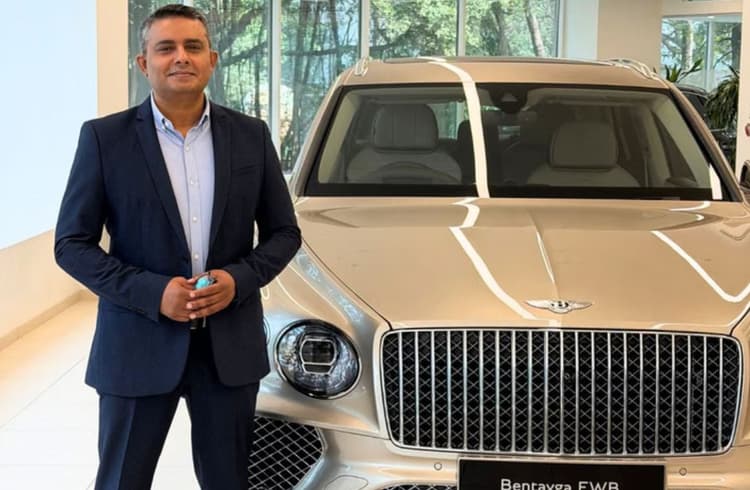
With a new National Sales Company structure, three dealer partners, and a sharper focus on pricing transparency, Bentley is laying the groundwork to scale up its India operations. Abbey Thomas, Head of Bentley India operations, outlines how the brand plans to move towards the landmark 100-unit mark annually, up from its historical highs of 60–70 units.
This aggressive roadmap comes close on the heels of the much-awaited India–UK Free Trade Agreement (FTA), which could significantly lower import duties for completely built units and reset pricing for ultra-luxury cars, thereby offering a significant boost to demand.
Abbey Thomas says that the company is aiming for the 100-unit sales mark in this financial year (2026–27). On the face of it, the target may appear ambitious, but the approach remains calibrated. It does depend on one caveat, which Thomas succinctly puts forth: “The 100-unit mark is achievable, but it depends on how quickly pricing becomes competitive.”
Under the new set-up, Bentley India’s strategy now rests on three key levers: streamlined pricing, stronger network control, and re-engaging its existing customer base. But the real unlock is expected to come from price reductions driven by the FTA. JLR India set the cat among the pigeons by announcing FTA-related price cuts of around 15 percent on its imports from the UK. It is logical that Bentley will follow.
With the new pricing structure awaited under the FTA, Bentley is taking a cautious approach to inventory. When Autocar India caught up with Thomas at the Bentley showroom, the limited number of cars on display stood out. But this, he insists, is intentional.
“There is clearly a wait-and-watch approach from customers today,” says Thomas.
Bentley is responding to this approach by aligning supply with demand at a time when customers themselves are understood to be delaying purchases in anticipation of potential price corrections once the FTA comes into effect.
A New Structure, a Fresh Start
Bentley’s shift to a direct NSC model, effective July 1, 2024, marked a clean break from its earlier importer-led setup. The brand now operates through three partners: Infinity in Mumbai, KUN Premium Cars in Bengaluru, and Bird Automotive in Delhi.
The move to Bengaluru over Hyderabad, traditionally a stronger ultra-luxury market, is a strategic one. As Thomas explains, customers are no longer restricted by geography. A buyer in Bengaluru can purchase from Delhi or Mumbai without any constraints, allowing the network to function as a unified national platform.
The biggest change, however, is pricing discipline. With a defined MSRP and a one-price policy across dealerships, Bentley aims to remove inconsistencies that previously affected the buying experience. Thomas notes that “there is no ambiguity anymore — we now have a one-price formula across the network.”
Backed by centralised global support in engineering, homologation, and logistics, the new structure gives Bentley far greater control over how it operates in India. More importantly, this structural reset is designed to position the brand for a step-up in volumes once pricing becomes more competitive under a lower-duty regime.
Three Dealers, Nationwide Reach
Bentley has deliberately limited its network to three partners for now, focusing on quality over scale. Each dealer is experienced in handling ultra-luxury clientele, and together they cover the entire country. Thomas believes that “three strong partners are enough to cover India at this stage.”
Aftersales has been given as much importance as sales under the new set-up. A new workshop in Navi Mumbai is already operational, while Bengaluru has separate retail and service facilities. This improved backend is expected to play a key role in building customer confidence. For the volumes it sells, Bentley believes this network is sufficient to support near-term growth and is instead focusing on utilisation and customer coverage rather than rapid expansion.
The brand has been around for decades. Bentley’s India car parc stands at around 1,000 units, of which roughly 400 are still active within the ecosystem. Instead of adding new stores and geographies, reaching out to these customers is a critical part of the growth strategy.
Abbey Thomas believes that “re-engaging existing customers is one of the fastest ways to drive volumes.” The company has initiated a centralised communication programme to bring existing owners back into the fold, highlighting improved service support and a more structured ownership experience.
Regulatory Realities
Like all import-dependent luxury brands, Bentley faces regulatory challenges. E20 fuel compliance has introduced delays in bringing new models to India, as certification is currently conducted in the UK. The company is exploring the possibility of local testing to reduce this gap.
GSR 870 norms, particularly around ADAS features, present another hurdle. Some systems designed for European conditions do not function optimally on Indian roads.
“Some global features simply don’t work in India the way they are designed,” says Thomas.
Bentley’s approach is to seek exemptions where possible or avoid bringing in variants where the customer experience could be compromised. While these are manageable, they continue to influence time-to-market and product availability.
SUV-led Demand, FTA Advantage
“India is an SUV market, and the Bentayga continues to lead our volumes.”
— Abbey Thomas, Brand Director and Country Head of Bentley India
The Bentayga continues to dominate Bentley’s India lineup, accounting for around 46–47 percent of sales. This reflects India’s strong preference for SUVs, even in the ultra-luxury segment.
It is also the model best placed to benefit from any duty reduction under the FTA, given its internal combustion powertrain, while electrified models may not immediately qualify under current terms. The Flying Spur remains the primary sedan offering, while the Continental GT and GTC cater to a more niche audience.
The Road to 100 Units
Bentley’s road to 100 units is not straightforward. It is closely tied to how pricing evolves.
“Today we can’t expand the base with the current pricing,” Thomas admits.
Under the present duty structures, the addressable market remains limited. However, a meaningful reduction in duties could significantly widen the customer base, allowing Bentley to expand the pie beyond its traditional ultra-high-net-worth buyer segment.
Even as there is an expected price benefit with the FTA, currency movements have added another layer of uncertainty to future pricing. “Pricing is the single biggest lever to expand this segment in India,” Thomas notes.
The intent, however, remains clear: pass on any pricing benefit to customers to drive demand. “We are not looking to maximise margins; we are looking to grow the market,” says Thomas. That strategy, if executed, could help unlock incremental volumes.
At the same time, Bentley is tightening its operational approach. Inventory is being carefully managed, and planning has shifted to a more flexible cycle in response to policy uncertainty. Thomas says that “planning today is no longer long-term — we are working on a half-yearly basis.”
For now, demand remains fluid, with buyers adopting a wait-and-watch approach ahead of potential price corrections. But Bentley believes the pieces are falling into place. If the FTA delivers on pricing, Bentley’s India story could be on the cusp of a meaningful expansion.
“The cars in the showroom may be few today, but the intent is to build for scale,” says Thomas.
(With inputs from Arushi Bhatia)

RELATED ARTICLES

"India Must Be an Innovation Hub, Not Just an Engineering Centre": Krishna Kumar G, Harman India
 Kiran Murali
 30 Sep 2026
Harman India is expanding manufacturing, engineering and connectivity capabilities as it targets business growth and see...


CCO, VECV: Intercity Travel Has Picked Up Like Never Before
Kiran Murali
14 Jun 2026
SS Gill of VECV on why India's bus market is crossing 100,000 units — and where it goes from here.

Stephan Winkelmann: Plug-in Hybrids Remain the Right Answer for Lamborghini
 Autocar Professional Bureau
13 Jun 2026
Autocar Professional Bureau
13 Jun 2026
Lamborghini CEO Stephan Winkelmann outlines India's untapped potential, hybrid strategy shifts, and why the brand is pos...