Follow us
The Million-Unit Milestone: FY26 Redefines India’s Tractor Market
A strong monsoon, election-year cash and a surprise tax cut combined to push FY26 wholesale dispatches to an all-time high of 11.6 lakh units, the first time the industry has crossed seven figures.
 By Anurag Chaturvedi
 1569 Views


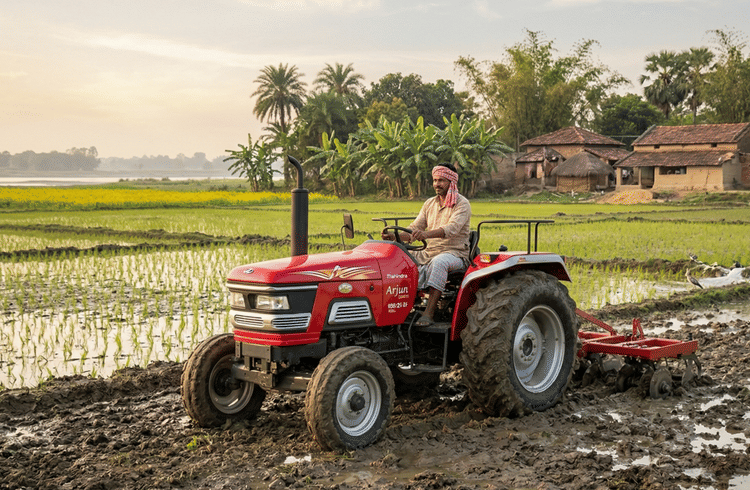
Few years in recent memory have brought together as many tailwinds for Indian tractor makers as fiscal 2026. An above-normal monsoon refilled rural cash flows. State governments in poll-bound Maharashtra and Bihar opened the subsidy taps. An unexpected cut in the Goods and Services Tax on tractors from 12 to 5 percent in late September lowered sticker prices overnight. And as the deadline for stricter TREM 5 emission norms drew closer, dealers and farmers pulled forward purchases they might otherwise have made later. By the close of March, the industry had sold more tractors than ever before.
Domestic wholesale dispatches are estimated to have risen by 23.47 percent to 11,60,231 units in FY26. Retail registrations tracked by FADA reached 10,50,077, up from 8,82,825 a year earlier. Both numbers are the highest the Indian tractor industry has recorded, and the first time wholesale volumes have crossed one million in a single fiscal year.
Mahindra & Mahindra retained its leadership by a wide margin. The group, which houses both the Mahindra and Swaraj brands, sold 5,05,930 tractors in the domestic market in FY26, a 24.28 percent rise over the previous year, lifting its wholesale share marginally to 43.61 percent. On the retail side, the Mahindra brand alone accounted for 23.81 percent of registrations and Swaraj for another 18.76 percent. In its April 1 statement, Veejay Nakra, president of Mahindra's Farm Equipment Business, said the company "ended FY26 with highest ever sales of 5,05,930 registering growth of 24%". He added that March alone delivered 43,403 units, a 33 percent jump "driven by the full Navratri season falling entirely in March'26, unlike last year when it was split between March and April".
The fastest gainer among the top six was CNH Industrial's New Holland, which expanded its wholesale volumes by 36.95 percent to 53,225 units and lifted its FADA-tracked retail sales by close to a third to 47,122 units. Speaking to Autocar Professional, Narinder Mittal, who heads CNH India, traced the year's outperformance to an effort that had begun nearly two years earlier, built on investments in network, brand and product. "Last year was a good year because of those actions we have taken," he said. The returns showed in the north. New Holland's market share in Punjab moved from around 11.5 to roughly 15 percent over the year, and in Haryana from about 6.5 to 9 percent. Mittal acknowledged that the September GST cut had caught the company off guard. "GST was something which was not expected," he said.
The Policy Tailwind
The single intervention that defined the year was GST 2.0, approved at the 56th Council meeting on September 3, 2025. The levy on tractors was cut from 12 to 5 percent with effect from September 22, lowering ex-showroom prices by ₹40,000 to ₹60,000 per unit depending on horsepower. The Council also reduced GST on tyres, tubes, hydraulic pumps and agricultural diesel engines from 18 to 5 percent, correcting a long-standing inverted duty structure.
Retail data tracked the change almost in real time. November 2025 was the industry's strongest month at around 1.26 lakh units, with December and January each holding at roughly 1.15 lakh.
Beyond GST, the fiscal backdrop was unusually supportive. The Union Budget for 2026-27 allocated ₹1,40,561 crore to the agriculture ministry. The Pradhan Mantri Kisan Samman Nidhi disbursed roughly ₹78,000 crore in four installments. The Sub-Mission on Agricultural Mechanisation continued to subsidise 40 percent of the cost of new equipment for general-category farmers and 50 percent for small, marginal, women and SC/ST buyers.
By January 2026, the Agriculture Infrastructure Fund had sanctioned ₹80,224 crore for over 1.5 lakh projects. Maharashtra's Mahayuti government ran the Namo Shetkari Mahasanman Nidhi, which adds ₹6,000 a year to PM-KISAN's ₹6,000, and committed ₹20,000 crore to a free-power scheme for irrigation pumps. Bihar, which went to the polls in November 2025, introduced a ₹3,000 state top-up to PM-KISAN that lifted the combined annual transfer for a Bihar farmer to ₹9,000, and offered subsidies of 40 to 80 percent on 91 categories of farm machinery. The pattern was clear in the sales data. "Maharashtra clearly outpaced pan-India growth by a decent margin," said Hemal Thakkar, senior director at CRISIL, attributing the gap partly to political factors.
The regional mix has shifted too. The northern belt still accounts for over a third of sales, but its growth has moderated relative to the rest of the country. The west was the strongest performer in FY26, taking nearly 40 percent of the market on year-on-year growth of up to 28 percent.
Trade policy added another layer. The India-UK Comprehensive Economic and Trade Agreement, signed in July 2025, grants 99 percent of Indian exports duty-free access to the British market from April 2026. The India-EU FTA was concluded on January 27, 2026, and the EFTA agreement with Switzerland, Norway, Iceland and Liechtenstein took effect on October 1, 2025, bringing with it a binding $100 billion investment commitment over 15 years. In early February, a reset with Washington lowered the effective US tariff on Indian goods from a stacked 50 to 18 percent, restoring competitiveness for exporters such as Mahindra and Sonalika after a bruising first half. Tractor exports are expected to cross 1 lakh units for the first time in FY26.
The looming implementation of TREM 5 shaped the second half of the year. The norms, comparable in scope to the BS-VI transition for passenger vehicles, will require diesel particulate filters and selective catalytic reduction systems on most tractor engines, and ICRA estimates this will add ₹1.5 lakh to ₹3 lakh to sticker prices once fully implemented. A draft notification from the Ministry of Road Transport and Highways has since proposed a phased rollout, starting with sub-25 HP and above-75 HP tractors in October 2026 and pushing the full norm for the dominant 25 to 75 HP segment to April 2032. Whether the prospect of those price increases pulled some FY27 demand into the closing months of FY26 remains contested. Thakkar is sceptical. "I don't think so," he said. "At the end of the day, the dealer knows the customer will come back to buy again in the future. Making a one-time push at the customer's expense is not a sustainable strategy for the dealer."
The Currents Beneath the Surge
The power profile of the Indian tractor market is shifting underneath these headline volumes. The 41-50 HP segment has grown from under half of all sales in FY19 to nearly two-thirds by FY26, largely at the expense of the 31-40 HP band. The 51 HP and above category has shrunk to a sliver. The industry appears to have settled on a band that suits both commercial haulage and the economics of custom hiring.
The first shift is the rise of non-farming use. Tractors are increasingly deployed for haulage, construction, sand mining and rural infrastructure work, and the share of commercially deployed units now varies, by various estimates, between 12 and 20 percent in normal years and considerably higher when rural construction activity is strong. An analyst who asked not to be named put the FY26 figure as high as 45 to 55 percent, citing the Vahan portal as the closest available source even though the absence of a separate commercial registration category for tractors makes precise measurement impossible.
Thakkar offers a more conservative band. "Whenever rural construction intensity is very high, commercial demand picks up," he said, noting that eastern states such as Bihar, West Bengal, Jharkhand and Odisha tend to have the highest commercial share. CNH's Mittal, too, said the company is "quite extensively working on the loader application" and on rig and trench-digging variants, with "a substantial improvement on these applications" expected this year.
The second shift concerns the land itself. The average operational landholding in India fell from 1.08 hectares in 2016-17 to 0.74 hectares in 2021-22, a product of inheritance laws, urbanisation and economic distress. On its face, this is a structural negative for an industry whose unit economics improve with scale. "Structurally, it should impact the industry negatively, because smaller farmland sizes reduce affordability," Thakkar said. The industry has so far defied that logic by moving up the horsepower curve, as labour shortages make mechanisation indispensable and as land consolidation through custom hiring offsets the fragmentation of ownership.
That brings the third trend into view. Custom Hiring Centres, which rent machinery to farmers who cannot justify the capital cost of ownership, have proliferated to 75,915 across India as of 2025, according to a recent review in the Asian Journal of Current Research. Punjab leads with 11,148 centres, followed by Andhra Pradesh and Haryana. Studies cited in the review suggest hiring through a CHC cuts the cost of cultivation by around 15.71 percent compared with private rentals and lifts net returns by 24 percent.
Financing remains the most reliable underpinning of demand. Roughly 95 percent of tractors sold in India are bought on credit, and 125 basis points of policy rate cuts delivered by the Reserve Bank in 2025 lowered borrowing costs for rural buyers.
Replacement demand, muted in 2023-24 because the cohort of tractors coming up for replacement was small, has also turned supportive. "The base coming up for replacement is from 2018-2019, which were strong years for the industry," Thakkar said, adding that a typical owner replaces a tractor every five to nine years.
Whether FY26 marks a new floor for the industry or an aberration will hinge largely on the rains. ICRA expects domestic tractor volumes to grow at a more modest 1 to 4 percent in FY27, citing the high base, the probability of an El Niño event, and the demand hangover after the GST-fuelled rush of the second half. CRISIL strikes a similar tone. "On a very high base, 20 percent plus for FY26, growth will be very muted. We will be happy if the industry grows at even a marginal single-digit level," Thakkar said. He flagged two specific risks for the year ahead. The first is the timely availability of fertilisers, made uncertain by the West Asia conflict, since a delay in supply during the sowing season directly impairs production. The second is the IMD's forecast of subpar rainfall, which in his view "could bring the industry down" if it materialises.
Even a flat year would leave the industry within striking distance of the run rate it touched in FY26. As one analyst, who requested anonymity, observed, "We have reached sales of 1,156,000 units, the highest ever recorded. Even if we are able to maintain around 1,127,000 units, that is still a very big number." The million-unit mark, in other words, may have begun to look less like a ceiling and more like a baseline.

RELATED ARTICLES

September a Mega Month for Scooter Industry with Highest Monthly Sales of 995,576 Units
 Ajit Dalvi
 15 Oct 2026
Scooter makers in India opened the festive season with record monthly dispatches of nearly one million units including 1...


Tesla Sales in India Cross 1,000 Units, 550 Model Ys Delivered Since July
Ajit Dalvi
03 Oct 2026
American EV maker clocks retail sales milestone with a stellar performance in September when it sold 291 units to outsel...

Tata, Vinfast, Kia, Toyota, Tesla Clock Best-Ever EV Sales in Record-Setting September
Ajit Dalvi
02 Oct 2026
Retail sales of electric passenger vehicles hit a new monthly high of 35,995 units in September. While market leader Tat...