



 Follow us
Tractor Dispatches Fall 18% as Retail Rises 14%, With Monsoon Risk Ahead
Mahindra & Mahindra accounted for 55.6 percent of the industry’s 26,513-unit decline. A monsoon nearly 13 percent below normal and concerns over El Niño leave the outlook for rural demand uncertain.
 By Anurag Chaturvedi
 1 Views


Tractor makers are entering the festive season after a monsoon that ended about 13 percent below normal, according to India Meteorological Department (IMD) data. Concerns about a strong El Niño raise the risk of further pressure on rural demand.
September sales offer a mixed first read. Tractor makers shipped 18.1 percent fewer units to dealers than a year earlier, yet buyers kept registering them at a faster pace. Dispatches fell to 1,19,667 units, while retail registrations rose 13.8 percent to 76,906 units, according to Federation of Automobile Dealers Associations (FADA) data.
A fall in dispatches alongside a rise in retail usually indicates an inventory correction, in which manufacturers cut shipments to match demand, rather than a drop in purchases. However, retail was not uniformly strong. Registrations fell 12.6 percent from August.
The year-on-year comparison also needs context. Last year's GST rate cut skewed the base, because some buyers deferred purchases ahead of the September 2025 transition. In addition, a later festive calendar this year complicates month-on-month comparisons. FADA cited both factors, along with uneven monsoon conditions, for the sequential fall in retail registrations.
The slowdown was already visible in August, when dispatch growth eased to 6.5 percent and retail registrations rose 0.8 percent.
Monsoon and El Niño risk
The effect on tractor demand depends on where and when the shortfall occurred, and on how it affects farm activity and the cash available for equipment purchases. Industry experts say the distribution of rain during sowing and crop growth matters more than the total shortfall.
Rice acreage is down about 3 percent, and yield reductions are expected to be sharper in the areas with the weakest rain. Cotton faces a third consecutive year of decline, with textile makers turning to cheaper imports because of domestic production costs. Coarse cereals such as jowar and bajra, and pulses, have fared better because they need less moisture and benefit from government procurement.
Even so, industry experts say structural changes in rural cash flows have cushioned demand relative to earlier drought cycles. Support now includes direct cash transfers, subsidised food grains, housing schemes and statutory social safety nets. The 16th Finance Commission reported that more than ₹4.17 lakh crore a year now goes directly to rural households across 17 states without conditions.
Non-crop agriculture, covering dairy, poultry and fisheries, has also grown faster than crops, at more than 6 percent a year against 3 percent to 4 percent. As a result, experts say, a deficient monsoon has a less immediate effect on rural spending than it once did.
State registrations
State registration data shows how uneven the effect has been.
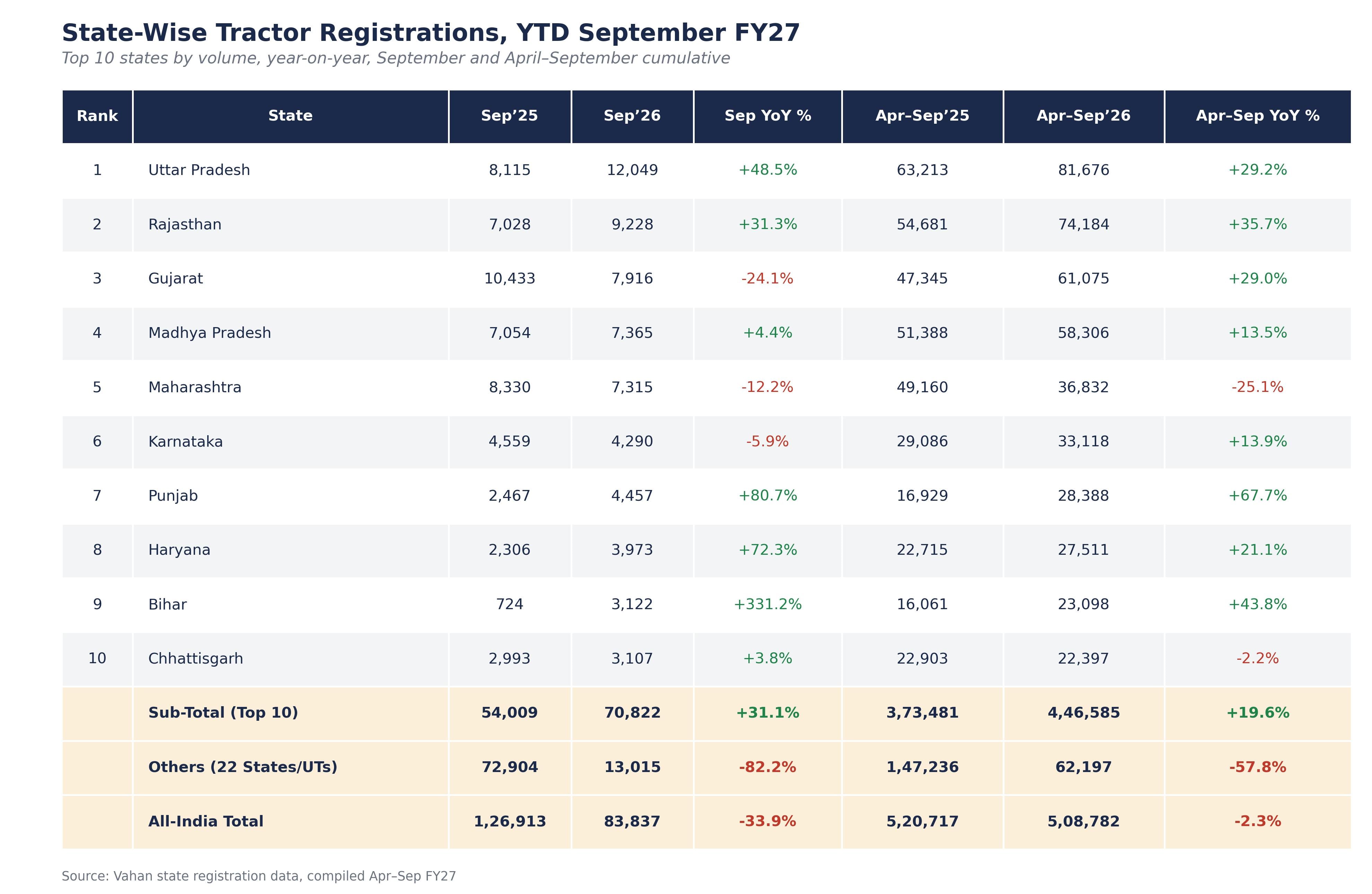
Gujarat shows how a single month can mislead. Registrations there fell 24.1 percent year-on-year in September but rose 29 percent across April to September.
Maharashtra presents a different picture. Registrations fell 12.2 percent in September and 25.1 percent in the six months to September, a decline consistent with the state's patchier rainfall this year. The state government has declared drought, put loan recoveries on hold and raised the farm loan waiver limit fourfold, from ₹50,000 to ₹2 lakh.
Punjab and Haryana, which depend more on canal irrigation than on the monsoon, grew in both periods. Registrations in the six months to September rose 67.7 percent in Punjab and 21.1 percent in Haryana.
Regional exposure also varies. Industry research points to South India's vulnerability to climate volatility, where dry spells alternate with localised flooding, weighing on tractor demand in Karnataka and Telangana. In contrast, Uttar Pradesh has been supported by better rainfall distribution and government spending ahead of the state election. Manufacturers more exposed to the weaker states could therefore see a different sales trajectory from rivals with a wider geographic footprint.
Dispatches by manufacturer
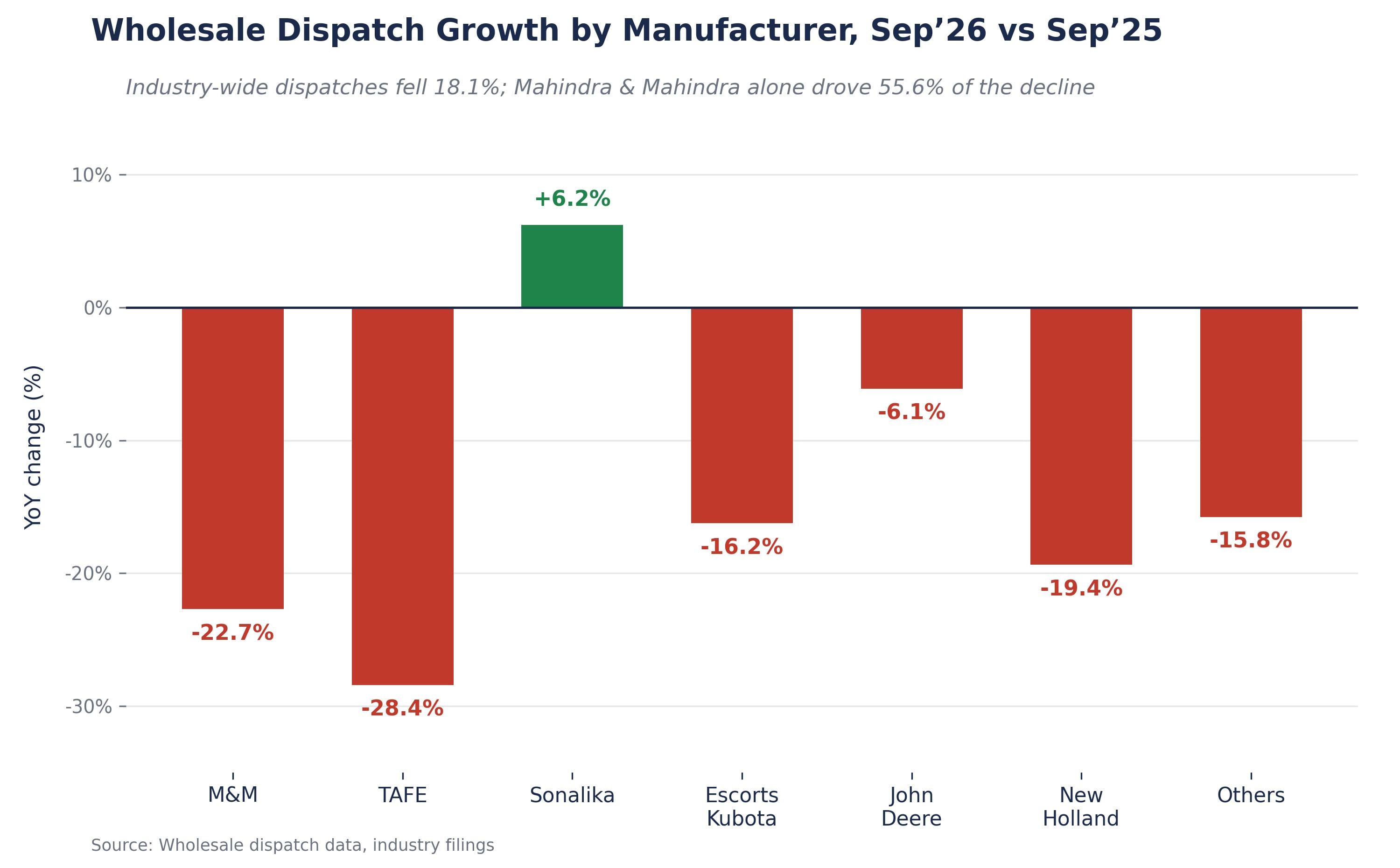
The September decline was concentrated in the market leader. Mahindra & Mahindra's dispatches fell 22.7 percent to 50,208 units, according to Tractor Junction data, accounting for 55.6 percent of the industry's 26,513-unit decline.
Sonalika, by contrast, was the only major manufacturer to add volume, up 6.2 percent to 19,086 units. Its market share rose 3.66 percentage points, the largest gain of any player in the data.
Among the other large makers, TAFE recorded the steepest percentage decline, down 28.4 percent to 19,711 units. Escorts Kubota fell 16.2 percent to 14,911 units and New Holland fell 19.4 percent to 5,504 units. John Deere fell 6.1 percent to 8,676 units, the smallest decline among the large players, and its market share rose 0.93 percentage points.
The smaller makers (Captain Tractors, Indo Farm, Preet, VST Tractors, Ace Group and SAME Deutz-Fahr) together hold about 1.3 percent of the market. Their combined dispatches fell 15.8 percent.
Product mix and mechanisation
The product mix is also shifting. Tractors of 40 to 50 HP now account for 47 percent to 48 percent of domestic sales, industry sources said, as farmers favour heavier implements.
Beyond tractors, CNH Industrial, the parent of New Holland, says mechanisation remains low in some specialised segments. Narinder Mittal, managing director of CNH Industrial India, told Autocar Professional that sugarcane harvesting mechanisation stands at 4 percent to 6 percent nationwide, even though Uttar Pradesh accounts for 40 percent of national production. Baler adoption is 2 percent to 4 percent.
Costs add a separate pressure. Raw material prices have risen 6 percent to 7 percent amid geopolitical tensions in West Asia, and the benefit of last year's GST rate cut has now been absorbed. Because farmers' crop realisations have not kept pace with input prices, manufacturers are largely absorbing the higher costs rather than passing them on to customers, which is weighing on margins.
Rabi outlook and industry guidance
The full effect of the weak monsoon is likely to emerge over several quarters, analysts say, even if festive-season purchases offer short-term relief. Reservoir levels in key Rabi-producing states are below historical averages, according to the Central Water Commission (CWC), limiting the water available for winter crops.
Because Rabi crop proceeds help fund tractor purchases during the next land-preparation phase, lower yields could weigh on demand into Q1 FY28 (April to June), traditionally the industry's peak sales quarter.
CNH has given the clearest public guidance for the near term. "We see Q4 of this calendar year could be minus 5 percent to flat. This is the scenario we are looking at currently," Mittal said. "If the situation stays like this, then the industry might dip 5 percent to 10 percent in Q1 [CY2027]."
The industry is coming off a strong run. Domestic wholesale volumes grew 23.5 percent in FY26, according to ICRA, which expects growth to slow to between 1 percent and 4 percent in FY27.
Unless winter rains replenish reservoirs, demand could stay flat to lower for three consecutive quarters, from October 2026 to June 2027. In that case, full-year FY27 growth could settle toward the lower end of ICRA's range.

RELATED ARTICLES

Vinfast India sells 14,600 EVs since market entry 14 months ago
 Ajit Dalvi
 16 Oct 2026
Vietnamese EV maker, which entered India in September 2025, delivers noteworthy performance to be ranked fourth in the e...


Hyundai Creta Sales Surpass 1.5 Million Units, Exports Nearing 300,000 Units
Ajit Dalvi
15 Oct 2026
Launched on July 21, 2015, Hyundai’s as well as India’s best-selling midsize SUV offered with petrol, diesel and electri...

Mahindra XUV 3XO crosses 500,000 sales ahead of new CNG model launch
Ajit Dalvi
14 Oct 2026
The XUV 3XO and its donor model, the XUV300, have surpassed half-a-million wholesales seven-and-a-half years after the X...