Follow us
Simple Energy Sales Cross 10,000 Units This Year, Targets Family E-Scooter Market With New Wave
Having delivered 10,429 Simple One and One S Gen 2 e-scooters in the January-August period, Simple Energy has entered the high-volume family scooter segment with its most affordable product, the Wave. Will the Wave, which pushes the scooter space envelope and goes head-to-head with the Ather Konarc, Bajaj Chetak, TVS iQube and Hero Vida, make waves in the e-2W market?
 7520 Views


Simple Energy, which has been a regular in the monthly Top 10 electric 2W OEM listing since February2026 with its Simple One performance e-scooter, has clockedcumulative sales of 10,000 units in the first eight months of this year. As per Vahan, between January and August, the Bengaluru-based EV startup registered retail sales (deliveries to customers) of 10,429 units, which is a 203% YoY increase (January-August 2025: 3,436 units).
This momentum comes just as Simple Energy launched its most affordable scooter yet – the Wave – priced at Rs 110,000 (ex-showroom) and also marked its entry into the high-volume family scooter segment, thereby expanding its portfolio beyond its performance-focussed e-scooters, the Simple One, One S and Ultra.
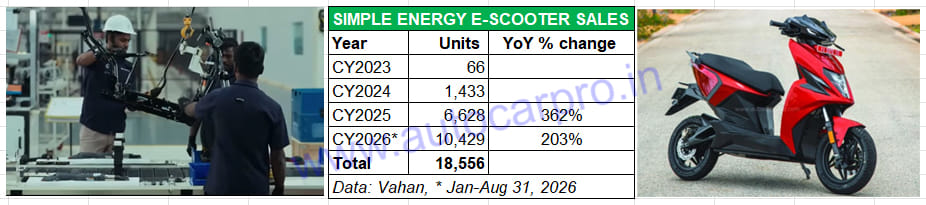 Growing demand for the Gen 2 Simple One and One S this year has seen the Bengaluru-based EV startup deliver 10,429 units in January-August, up 203% on the 3,436 units in the year-ago period.
Simple Energy’s cumulative retails from June 2023, when it launched the Simple One, till August 2026 are 18,556 units. Priced from Rs 160,000 for the Simple One to Rs 195,000 (ex-showroom) for the Simple One S Gen 2 model, the e-scooter is designed for efficient and eco-friendly rides and delivers a claimed battery range of 248km per charge.The Simple One is available in two battery packs – 4.5kWh and a larger 5kWh battery. In February 2026, the company introduced two new riding modes in the Simple One S Gen 2 model — Eco X and Sonic X — taking the total to six: Eco X, Eco, Ride, Air, Sonic and Sonic X.
There is also the Simple Ultra, launched in April this year and priced at Rs 235,000 (ex-showroom) albeit deliveries have yet to commence. Powered by a 6.5kWh battery and offering an IDC range of 400 km, the Ultra has a top speed of 115kph and accelerates from 0 to 40kph in 2.77 seconds
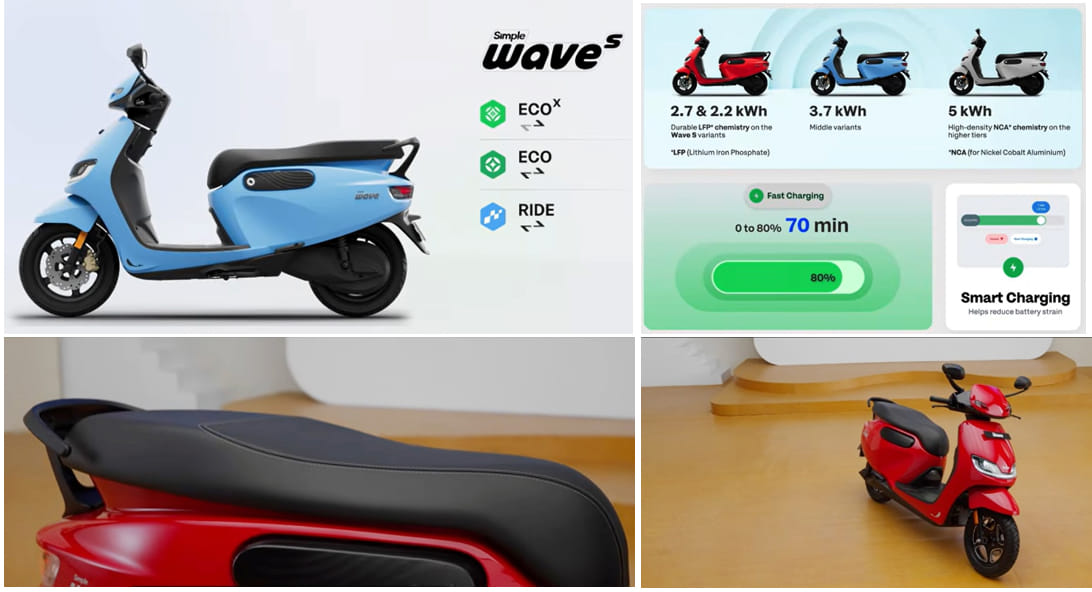
Clockwise from top left: While Wave S variants get 3 ride modes, the Wave and Wave + have an additional Sports mode to increase top speed to 90kph; Simple Energy claims a 0-80%fast charge will take an hour and 10 minutes; Wave’s 920mm seat is the longest on a 2W in India.
Simple Wave Targets Demand In High-Volume, Family Scooter Market
With its new Wave, Simple Energy has strategically targeted the family e-scooter segment, which has been dominated by the TVS iQube, Bajaj Chetak and Hero Vida for the past couple of years, and recently saw a new rival in the Ather Konarc launched on August 29.
Compared to the more performance-based One, One S and Ultra models whose base variants are priced above Rs 160,000, the Simple Wave targets a much wider customer with its base Wave S 2.2 variant pricing (Rs 110,000 ex-showroom) as also the focus around everyday practicality, ride comfort, and usability across diverse rider demographics and age groups. Built on an updated Simple One platform, the Wave uses a twin-shock rear suspension instead of the One’s monoshock and sports a 920mm-long seat, claimed to be the longest on a 2-wheeler in India. The Wave also has 70 litres of storage space, comprising 63 litres in the under-seat compartment, 3 litres in the front apron cubby and 4 litres in a quick-access pocket on the left side of the rider’s seat (called Pill Storage). An identical pocket for the right side is offered as an accessory.
The Wave is available in four variants as per the battery capacity. The base Wave S is offered in two battery capacities: 2.2kWh (110km IDC range) and 2.7kWh (132Km IDC range). While the middle variant (Wave), has a 3.7kWh battery and 171km of IDC range, the top Wave + variant has a 5kWh battery and is claimed to go 243km on a single charge, offering the highest range in its segment. Compared to the One range, the Wave’s powertrain gets updates all over. Both the 6.4kW motor and the Battery Management System have been updated to the third generation, and the motor’s overall size has been reduced by 15 percent. As for charging, Simple claims a 0-80% charge will take two hours and 15 minutes, but that's likely for the 2.2kWh variant; charging times for the others are awaited. However, all variants get a 750W charger bundled as standard—right up there with the Chetak and it's something Simple deserves praise for.The Wave S variants get three ride modes (EcoX, Eco and Ride) and have a claimed top speed of 75kph. Wave and Wave + add an additional Sports mode and increase the top speed to 90kph.
Simple Energy plans to begin Wave deliveries to customers on September 25 when the festive season in India has commenced. In tandem with the Wave’s launch and expected market demand, the company states that it is scaling its manufacturing and retail footprint. The company, which currently has a production capacity of 3,000 units per month, has over 75 outlets across 63 cities in India including Bengaluru, Delhi, Patna, Nagpur, Bhopal, Agra, Goa, Vijayawada, Hyderabad, Visakhapatnam, Kochi, and Chennai.
For Simple Energy, whose highest monthly retails were in March 2026 (1,780 units), the new Wave gives it an opportunity to target the highest-selling sub-category in e-2Ws: the family scooter. The company, which was ranked e-2W OEM No. 13 in CY2025, entered the Top 10 e-2W listing for the first time in February 2026 and March, April, May, June, July and August and has consistently averaged ninth position.
Will the new Wave, which goes head-to-head with the just-launched Ather Konarc, Bajaj Chetak, TVS iQube and Hero Vida and has travel range as the trump card over its rivals, give the Bengaluru-based startup a new sales charge and push it up the ranks in the Top 10 listing each month? Watch this space for regular updates and sales analyses.

RELATED ARTICLES

Motorcycle OEMs clock second-highest H1 sales of 6.92 million, Hero and Honda up 12%, Bajaj down 7%
 Ajit Dalvi
 23 Oct 2026
Riding on best-ever monthly 1.41 million units in September, H1 FY2027’s 6.92 million are the next best after H1 FY2019’...


Maruti Suzuki’s SUV, MPV share of PV sales at 42% in H1 FY2027 with 455,692 units
Ajit Dalvi
21 Oct 2026
Utility vehicle market leader’s nine-model portfolio scales a new high for the first half of a fiscal and places it on t...

Scooter sales jump 29% to 4.86 million units in H1 FY2027, EV share grows to 20%
Ajit Dalvi
19 Oct 2026
With 26,585 scooters sold on each of the 183 days in April-September 2026, demand for scooters jumped 29% YoY in H1 FY20...