Follow us
AMP 2006-2016 falls short of some targets but overall it vrooms along
As the world economy sputtered in the aftermath of the economic slowdown, in India, the automotive sector recorded a positive CAGR for a three-period between FY2013 to FY2016.
 By Shobha Mathur
 16336 Views


With the Automotive Mission Plan 2006-16 (AMP) drawing to a close, it can be revealed that while it was chugging along nicely towards its targets, a change in growth trajectory in the last three years saw it missing a few.
As the world economy sputtered in the aftermath of the economic slowdown, in India, the automotive sector recorded a positive CAGR for a three-period between FY2013 to FY2016 of 1.2 percent for passenger vehicles and 5.8 percent for two-wheelers. However, the commercial vehicle segment posted de-growth of 5.9 percent while three-wheelers experienced 3-year negative growth of 0.4 percent in terms of domestic sales.
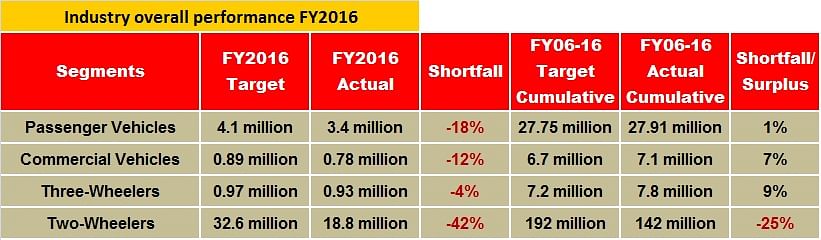
In terms of volumes, the most affected was the two-wheeler segment that faced a shortfall of 25 percent as actual volumes of two-wheelers in the closing year of the Plan fell short of the targeted 192 million with achieved figures being 142 million.
A year before its closing, SIAM had disclosed at its Annual Convention 2015 that AMP 2006-16 had achieved about 70 percent of its targets. Some of its key achievements were an incremental employment creation of 25 million jobs over the last 10 years. India had attracted a significant quantum of investments from global and local OEMs as well as component manufacturers exceeding the target of Rs 157,500 crore.
Prime mover in country’s growth
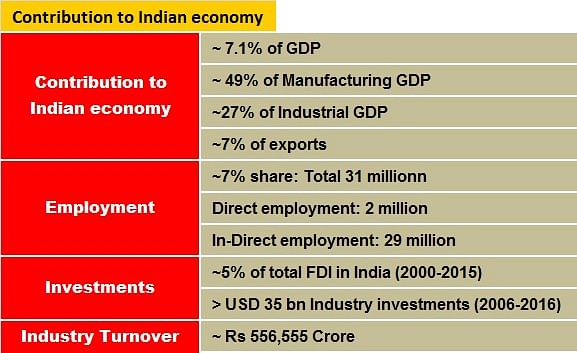
At the close of the Plan period, the industry has generated employment for 31 million with 2 million contributed by direct employment. The industry has invested $35 billion (Rs 221,095 crore) during the last decade and generates a turnover of Rs 556,555 crore.
Among the nodal interventions that are still in progress relate to incentivising modernisation of vehicle fleets, a proposal which has started moving within the government but is yet to see a formal legislation. Institutional and infrastructural structure for networking Regional Transport Offices through the IT backbone VAHAN project is being implemented by the Ministry of Road Transport and Highways. The draft notification leapfrogging to BS-VI norms by 2020 has been released recently. A boost has been granted to hybrid and electric vehicles through the FAME programme of the government and initiatives to set up 10 pilot centres for mandatory inspection and certification systems are expected by end-2016. A National Automotive Institute will also be set up to look at human resources training and ensure availability of trained manpower shortly.
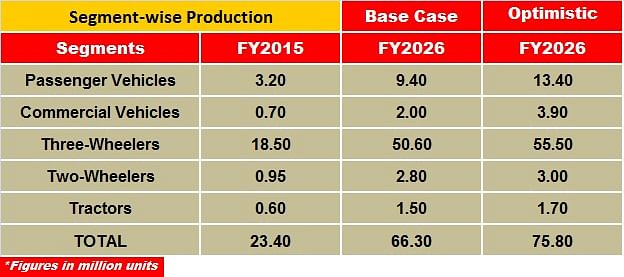
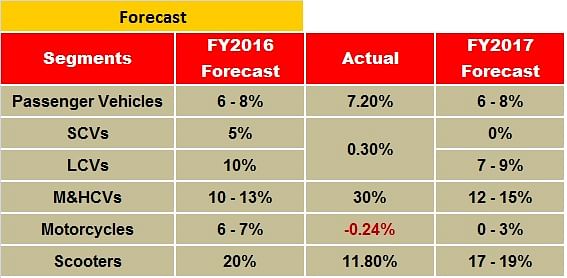
Meanwhile the new Automotive Mission Plan 2026 that envisions that by 2026 the Indian auto industry will be among the top three in the world in terms of engineering, manufacturing and export of vehicles as well as auto components and will encompass safe, efficient and environment friendly conditions for affordable mobility of people and transportation of goods in India is targeting a growth 3.5 to 4 times in value to about Rs 16,16,000 –Rs 18,88,500 crore by 2026. This will be based on a growth of 5.8 percent with an average GDP growth of 7.5 percent during this period.
This will be in line with global standards growing in value to over 12 percent of India’s GDP and generating an additional 65 million jobs. Currently, the auto sector accounts for 7.1 percent of the country’s GDP and 49 percent of the manufacturing GDP.
Recommneded:
- SIAM forecasts positive outlook for India auto sales in 2016-17

RELATED ARTICLES

TVS Motor: The New King of India's Electric 2-Wheeler Market
 Angitha Suresh
 11 Feb 2026
January 2026 sees TVS Motor solidify its position with 34,558 units Bajaj struggles to keep pace.


Electric PV Sales Stabilize after GST Hit
 Arunima Pal
11 Feb 2026
Arunima Pal
11 Feb 2026
Fresh FADA data shows January 2026 registrations surging 55% year-on-year, with Tata, JSW MG, and Mahindra all posting s...

Bajaj Chetak production plunges by 47% in July due to shortage of rare earth magnets
 Ajit Dalvi
14 Aug 2025
Ajit Dalvi
14 Aug 2025
Bajaj Auto manufactured 10,824 Chetaks last month, 9,560 fewer units than the 20,384 Chetaks produced in July 2024. As a...