



 Follow us
Right Target, Uneven Burden
Delhi’s EV policy targets the right vehicles; the data show who pays.
 18 Oct 2026
 1 Views
Share -
1 Views
Share -


The Delhi EV Policy 2026, is in force from 1 July 2026 to 31 March 2030, is the capital's most direct attempt to cut vehicular pollution. In 2025, Delhi's annual average PM2.5 level was 82.2 µg/m³, more than 16 times the WHO recommended guideline. Two-wheelers make up two-thirds of the city's vehicles and account for roughly a third of vehicular emissions.
On the incentive side, buyers of electric two-wheelers receive a purchase subsidy of ₹30,000 in the first year, which falls to ₹10,000 by the third year. Electric vehicles priced up to ₹30 lakh also pay no road tax or registration fee.
On the mandate side, From 1 January 2027, only electric three-wheelers and light goods vehicles can be newly registered. From 1 April 2028, the rule extends to two-wheelers. But private cars face no deadline, so the obligation to switch falls first on every day and commercial vehicles, not on costlier ones. The Govt has announced ₹15,000 crore Budget, aims for a 30 per cent electric fleet by 2030. The government aims that lower running costs will outweigh higher purchase prices, especially for gig workers.
FIGURE 1 Registration mandates by vehicle type, July 2026 to March 2030
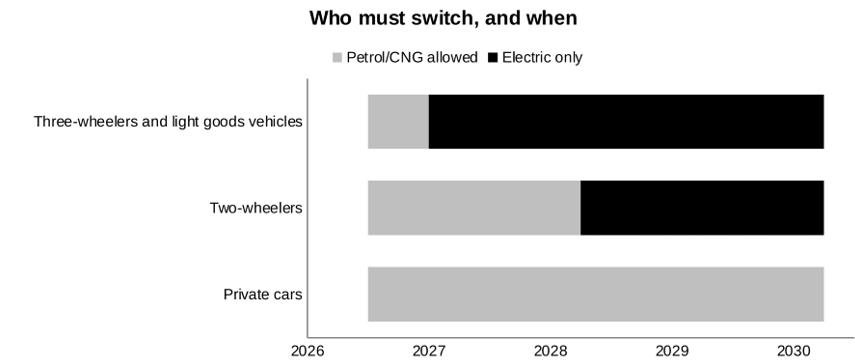
Source: Delhi EV Policy 2026, as reported by Outlook and Business Standard (July 2026). Chart: author
Potential Policy Issues
First, the incentives favor car buyers over scooter buyers. The buyer of a ₹30 lakh electric car saves up to ₹3 lakh in road tax and can claim ₹1 lakh for scrapping an old vehicle, about ₹4 lakh in all.
The buyer of a ₹1.2 lakh electric scooter can receive up to about ₹47,000 in the first year: a ₹30,000 subsidy, about ₹7,200 in waived road tax, and a ₹10,000 scrappage incentive conditional on a purchase within six months.
By the third year, when the mandate in enforceable, the subsidy shrinks to ₹10,000. This is counter-intuitive as, the largest benefits go to 2027 buyers who face no mandate; the smallest incentives go to those who buys in 2030 when the mandate and its legal implications take into effect.
FIGURE 2 Maximum state benefit per vehicle, by buyer
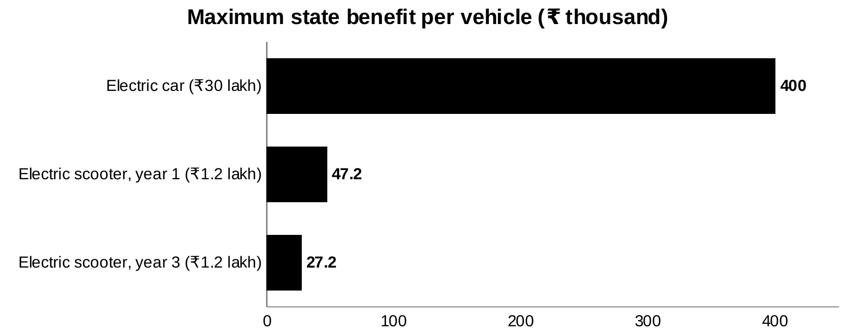
Note: Car benefit is road tax waived at 10 per cent plus ₹1 lakh scrappage incentive. Scooter benefit is subsidy, ₹10,000 scrappage incentive and road tax waived at 6 per cent. Registration fees excluded. Source: author's calculation from the Delhi EV Policy 2026 and Delhi road-tax slabs.
The charging capacity doesn’t meet the desired demand. Delhi, in January 2026, had 8,849 public charging points against an estimated requirement of 36,150. A full charge takes four to six hours at home, or about an hour with a fast charger.
Home charging is impractical for many of the 40 lakh users of tw0 and three wheelers, most of whom live in the 1700 unauthorized colonies. In these colonies do not have infrastructure, roads and charging networks to event park the vehicles, let alone a fire-proof charging point.
If 30 per cent of Delhi's 1.05 crore two-wheelers relied on public charging every other day, demand would reach about 15.8 lakh charges a day. Even 32,000 points running around the clock, would supply only about 7.7 lakh charges a day. This would strain the grid, increasing the risk of grid failure, specially during peak charging hours. In unregulated colonies, charging during peak hours, especially during peak summers when the air-conditioners are running increases the risk of major fire.
FIGURE 3 Estimated daily two-wheeler charging demand against public capacity
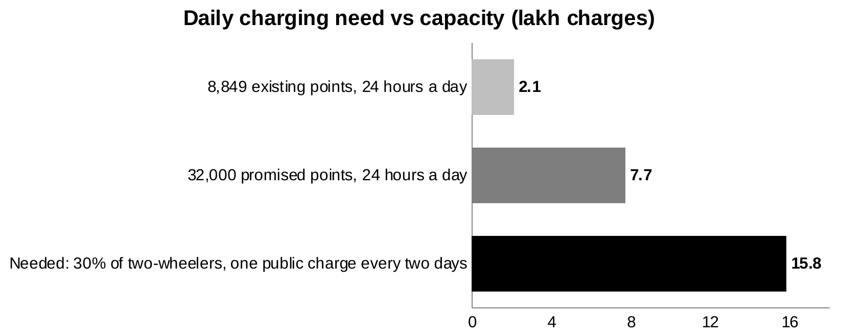
Note: Author's estimate. Assumes one hour per charge and all points used only by two-wheelers, so actual capacity is lower. Sources: Delhi government via Business Standard (January 2026); VAHAN; SEWA Bharat.
The 2014 study by Ram Singh Bora on Informal sector published in Modern Economy suggests that 7.2 % of the total employed workforce consist of automobile mechanics. These mechanics are not formally trained to handle the complexities and needs of an electric vehicle.
This could lead to other types of negative externalities in the forms of unemployment, poor service and maintenance and increase wastage of batteries and related pollution.
Potential Policy Solutions
On fairness, the two-wheeler subsidy could stay at ₹30,000 until the 2028 or beyond the year the policy kicks. Low-interest loans for delivery riders, like those the PM SVANidhi scheme offered to street vendors, could expand its mandate for gig riders and daily based commuters.
On skills, makers of subsidized models could be required to share diagnostic tools and spare parts with certified independent garages, supported by paid courses in repair markets such as Karol Bagh. On charging, licensing trained mechanics as charging and battery-swap operators would add capacity without new land and give them a new income. Cheaper night-time tariffs would ease the evening peak demand and usage, reducing the risk of grid load.
Government could also introduce grid surge fees to disincentivize the users from charging during peak hours. Delhi operates 474 delivery dark stores employing 80,000+ scooter riders. Require Zomato, Swiggy, and Flipkart to install 20 chargers per hub—9,500 points accessible during shifts, closing the infrastructure gap without public spending.
The policy targets the right segment. Its success will depend on whether the cost of the transition is shared in proportion to the ability to bear it.
Ankit Singh is a public policy Scholar at BML Munjal University. Dr. Anirudh Agrawal is a Professor and public policy researcher at BML Munjal University. All views expressed are the authors' own.

RELATED ARTICLES

Why India’s Multi-Fuel Future Needs Intelligent Infrastructure
 Autocar Professional Bureau
17 Oct 2026
Autocar Professional Bureau
17 Oct 2026
India’s transition to cleaner mobility is likely to involve petrol, diesel, CNG and electric power running in parallel, ...


Beyond the Dashboard: How Software Is Redefining the In-Vehicle Experience
Autocar Professional Bureau
11 Oct 2026
Automakers are shifting from hardware-led development cycles to continuous software delivery models, driven by rising co...

From Parking Lots to Power Hubs: How Real Estate Can Shape the Next Phase of EV Charging Infrastructure
Autocar Professional Bureau
04 Oct 2026
As EV adoption accelerates, real estate developers are integrating charging infrastructure into residential, commercial ...