Follow us
Tata and M&M Power Record Sales of Electric Cars, Suvs in May Amid Petrol-Diesel-CNG Price Hikes
With e-PV market leader Tata Motors surpassing 10,000 units for the first time and Mahindra & Mahindra scaling a new high of 6,133 units, retail sales soared to a record 26,221 units with 80% YoY growth in May. Luxury car and SUV OEMs also clocked best-ever retails in a month which saw multiple petrol, diesel and CNG price hikes.
 11538 Views


Demand for electric passenger vehicles (e-PV) soared to a new monthly high of over 26,000 units in May 2026, propelled by the four price hikes for petrol and diesel and two for CNG last month. As per the retail sales data on the Vahan portal (as of June 1, 6 am), the 17 e-PV manufacturers delivered 26,221 zero-emission hatchbacks, sedans, SUVs and MPVs to customers last month, registering stellar 80% YoY growth (May 2025: 14,580 units). This number is expected to increase by another 1,500-2,000 units once all new EV registrations from RTOs nationwide are factored in.
May 2026 is the fourth month in this year to register over 20,000 sales and beats the previous best of 25,250 units in April 2026. In fact, it is only the sixth instance of the e-PV industry crossing 20,000-unit sales after August 2025 (20,202 units), October 2025 (20,975 units), January 2026 (21,399 units), March 2026 (24,635 units) and April 2026 (25,250 units).
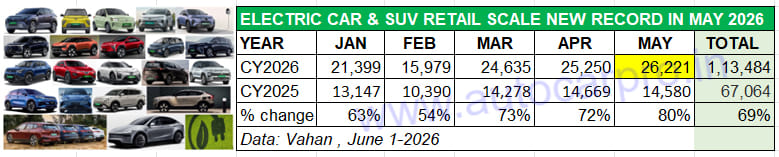 May 2026 (26,221 units) sets a new benchmark for India e-PV Inc. While 10,304 units were sold in the first half, 15,917 units were sold in the May 16-31 period, which saw petrol-diesel-CNG price hikes.
The second fortnight of May saw oil marketing companies implement four hikes in petrol and diesel prices in a span of 10 days, starting May 15. In Mumbai, petrol (priced at Rs 104.21 on May 14) became costlier by Rs 7 and 7% to Rs 111.21 a litre. Diesel took a bigger hit – at Rs 97.83 a litre, it turned Rs 7.82 and 8.68% costlier (Rs 90.01 on May 14). CNG rates too have been hiked, albeit the rise is more muted – at Rs 86 per kg, CNG price has risen by 6% over the Rs 81 in April 2026.
A quick look at the Vahan-sourced retail sales data for the first half of May and the second half reveals just how strongly the market has reacted. While the May 1-15 period saw a total of 10,304 e-PVs sold, the May 16-31 period saw deliveries of 15,917 units. Percentage-wise, this works to 39% in the first-half and 61% in the second-half of the month.
The surge in demand was powered by the top two players – Tata Motors and Mahindra & Mahindra – both registering their highest monthly retail sales yet, even as a few other players from the 17-member e-PV segment also posted their best-ever numbers. Let’s take a closer look at their performance in a month which sets the tone for a record FY2027.
Market leader Tata Motors, which launched the new MY2026 Tiago EV on May 28 at a very aggressive starting price of Rs 699,000 with the same 19.2kWh (226km range) and 24kWh (285km range) battery options, had an outstanding month of sales. The car and SUV manufacturer delivered a record 10,231 EVs, up 102% YoY (May 2025: 5,068 units) to achieve the 10,000-units monthly retail milestone for the first time. As a result, Tata Motors’ market share grew to 39%, up from the 35% it had in May 2025.
The new Tiago EV’s launch comes on the back of the rollout of the new Punch EV in February this year. Both these hatchbacks have a large percentage of first-time EV buyers albeit the new Tiago EV is expected to draw new buyers transiting from ICE hatchbacks, particularly in the wake of the recent petrol-diesel price hikes.
While the Harrier EV has helped revive demand, the Nexon EV continues to rule the company’s sales chart. The Curvv coupe-SUV, however, is yet to achieve proper sales traction for Tata Motors, whose EV portfolio also includes the Tigor (XPres-T). The company, which clocked record retails of 85,470 EVs in FY2026, had seen its e-PV market share drop to 39% last fiscal from 53% in FY2025. That’s mainly due to the rapid advance of JSW MG Motor India and Mahindra & Mahindra, even as three new players – Maruti Suzuki India, Vinfast and Tesla – entered the market last fiscal. The MY2026 Tiago EV, which continues the brand’s draw of being the most affordable e-PV in India, should give Tata Motors plenty more ammo for higher sales and market share.
Mahindra & Mahindra, which is riding high on demand for its trio of Electric Origin SUVs – BE6, XEV 9e and XEV 9S – whose cumulative sales have crossed 65,000 units including 55,000 retails, has outsold JSW MG Motor India for the third straight month. In May, M&M delivered 6,133 e-SUVs to customers, crossing the 6,000-unit mark for the first time with robust 96% YoY growth (May 2025: 3,130 units). This gives it a 23% e-PV share, improving upon the 21% it had a year ago. May 2026 also marks M&M’s highest monthly EV score, beating the previous best of April 2026 (5,853 units).
While the BE 6 and XEV 9e, launched 15 months ago, continue to see demand, the XEV 9S, M&M’s first three-row, born-electric SUV launched last November, has given M&M a new charge. The XEV 9S, which has battery options spanning 59 kWh, 70 kWh and 79 kWh, slots above the XEV 9e and BE 6, both of which are two-row EVs.
JSW MG Motor India, now pushed to the No. 3 position on the e-PV podium, sold 4,936 units last month, up 7% YoY (May 2025: 4,594 units). This gives it an 19% e-PV market share in May 2026, substantially down from the 31% it had in May 2025. The game-changing Windsor EV remains its best-selling product from a portfolio which includes the M9 MPV, Cyberster roadster, ZS EV and Comet EV.
Maruti Suzuki India, which surpassed deliveries of 1,000 units for the first time in April, is among the e-PV OEMs to hit a new high with deliveries of 1,577 e-Vitara SUVs, which gives it a market share of 6% and the fourth rank in May. It is understood that due to production constraints, the company has allocated between 2,000-2,500 units for the domestic with far more for exports. In fact, the e-Vitara (25,549 units) was the fifth most-exported SUV in FY2026 after the Maruti Fronx (90,186 units), Jimny (72,209 units), Nissan Magnite (56,704 units) and the Toyota Hyryder (38,854 units).
Vinfast India, the local arm of Vietnamese EV major Vinfast, registered its second-highest monthly sales since its market entry last year. It is ranked fifth amongst the 17 e-PV OEMs with 1,224 units which give it a 5% e-PV share. Vinfast’s May sales though are 5% lower than the 1,288 units it sold in April 2026. Vinfast began deliveries of the locally assembled VF6 and VF7 e-SUVs in October 2025, followed more recently by the VF MPV7 which is claimed to deliver 517km range on a full charge.
Vinfast will be looking to achieve higher sales traction when it launches the VF5 hatchback, which is likely to go head-to-head against the Tata Tiago EV or Punch EV, depending upon its specifications.
Sixth-ranked BYD India, the local division of China’s BYD, also scaled a new high in May with 683 units, up 28% YoY (May 2025: 533 units). Its previous best was in October 2025 (615 units). On May 1, the company increased prices across its EV portfolio by Rs 50,000 to Rs 100,000 covering the Atto 3 SUV, e-Max 7 MPV, Seal sedan and Sealion 7 SUV. Current ex-showroom prices start from Rs 24.99 lakh for the entry level Atto 3 through to Rs 49.40 lakh for the top-spec Sealion 7. The company has announced a further hike, expected to range between 1-2%, from July 1 which is possibly why there was a surge in sales last month.
Hyundai Motor India, which continues to feel the heat of the intense competition in the e-SUV market, sold 454 EVs, down 37% YoY (May 2025: 719 units). The company, whose e-PV share is down to less than 2% from 5% a year ago, continues to see tepid demand for its main product – the Creta EV – and the Ioniq 5.
Kia India , with 345 units, up 741% on a low year-ago base of just 41 units, is ranked ninth on the e-PV ladderboard. Following the launch of the mass-market Carens Clavis EV MPV, which joined the far more expensive EV6 and EV9 imported as CBUs, Kia had seen its monthly numbers improve last year. However, after having posted strong sales last August (465 units), September (530 units), October (681 units), November (480 units), demand has dropped in CY2026: January (397 units), February (368 units), March (512 units), and April (401 units).
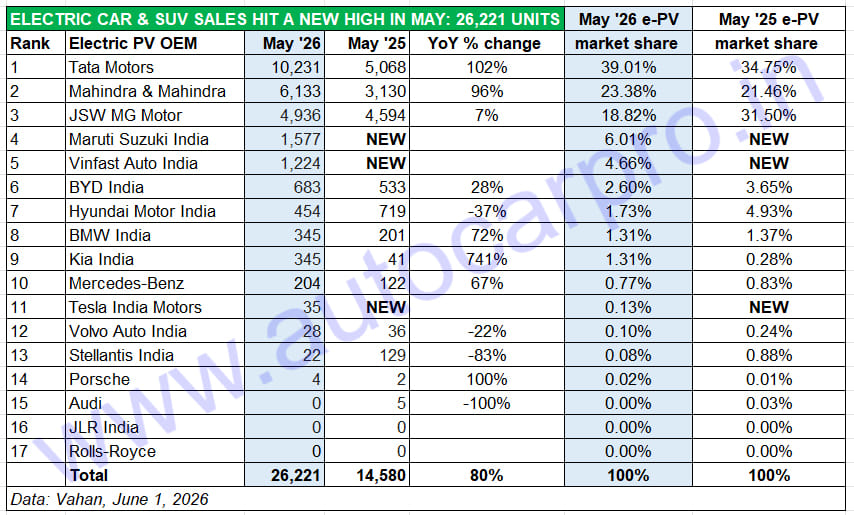 The top three OEMs – Tata Motors, M&M and JSW MG Motor – between them accounted for 81% of the record 26,221 electric cars and SUVs sold in May 2026.
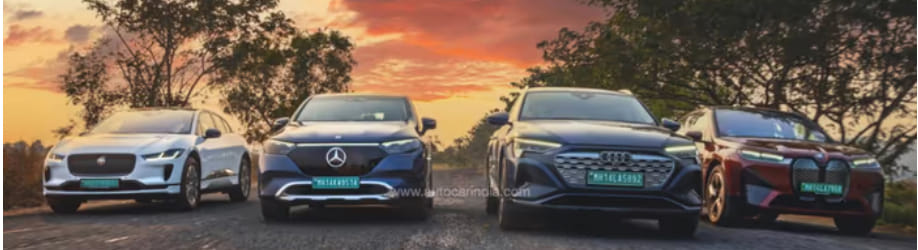
Luxury Carmakers Register Record Sales of Over 600 Units in May
In tandem with the mass-market electric car and SUV OEMs, demand for luxury cars, SUVs and sedans also registered handsome growth last month. In May 2026, total retail sales of the eight OEMs in this sub-segment were 616 units, up 68% YoY (May 2025: 366 units). This strong performance was driven by the top two OEMs – BMW and Mercedes-Benz.
BMW India, which topped the luxury e-PV category in FY2026 with a record 3,898 e-PVs and is ranked No. 8 amongst the 17 e-PV OEMs in May, maintained its No. 1 status with 345 units, up 72% YoY (May 2025: 201 units), which gives it a 56% share for last month. However, its May 2026 sales are still below what the company sold in March 2026 (520 units).
Mercedes-Benz India, with 204 EVs sold last month, up 67% YoY (May 2025: 122 units) registered strong growth on the back of the launch of the CLA electric sedan in end-April priced from Rs 55 lakh to Rs 59 lakh (ex-showroom). Based on the Mercedes-Benz Modular Architecture (MMA) EV-first platform, the CLA EV replaces the combustion-powered A Class sedan, plus the EQA and EQB electric SUVs in India. This technology-led model built on a new dedicated EV architecture with an 800-volt system and the brand’s latest MB.OS operating system serves as a foundation for a new generation of software-defined vehicles in the company’s global portfolio.
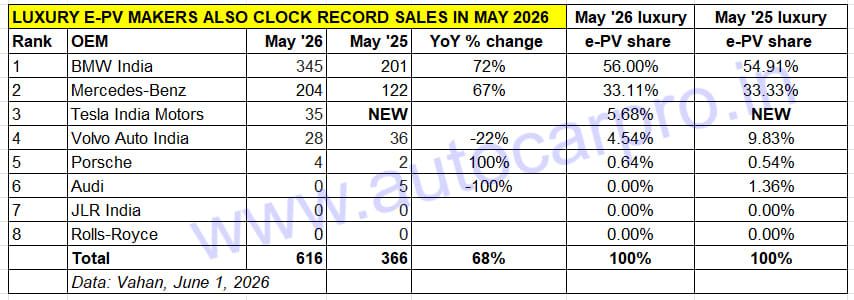 BMW maintained its strong lead in the luxury electric car and SUV segment with 345 units and a 56% share. Mercedes-Benz also registered strong sales of 204 units, up 67% YoY for a 33% share.
Meanwhile, Tesla, which expanded its portfolio in India with the extended-wheelbase six-seater Model Y L, sold 35 units last month. This takes its cumulative sales in the past nine months to 424 units, far lower than what was expected from the American EV maker. In an effort to draw more buyers to its first product in India – the Model Y e-SUV – Tesla India has slashed this e-SUV’s price to Rs 50.89 lakh (ex-showroom), down by Rs 900,000. The Model Y Premium AWD variant, which had a price sticker of Rs 61.99 lakh, has been discontinued and leaves the Model Y Premium RWD as the sole variant. It remains to be seen if this strategy clicks in one of the world’s most price-sensitive automobile markets. Tesla India’s highest monthly sales to date have been 69 units in September and December last year.
Volvo India, which hiked the prices of its products by up to Rs 100,000 from May 1, citing ongoing global supply-chain challenges and fluctuations in foreign exchange rates, sold 28 units in May 2026, down 22% YoY (May 2025: 36 units).
German sports car maker Porsche sold 4 units last month, twice the number it sold in May 2025. The remaining three other luxury carmakers – Audi, Rolls-Royce and JLR – did not sell a single EV last month, as per Vahan.
In terms of EV market penetration, the eight luxury EV OEMs had a 2.34% share of the 26,221 e-PV sold in May 2026 compared to 2.51% in May 2025. Over the past four fiscals, demand for luxury cars, SUVs and sedans has risen by 450% from 986 units in FY2023 to 5,450 units in FY2026. FY2027 looks set to drive in the same growth lane. In the first two months of the new fiscal year, sales have already crossed 1,100 units, which sets the foundation for a new fiscal-year high for luxury EVs.
Growth Outlook for Electric Passenger Vehicle Industry in FY2027
The shifting consumer and automobile market dynamics, as a result of the West Asia crude oil crisis and the resultant price hikes in petrol, diesel and CNG, could be likened to a GST 2.0-driven surge in demand for electric vehicles in India.
While the volume segment of electric 2-wheelers will, of course, lead the charge for the domestic EV industry, the electric 3-wheeler segment will also witness a good spike in demand this fiscal. The same can also be expected in the electric passenger vehicle segment. Given that combined retail sales in April and May 2026 have already surpassed 50,000 units, FY2027 should see e-PV sales cross the 300,000 milestone for the first time. This growth will be driven by new products, including new and affordable hatchbacks from Tata Motors, the ramp-up of manufacturing capacity by an aggressive Mahindra & Mahindra, which has unseated JSW MG Motor India from the No. 2 spot and a growing consumer shift from ICE to EVs. Meanwhile, Toyota Kirloskar Motor has also plugged into the market with the new Urban Cruiser Ebella, the first Toyota EV in India and a badge-engineered version of the Maruti e-Vitara. Stay firmly plugged into the India EV growth story as Autocar Professional brings you up-to-date on the latest action and numbers from the zero-emission vehicle marketplace.
ALSO READ:
World Environment Day Special: 9.1 Million EVs Sold In India In The Past 10 Years

RELATED ARTICLES

Hyundai Creta Sales Surpass 1.5 Million Units, Exports Nearing 300,000 Units
 Ajit Dalvi
 15 Oct 2026
Launched on July 21, 2015, Hyundai’s as well as India’s best-selling midsize SUV offered with petrol, diesel and electri...


Mahindra XUV 3XO crosses 500,000 sales ahead of new CNG model launch
Ajit Dalvi
14 Oct 2026
The XUV 3XO and its donor model, the XUV300, have surpassed half-a-million wholesales seven-and-a-half years after the X...

Q2 surge powers electric car, SUV sales past 192,000 units in first-half FY2027
Ajit Dalvi
13 Oct 2026
Four straight months of 32,000-plus retail sales including a record 36,904 units in September have boosted deliveries of...