Follow us
Maruti Suzuki Reports Modest 7.6% Revenue Growth in Q1 FY26
Net profit remained virtually flat at ₹3,792 cr compared to ₹3,760 cr in Q1 FY25, highlighting rising costs as the entry-level and hatchback segment continues to languish.
 By Autocar Professional Bureau
 3667 Views


Maruti Suzuki India Limited reported first quarter revenues of ₹38,605 cr for the period ended June 30, 2025, representing a 7.6% increase over the same quarter last year. However, net profit remained virtually flat at ₹3,792 cr compared to ₹3,760 cr in Q1 FY25, highlighting rising costs as the entry-level and hatchback segment continues to languish.
The country's largest carmaker by volume continues to face headwinds from declining demand in its traditional stronghold of entry-level cars and hatchbacks, and its growth rate has trailed those of SUV-focused competitors like Mahindra and Toyota, which have been posting growth rates of 15-20% annually.
Product sales for the June quarter stood at ₹36,624 cr, up 8.1% from ₹33,876 cr in in the corresponding quarter last year. However, sequential performance showed weakness, with sales declining 4.6% from ₹38,842 cr in Q4 FY25. Other operating revenues remained stable at ₹1,981 cr.
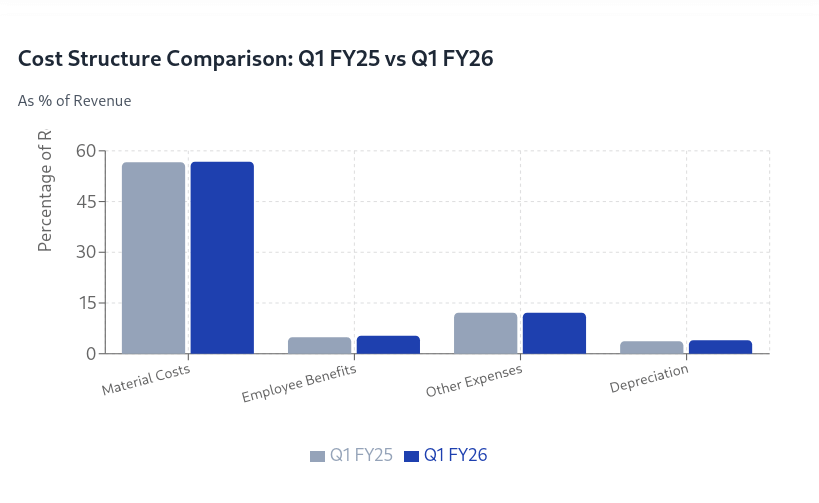
The pressure on profitability was evident across multiple cost categories. Material costs increased to ₹21,937 cr, representing 56.8% of revenues compared to 56.6% in the previous year. Employee benefit expenses rose to ₹2,048 cr from ₹1,758 cr, while other expenses climbed to ₹4,662 cr from ₹4,323 cr, reflecting higher marketing and distribution costs associated with the company's SUV push.
Profit before tax improved marginally to ₹49,435 million from ₹48,357 million, translating to a PBT margin of 12.8%. After accounting for tax expenses of ₹11,511 million, the company's net profit showed minimal growth of 0.9% year-over-year.
The financial results underscore the challenges Maruti faces in repositioning itself in the Indian automotive market. Maruti must overcome its budget-car image while establishing credibility in the higher-margin SUV segment. This brand perception challenge has resulted in lower pricing power and higher customer acquisition costs in the SUV market.
The company's purchases of stock-in-trade decreased to ₹57,038 million from ₹61,636 million in the previous quarter, indicating cautious inventory management as it navigates the product mix transition.
On the positive side, Maruti's financial health remains robust. Finance costs were minimal at ₹468 million, reflecting strong cash generation and low leverage. Other income surged 78% to ₹18,882 million from ₹10,605 million, providing some cushion against operating margin pressures. This increase suggests strong treasury management and higher cash reserves.
Depreciation and amortization expenses held steady at ₹15,560 million, indicating no major capacity additions during the quarter as the company focuses on maximizing utilization of existing assets.
The results come at a time when the Indian automotive market is experiencing a fundamental shift in consumer preferences. First-time car buyers are increasingly opting for used vehicles or two-wheelers, while those who can afford new cars are bypassing the small car segment entirely in favor of SUVs. Rising interest rates have further dampened demand in the budget segment, traditionally Maruti's core market.

RELATED ARTICLES

Suzuki Motorcycle India Launches Hayabusa Special Edition at Rs 19.90 Lakh
 Dev Vadchhedia
 28 Sep 2026
Suzuki's flagship superbike receives lighter lithium-ion battery, recalibrated electronic rider aids, and new dual-tone ...


Tata Motors Expands BaaS Across Entire EV Line-Up
Dev Vadchhedia
28 Sep 2026
Tata Motors introduces the scheme to its Nexon, Curvv, Sierra, and Harrier EVs.

Mahindra Plans Up To Rs 25,000 Cr Capex by FY2028 as ICRA Reaffirms AAA Rating
Dev Vadchhedia
28 Sep 2026
ICRA maintains stable outlook across Rs 1,150 crore debt facilities, as Mahindra considers greenfield facility in Nagpur...