

 Follow us
International study tour in India showcases EV battery innovation
The event was supported by NITI Aayog and organised by the Asia LEDS Partnership (ALP), with ICLEI South Asia acting as the ALP secretariat.
 By Autocar Professional Bureau
 3340 Views


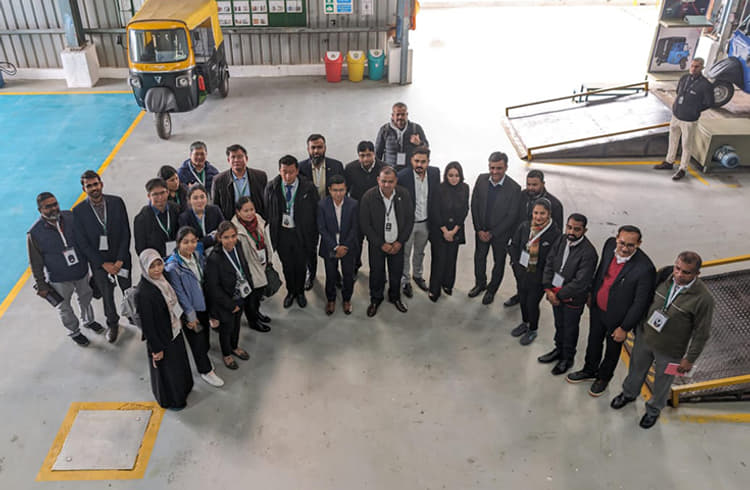
India hosted a first-of-its-kind international study tour for representatives from seven Asian countries this week (January 30 and 31), spotlighting its electric vehicle (EV) sector's advancements. This is the first time a number of Asian countries have visited India to learn about the expanding EV sector.
The tour comes on the heels of the Union government's budget announcement, aimed at expanding the EV sector. Delegates from Bangladesh, Bhutan, Indonesia, Sri Lanka, Philippines, Thailand, and Vietnam participated in this knowledge-sharing program, focusing on India's progress in EV manufacturing and battery innovation.
The event was supported by NITI Aayog and organised by the Asia LEDS Partnership (ALP), with ICLEI South Asia acting as the ALP secretariat. Sudhendu J. Sinha, Adviser at NITI Aayog, said, “There is a need for impactful awareness campaigns, support for technological advancements, and sustainable business models to scale EV implementation effectively.”
The delegates visited EV manufacturing facilities, including LOHUM in Greater Noida and Omega Seiki Mobility in Faridabad, understanding battery technology, manufacturing processes, and recycling. “Learning from developments in India offers valuable lessons that we can adapt and apply in Thailand," said Minta Poowatanavong from the Ministry of Energy, Thailand.
The study tour encouraged international collaboration on enhancing battery life and efficiency. “The practical, actionable insights and information gained underscores the importance of sharing experiences towards sustainable mobility across Asian nations,” said Prillya Agusti, from the Ministry of Transportation, Indonesia.
As of 2024, India's EV industry has made significant progress in manufacturing and global market penetration. The electric two-wheeler market, in particular, has shown resilience after initial disruptions caused by updates in the FAME-II subsidy scheme. The market is now stabilising with pricing close to non-subsidy levels, indicating a maturation phase, especially after the recent budget announcements.
"The adoption of EVs is extending beyond major urban areas, with a noticeable increase in uptake from tier-2 and tier-3 cities. In the realm of public transport, electric buses, three wheelers and two wheelers, are particularly gaining momentum, contributing substantially to reducing emissions,” said Emani Kumar, executive director, ICLEI South Asia.

RELATED ARTICLES

Petronet LNG and Gruner Renewable Energy Enter JV to Build CBG Plants
 Dev Vadchhedia
 22 Oct 2026
The State-run LNG importer signs binding term sheet for 50:50 joint venture to establish 10 compressed biogas units wort...


Rajratan Global Wire Q2 Net Profit Rises 17 Percent to Rs 24.14 Crore
Dev Vadchhedia
22 Oct 2026
The tyre bead wire maker records 26 percent revenue growth driven by export demand and operational turnaround at its Che...

Tata Passenger Electric Mobility Crosses 1,000 Fast-Charging Points Across India
Dev Vadchhedia
22 Oct 2026
Tata Motors-led EV network energizes 180 highway corridors and installs 40 MW of total charging capacity.