

 Follow us
Auto Component Industry Targets $200 Billion by FY30 – a 2.5x Jump in Four Years
ACMA's members are aiming at ₹17.6 lakh crore in turnover and $45 billion in exports by FY30, a pace well above the 17% a year just delivered.
 By Shruti Shiraguppi
 343 Views


India's auto component industry is aiming to more than double in size by FY30, targeting turnover of about $200 billion – roughly ₹17.6 lakh crore – against about $86 billion, or ₹7.6 lakh crore, in FY26. Exports are targeted at about $45 billion, up from about $24 billion.
The BCG-ACMA report Beyond Resilience is explicit that these are aspirations drawn from industry sources, and sets them apart from the independent market projections it cites for vehicle volumes. The distinction matters, because the two sets of numbers do not carry the same evidentiary weight.
On the volume side, the projections are relatively contained. Passenger vehicles are expected to grow from about 4.6 million units in FY26 to 5.4–5.8 million by FY30, a 4–6% annual pace. Two-wheelers are projected to move from about 21.7 million to 26–28 million, at 5–7%. Total annual vehicle production is expected to rise from about 30–35 million units in FY25 to 50–55 million by 2030, growing at 8–10% a year.
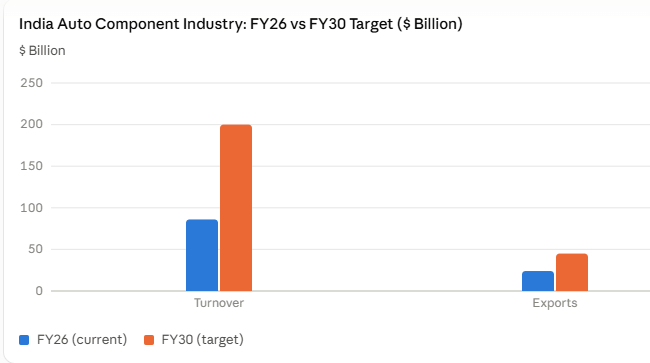
The turnover aspiration implies something considerably steeper. Going from ₹7.6 lakh crore to ₹17.6 lakh crore in four years works out to roughly 23% compound annual growth. In dollar terms the ratio is similar – $86 billion to $200 billion is about 2.3 times, or about 23.5% a year. That is six percentage points a year above the 17% the industry has just delivered over five years, and roughly double the 12% ten-year rate.
The report's own exhibit describes the move as approximately 2.5 times by FY30, which does not reconcile with the FY26 base of $86 billion. It reconciles closely with the FY25 base of about $81 billion, suggesting the multiple was framed against the earlier year. On that base the required pace rises to about 26% a year. The export target is the more grounded of the two: $24 billion to $45 billion is about 1.9 times, or roughly 17% a year – almost exactly the rate exports have compounded at over the last five years.
The gap between volume growth and value growth is where the ambition sits. If production rises about 1.6 times by 2030 while turnover rises about 2.3 times, the balance has to come from more value captured per vehicle and from a larger share of global demand. The report identifies six structural forces it expects to do that work: premiumisation, with SUVs moving from 23% of PV sales in FY19 to 55% in FY25; rising electronics content, projected globally to move from 30–35% of car cost in 2020 to 45–55% by 2030; safety, with ADAS penetration in new PVs rising from under 1% in 2021 to about 8% in 2025; electrification, with EV registrations across categories rising from about 0.14 million in FY21 to about 2.5 million in FY26; exports; and deeper localisation.
Electronics is the largest single gap between opportunity and current position. Electricals and electronics accounted for only about 12% of India's component supply in FY25, against a global cost share heading towards half a vehicle. Closing that – across sensors, ECUs, power electronics, ADAS, connectivity and battery management systems – is the most capital- and capability-intensive part of the FY30 arithmetic.

RELATED ARTICLES

JLR India to Launch Three Electric Range Rovers, Reintroduce Jaguar Next Year
 Anurag Chaturvedi
 20 Oct 2026
JLR's electric debut targets Indian luxury buyers who want battery power without giving up brand identity.


Chasing 'China-Like' Speed, European OEMs Are Handing Core Vehicle Realization to India
 Shahkar Abidi
20 Oct 2026
Shahkar Abidi
20 Oct 2026
Turnkey vehicle realization agreements take center stage with Indian tech engineering companies as Western OEMs under pr...

JLR India to Close Retail Gap with Rivals After Sales More than Double
Anurag Chaturvedi
20 Oct 2026
After three years without a new outlet, the luxury carmaker is taking its showrooms to more cities, with customer experi...