Follow us
India's Vehicle Stock to Double by 2050, EVs Cost-Competitive in Key Segments: CEEW
Without faster electrification and better infrastructure, diesel will remain the dominant road transport fuel into the 2040s, peaking around 2047, as per the CEEW studies.
 By Arunima Pal
 3495 Views


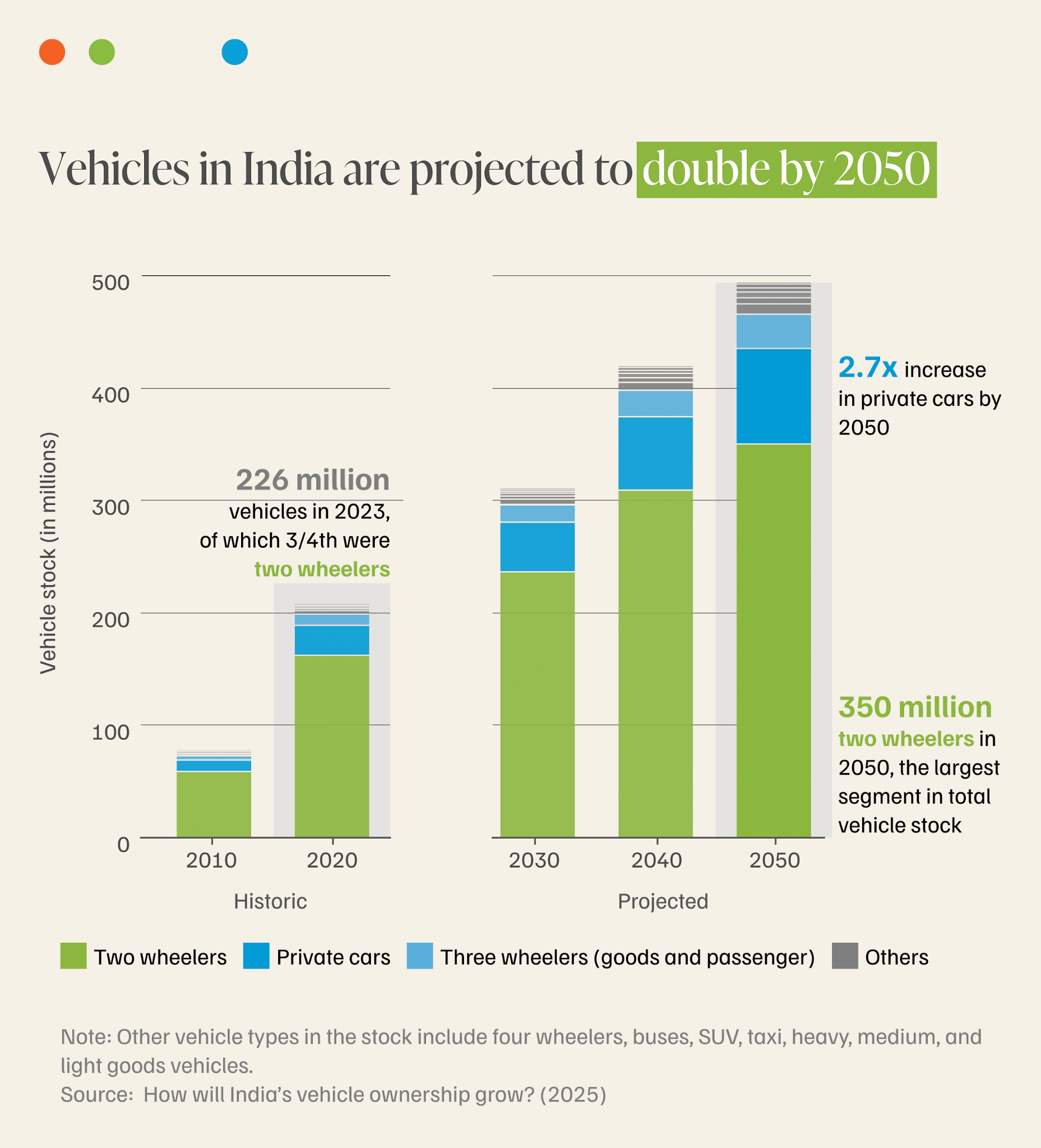
India's vehicle ownership will more than double from 226 million in 2023 to nearly 500 million by 2050, according to studies by the Council on Energy, Environment and Water (CEEW).
Two-wheelers will account for 70% of all vehicles by 2050, reaching over 350 million units. Private car ownership will triple to 90 million vehicles by mid-century, the studies said.
The research provides district-level projections of India's vehicle stock, ownership costs, and transport fuel demand. It predicts Uttar Pradesh will house over 90 million vehicles, while Bihar, Maharashtra, Madhya Pradesh, and Gujarat will see growth. Southern states will experience plateauing due to population trends.
Urban centers including Delhi, Bengaluru, Thane, Pune, and Ahmedabad will hold 10% of India's total vehicle stock in 2050.
Electric Vehicles Already Competitive
Electric vehicles are cost-competitive in two-wheelers, three-wheelers, taxis, and private cars in states with supportive policies, the studies found.
Electric two-wheelers cost Rs 1.48 per kilometer compared to Rs 2.46 for petrol models. Three-wheeler EVs cost Rs 1.28 per kilometer versus Rs 3.21 for petrol variants. Commercial taxis see savings with EVs due to daily operating costs.
For medium and heavy goods vehicles, EVs remain more expensive than diesel, CNG, or LNG. LNG will remain the cheapest option for buses and trucks until 2040.
Fuel Demand Projections
Without progress on electrification and infrastructure, diesel will dominate road transport energy demand into the 2040s. Diesel demand would peak by 2047 under current conditions, while petrol demand could peak around 2032.
Buses and trucks will generate nearly 70% of transport emissions in 2050 without intervention, requiring focus on LNG refueling stations and high-capacity EV charging infrastructure.
"India's road transport system is entering a phase where transition decisions impact fuel suppliers and auto manufacturers," said Hemant Mallya, Fellow at CEEW. "Understanding how vehicles grow, what fuels them, and ownership costs is needed for managing this transition."
Policy Recommendations
The studies recommend strengthening vehicle stock data through the VAHAN portal and bridging district-level information gaps. Battery financing models through public banks and NBFCs could improve EV affordability.
States should explore distance-based taxation as fuel tax revenues decline beyond the 2040s. Mapping parking access can identify households likely to adopt EVs for overnight charging.
"India's transport sector faces energy security, congestion, and emissions challenges," said Dr. Himani Jain, Senior Programme Lead at CEEW. "We need walkable, efficient, low-carbon urban transport systems."
The Transportation Fuel Forecasting Model (TFFM) enables district-level projections of vehicle stock and energy demand for manufacturers, fuel providers, and policymakers.
The studies examined GDP and population projections at district and state levels, with limitations including delays in census data and assumptions about charging infrastructure growth based on expert surveys.

RELATED ARTICLES

Ashok Leyland Evaluates EV Battery Project in Bhandara with up to Rs 15,000 Crore Outlay: TOI
 Dev Vadchhedia
 21 Sep 2026
Nitin Gadkari pitches Vidarbha's logistics and export infrastructure to automotive manufacturers.


Escorts Kubota Appoints Manish Sharma as President of Agri Business
Dev Vadchhedia
21 Sep 2026
Former Panasonic India head to lead tractors, agricultural solutions, spare parts, and service across domestic and globa...

Maruti Suzuki to Upgrade 31 ITIs to JIM Standards
 Kiran Murali
21 Sep 2026
Kiran Murali
21 Sep 2026
Carmaker commits close to Rs 100 crore over two years to expand Japanese manufacturing curriculum and modern training in...