Follow us
India's Passenger Vehicle Market Posts Record February, Sets Course for 5 Million Units in 2026
Domestic manufacturers Tata and Mahindra are reshaping the competitive order as SUVs account for over 80% of all volume growth and a GST cut adds structural momentum.
 By Autocar Professional Bureau
 2421 Views


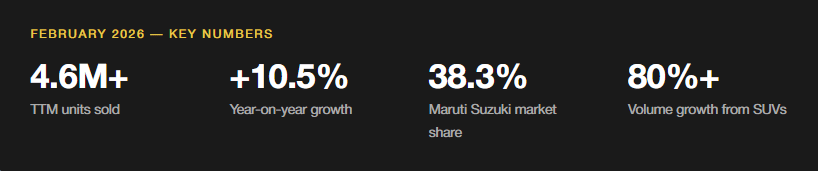
TTM Passenger Vehicle Sales India. February 2026 marks the highest-ever February volume on record. (Source: Autopunditz)
India's passenger vehicle market recorded its highest-ever February sales in 2026, with year-on-year growth of 10.5% pushing the Trailing 12 Month (TTM) total past 4.6 million units. The result extends a run of sustained monthly gains — October (+17%), November (+19%), December (+26%) and January (+13%) — that analysts say reflects a structural shift in demand rather than a short-term uptick.
At the current pace, the market is on course to breach 5 million annual units for the first time, a threshold that would mark a watershed in India's automotive history. The market crossed the 4 million mark relatively recently, making the trajectory of the past two years notable by any measure.
SUVs Account for Over 80% of Volume Growth
The shift in Indian consumer preferences toward sport utility vehicles, which has been building for nearly a decade, is now visible in the monthly data. In February 2026, SUVs contributed 32,325 incremental units compared to the prior year — more than 80% of total volume growth. Multi-utility vehicles (MUVs) added a further 9,045 units (+16.4%), and sedans contributed 5,474 units (+18.0%), aided by the new generation Maruti Suzuki Dzire.
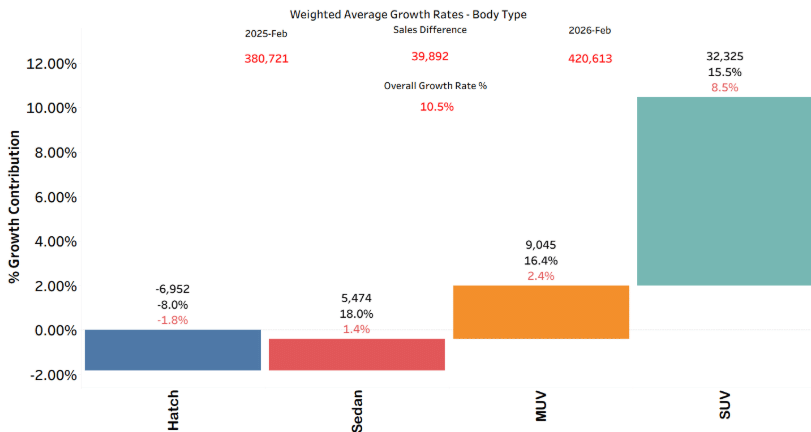 Incremental Volume Change by Body Type — February 2026 vs February 2025
The hatchback segment moved in the opposite direction, posting a decline of 6,952 units (-8.0%). Once anchored by the Wagon R and Swift, the category faces dual pressure: entry-level buyers are either upgrading to compact SUVs or, in urban markets, choosing two-wheelers as rising equated monthly instalments (EMIs) make four-wheel ownership less accessible. The direction of the data is unambiguous — India is now structurally an SUV market.
Tata and Mahindra Gain Ground on Maruti
Among manufacturers, Tata Motors recorded the highest growth rate of any volume original equipment manufacturer (OEM) in February, posting a 34.2% year-on-year increase. Mahindra followed with 19.0% growth. Both companies have introduced new-generation products over the past three years that have found traction across urban and semi-urban markets.
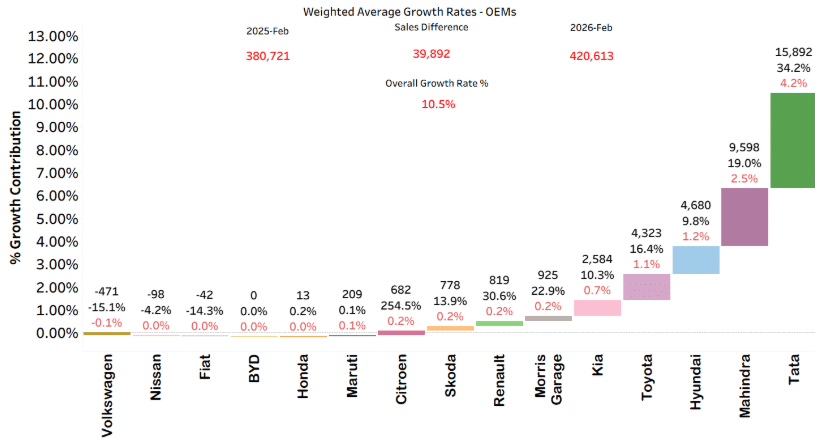 OEM-wise Year-on-Year Volume Growth — February 2026
Toyota maintained a growth rate of 16.4%, driven by the Fortuner, Innova Hycross and Urban Cruiser Taisor. Hyundai grew 9.8% and Kia 10.3%. Honda remained under pressure, declining 6.4% on a TTM basis, while Nissan continued a structural retreat with a TTM decline of 19.6%.
Maruti Suzuki retained its position as the market's largest player by a considerable margin, dispatching 1,61,000 units in February for a 38.3% market share. However, that share has compressed from 42.2% a year earlier — a four-percentage-point erosion over 12 months. The company grew just 0.1% year-on-year in the month, suggesting it is absorbing competitive pressure across multiple segments.
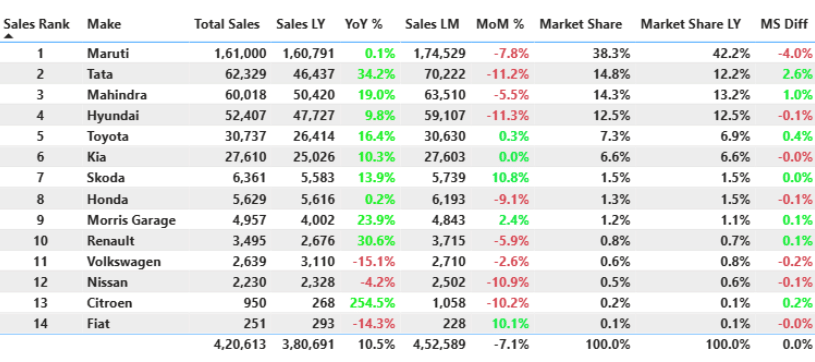 OEM Sales Rankings with YoY Growth, Market Share and MoM Change — February 2026
Tata Motors Crosses 600,000 in Annual Sales
On a trailing 12-month basis, Tata Motors crossed 600,000 units for the first time, up from 553,000 a year earlier — an addition of approximately 63,000 units of annualised run-rate in a single year. Over the same period, Hyundai's TTM tally declined from 598,000 to 581,000 units, illustrating the reversal of positions between the two brands.
The arrival of the Tata Sierra, Tata's flagship SUV, is expected to be a test of the brand's ability to sustain momentum in the upper segments of the market. If the model can hold 10,000–15,000 monthly units, Tata would add further pressure on Mahindra's TTM No. 2 position.
Top-Selling Models in February
The Tata Nexon led all models with 19,430 units, followed by the Maruti Suzuki Dzire at 19,326 units — its highest monthly showing in several years, attributed to the launch of a new generation of the sedan. The Tata Punch rounded out the top three at 18,748 units, confirming the sub-compact SUV's continued relevance at the mass market level.
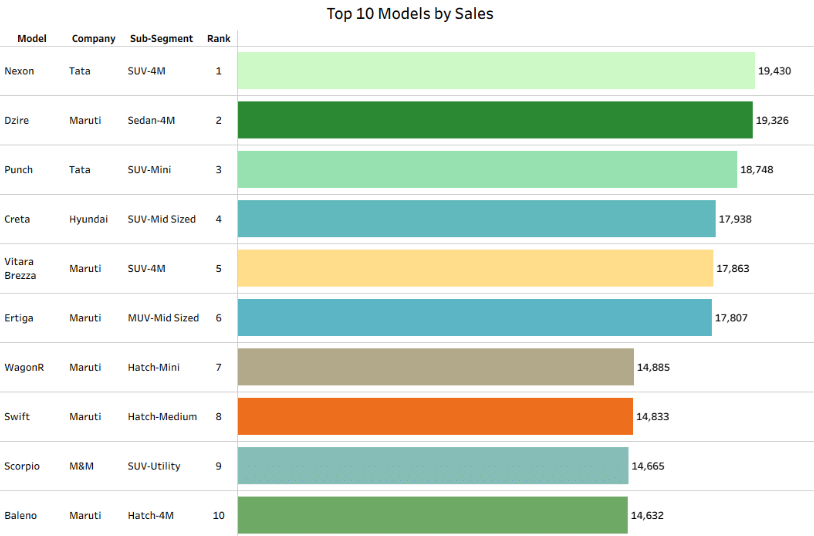 Top Selling Models by Volume — February 2026
GST Rationalisation Adds 80,000 Units of Monthly Volume
A tax policy change in September 2025 appears to have had a measurable and lasting effect on monthly volumes. Since the GST rationalisation on passenger vehicles, monthly industry sales have not dipped below 400,000 units, averaging over 430,000 units in the months that followed. The seven months before the policy change averaged 351,000 units per month — a difference of roughly 80,000 units that has held through the subsequent data.
The benefit has not been uniform across the industry. The reduction applied to conventionally-powered vehicles narrowed the price advantage that electric vehicles previously held, weighing on manufacturers with EV-heavy portfolios. MG Motor, for example, posted more modest growth despite strong overall market conditions. Skoda's growth, meanwhile, appears tied more closely to the Kylaq launch cycle than to the GST effect alone.
Momentum Analysis: Structural vs Cyclical Growth
An analysis of TTM compound annual growth rates (CAGR) across rolling periods highlights which manufacturers carry structural demand tailwinds. Skoda leads the CAGR table, driven by the Kylaq's entry into a segment with limited competition. Mahindra, MG, Toyota and Tata follow, each supported by recent product introductions. Honda, Nissan and Volkswagen show deteriorating momentum curves, a concern that model launches must address to reverse.
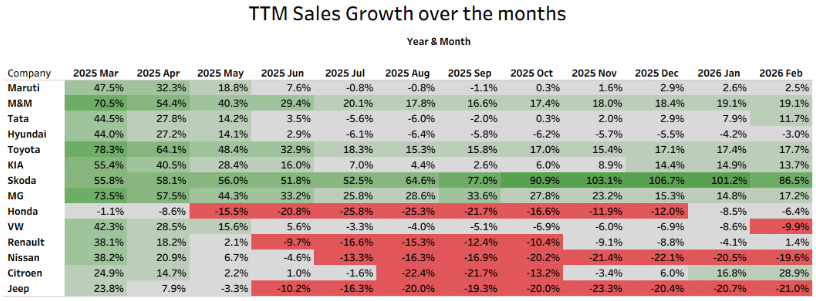 TTM Sales Growth Rate (CAGR) by OEM — March 2025 to February 2026
At the sub-segment level, all meaningful positive CAGR momentum is concentrated within SUV and MUV categories — mid-size SUVs, compact SUVs and utility vehicles. Hatchbacks and compact sedans are in structural volume decline. For manufacturers without an SUV pipeline, the data presents a clear challenge.
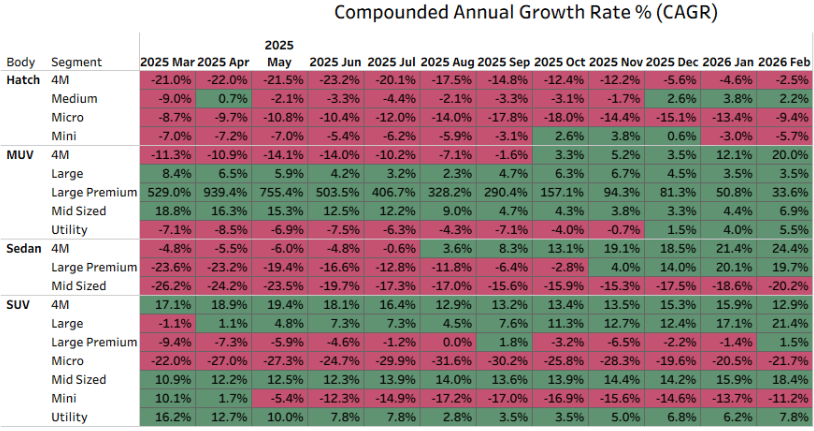 TTM Sales CAGR by Sub-Segment — March 2025 to February 2026
Background: India's Automotive Growth Trajectory
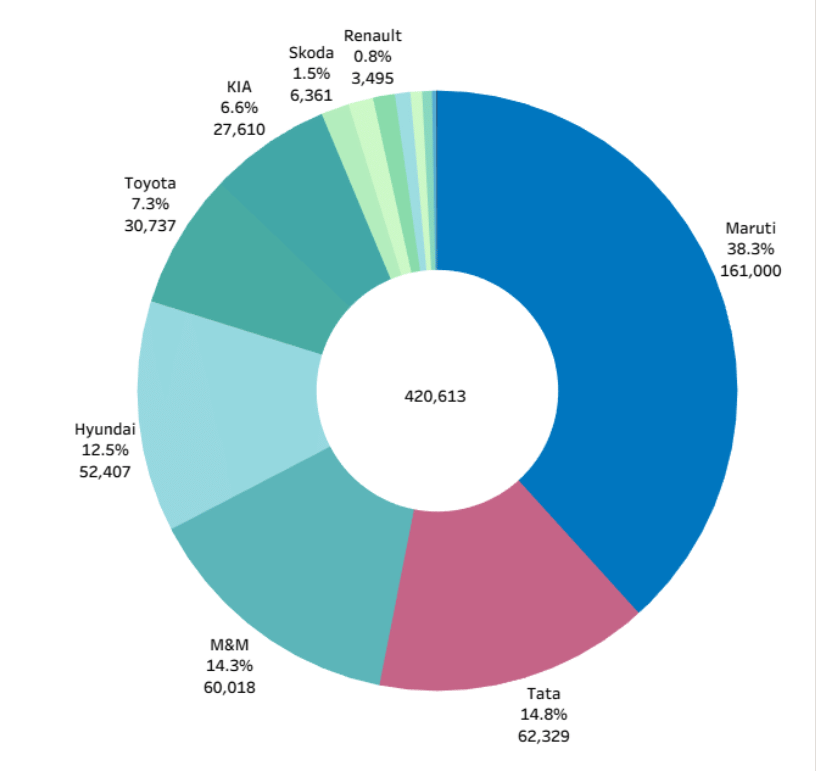 Market Share by OEM — February 2026
India overtook Japan to become the world's third-largest passenger vehicle market in 2023. The country's market has grown from approximately 3 million annual units in 2021 to over 4.6 million today, driven by a combination of rising disposable incomes, expanding road infrastructure, new product launches, and favourable financing conditions. The SUV boom is not unique to India — it mirrors a global pattern — but the speed of the transition from hatchback-dominant to SUV-dominant has been particularly pronounced in the Indian context.
The macro risk flagged in the February data is the potential for global commodity price increases linked to the Iran conflict, which could affect vehicle input costs and consumer sentiment. As of the time of writing, this remains a watch item rather than an active headwind in the domestic data.
Data source: Autopunditz

RELATED ARTICLES

Volvo Plans 13 New Models by 2030 in Largest Product Expansion in Company History
 Angitha Suresh
 19 Sep 2026
The Swedish automaker will split its line-up between Western and Chinese markets, offer both electric and hybrid powertr...


Kolkata Police Adds 183 Ultraviolette Electric Motorcycles to Its Fleet
Angitha Suresh
19 Sep 2026
The Kolkata Police has taken delivery of 183 units of the Ultraviolette X-47 Skyforce, a dedicated law-enforcement varia...

Mahindra Last Mile Mobility Named Finalist for 2026 Earthshot Prize
Angitha Suresh
19 Sep 2026
The Indian electric vehicle manufacturer is the only automotive company among 15 global finalists, with Mumbai set to ho...