Follow us
Icra Sees Passenger Vehicle Growth Moderating to 4–6% in FY2027
Rating agency ICRA projects slower expansion ahead as GST-driven tailwinds and record FY2026 volumes give way to a tougher base, uncertain monsoon prospects, and the ongoing West Asia conflict.
 By Sarthak Mahajan
 806 Views


India's passenger vehicle (PV) industry is expected to see wholesale volume growth slow to 4–6% in FY2027, down from 8.6% in FY2026, according to credit rating agency ICRA. The moderation reflects an elevated base following record volumes last fiscal year, alongside a weak monsoon outlook that could weigh on rural demand sentiment.
ICRA noted that demand momentum is likely to be sustained, supported by GST rate reductions and new model launches by original equipment manufacturers (OEMs). However, the impact of the ongoing West Asia crisis on inflation and consumer confidence remains a key variable that the industry will need to monitor closely.
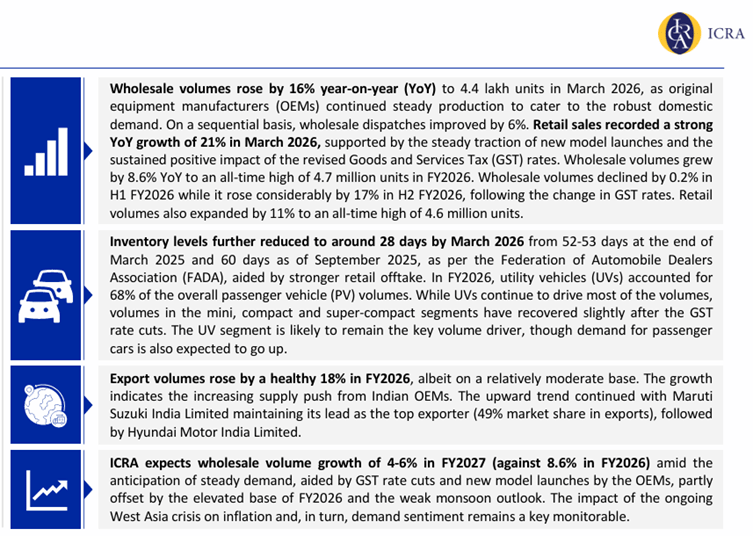
March 2026 closed on a firm note, with wholesale volumes rising 16% year-on-year to 4.4 lakh units, as OEMs maintained steady production to meet robust domestic demand. Retail sales grew even faster at 21% year-on-year during the month, reflecting the continued pull-through from new launches and revised GST rates. For the full year, wholesale volumes reached an all-time high of 4.7 million units, while retail volumes hit a record 4.6 million units, up 11% year-on-year.
The industry's performance in FY2026 was notably back-end loaded. Wholesale volumes dipped marginally by 0.2% in the first half before surging 17% in the second half following the GST rate revision. Dealer inventory levels improved significantly as a result, falling to approximately 28 days by March 2026 from 52–53 days a year earlier and a peak of 60 days in September 2025, as per data from the Federation of Automobile Dealers Association (FADA).
Utility vehicles (UVs) continued to dominate, accounting for 68% of total PV volumes in FY2026. ICRA expects UVs to remain the primary volume driver in FY2027, though it observed early signs of recovery in the mini, compact, and super-compact passenger car segments following the GST adjustments. Demand for passenger cars is also expected to improve incrementally.
On the export front, volumes climbed 18% in FY2026, reflecting a growing supply push from Indian OEMs targeting overseas markets. Maruti Suzuki India Limited retained its position as the top exporter with a 49% share of export volumes, followed by Hyundai Motor India Limited.

RELATED ARTICLES

Vienna Motor Symposium 2027 to Focus on SDVs, Batteries, and AI Data Center Power
 Autocar Professional Bureau
 20 Oct 2026
Organizers close paper submissions with contributions from global OEMs and universities, while 80 percent of exhibition ...


TVS Motor Redeems Short-Term Debt as CARE Reaffirms AAA Rating
Autocar Professional Bureau
20 Oct 2026
The rating agency reaffirms top investment grade on long-term bank facilities and debt instruments.

Schaeffler India CEO Harsha Kadam Taken Into Police Custody Over Fatal June Factory Accident
 Shahkar Abidi
20 Oct 2026
Shahkar Abidi
20 Oct 2026
Regulatory filing reveals top executive detained as legal 'occupier' following fatal CO₂ leak at Talegaon plant; company...