Follow us
Electric Two-Wheeler Sales Dip 22% Month-on-Month in April 2026, Surge 61% Year-on-Year
India's electric two-wheeler retail registrations fell sharply from March's peak but continued their strong upward trajectory compared to the same period last year, FADA data shows.
 By Angitha Suresh
 964 Views


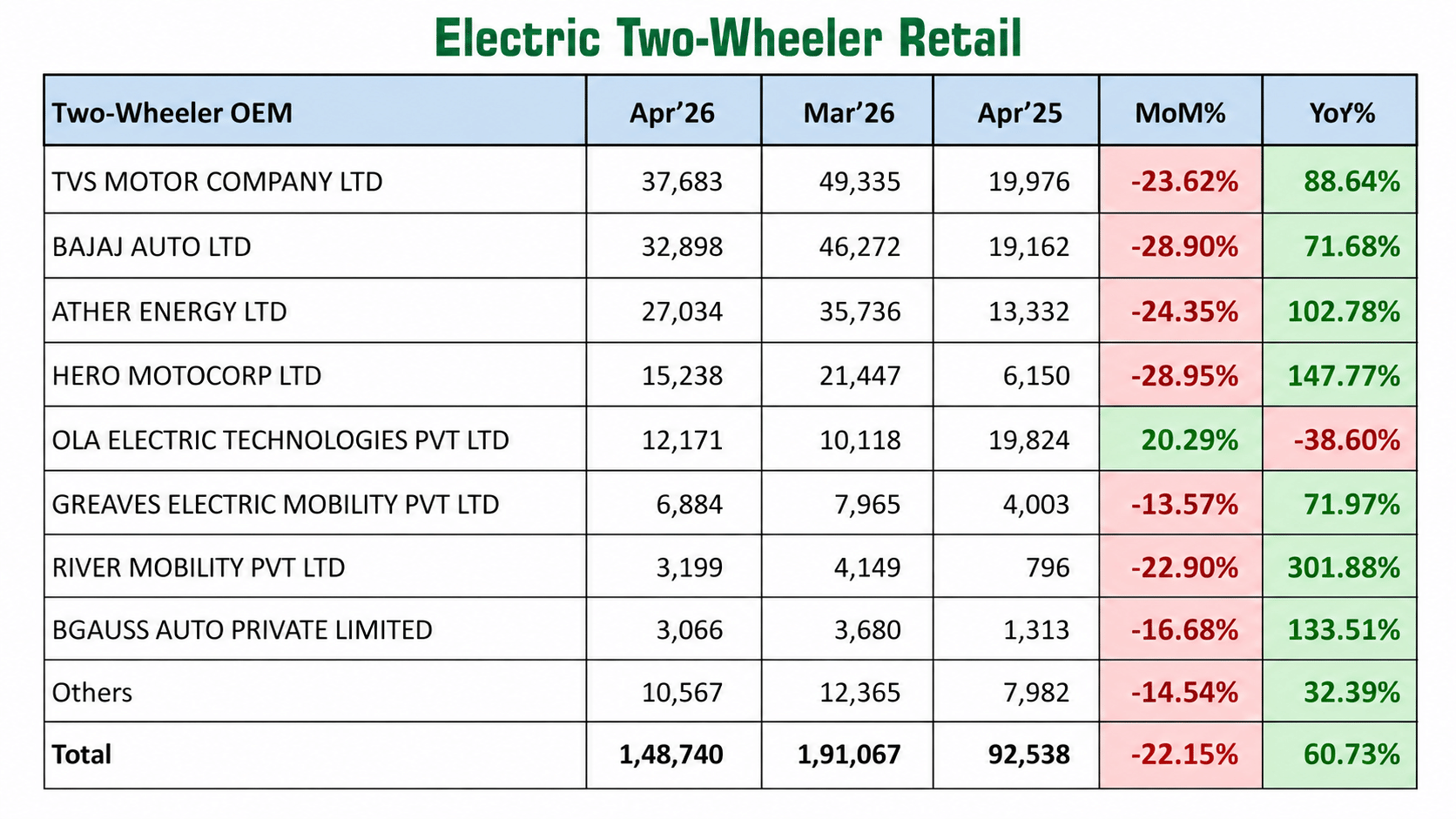
Electric two-wheeler retail sales in India stood at 1,48,740 units in April 2026, a decline of 22.15% from 1,91,067 units registered in March 2026, according to data released by the Federation of Automobile Dealers Associations (FADA). Despite the monthly drop, sales were up 60.73% compared to April 2025, when 92,538 units were sold. The data, collated on May 3, 2026, covers 1,463 of 1,466 Regional Transport Offices (RTOs) across the country, with Telangana excluded from the current reporting cycle.
The monthly contraction follows a pattern that is well-established in the Indian automobile retail calendar. March, being the final month of the financial year, consistently produces elevated registration numbers as dealers push to clear inventory and consumers accelerate purchase decisions ahead of potential price revisions or policy changes. April, by contrast, marks the start of a new financial year and typically sees demand normalise. The 22% decline observed this April, while significant in absolute terms, should therefore be read alongside the broader year-on-year trend, which points to sustained growth in the segment.
 Manufacturer-wise Performance
TVS Motor Company retained its position at the top of the electric two-wheeler market with 37,683 units sold in April 2026, down 23.62% from 49,335 units in March. Despite the monthly softening, the company's year-on-year growth of 88.64% — nearly doubling its April 2025 tally of 19,976 units — reflects the strength of its electric portfolio, anchored by the iQube range, which has steadily expanded across price points and geographies.
Bajaj Auto came in second with 32,898 units, recording a month-on-month decline of 28.90% from 46,272 units in March. Its year-on-year growth stood at 71.68%, building on the rapid market acceptance of the Chetak electric scooter, which the company has aggressively expanded through new variants and a wider dealership network over the past year.
Ather Energy, which has positioned itself as a technology-first brand in the premium electric scooter space, registered 27,034 units in April 2026 — a 24.35% fall from 35,736 units in March, but a 102.78% increase over April 2025's 13,332 units. The company's year-on-year performance, more than doubling its sales, is notable given the competitive pressure it faces from both legacy automakers and newer entrants in the segment.
Hero MotoCorp, the country's largest two-wheeler manufacturer by overall volume, recorded 15,238 electric units in April 2026, a 28.95% month-on-month decline from 21,447 units in March. However, its year-on-year growth of 147.77% — the highest among the major players in this dataset — points to an accelerating ramp-up in its electric business. The company has been expanding its Vida electric scooter lineup and distribution network, and the numbers suggest those efforts are translating into retail traction.
Ola Electric Bucks Monthly Trend, but Trails Year-on-Year
Ola Electric Technologies was the sole manufacturer to post a month-on-month increase in April 2026, selling 12,171 units compared to 10,118 units in March — a rise of 20.29%. However, the company's year-on-year picture presents a contrasting story. Its April 2026 sales were 38.60% lower than the 19,824 units it registered in April 2025, making it the only major brand to report a year-on-year decline. Ola Electric had a strong presence in the market in early 2025, and the erosion in its year-on-year numbers reflects both a high base effect and the intensified competition from incumbent manufacturers that have since scaled their electric offerings.
Smaller Players Post Strong Year-on-Year Gains
Greaves Electric Mobility, which markets vehicles under the Ampere brand, sold 6,884 units in April 2026, down 13.57% from 7,965 units in March, but up 71.97% year-on-year from 4,003 units in April 2025. River Mobility, a relatively newer player, posted 3,199 units — a 22.90% monthly decline but a 301.88% year-on-year surge from just 796 units in April 2025, indicating rapid scaling from a low base. BGauss Auto registered 3,066 units, declining 16.68% from the previous month but growing 133.51% over April 2025's 1,313 units. The "Others" category, which aggregates the remaining manufacturers, contributed 10,567 units, down 14.54% month-on-month but up 32.39% year-on-year.
The aggregate market share of electric two-wheelers as a proportion of total two-wheeler retail stood at 7.8% in April 2026. This compares to 9.8% in March 2026 and 5.5% in April 2025. The sequential dip in penetration rate from March to April is largely a reflection of the post-financial-year-end normalisation in the overall two-wheeler market rather than a structural reversal. The year-on-year expansion of 230 basis points in electric market share over twelve months indicates that the segment continues to gain ground within the broader two-wheeler industry, albeit at a pace that remains sensitive to seasonal demand patterns, charging infrastructure availability, and government incentive frameworks.
The Union government's EMPS (Electric Mobility Promotion Scheme) and state-level subsidies across several markets have been among the key demand levers for the segment. Any revision to these schemes is closely watched by both manufacturers and dealers, as subsidy changes have historically led to demand concentration in specific months — a dynamic that can amplify month-on-month volatility in retail data.
FADA collects retail registration data directly from RTOs to provide a demand-side view of vehicle sales, as distinct from wholesale dispatch numbers reported by manufacturers to the Society of Indian Automobile Manufacturers (SIAM). The RTO-based methodology is considered a more accurate reflection of actual consumer purchases and is widely referenced by industry analysts and investors tracking the electric vehicle transition in India's two-wheeler market.

RELATED ARTICLES

Škoda Auto India to Raise Prices by up to 1.2% from October 1
 Shruti Shiraguppi
 29 Sep 2026
The ex-showroom price increase across the India portfolio will vary by model and variant, with a maximum rise of ₹20,000...


JSW MG Motor India Delivers 50 Hector Tomahawk EVs in One Day in Surat
Shruti Shiraguppi
29 Sep 2026
The company said the deliveries reflect interest in the recently launched electric SUV and growing adoption of electric ...

Endurance Technologies Subsidiary Completes Remaining 32% Acquisition in Stöferle Entities for €18 Million
Shruti Shiraguppi
29 Sep 2026
Endurance Overseas SpA exercised the acquisition option ahead of the original timeline, which ran to June 2030, and now ...