

 Follow us
Ford increases virtual crash computing power
To facilitate growing demand for virtual crash test data, Ford Motor Co is increasing its investment in computing power by an additional 50 percent this year.
 11 Mar 2014
 4224 Views
Share -
4224 Views
Share -


To facilitate growing demand for virtual crash test data, Ford Motor Co is increasing its investment in computing power by an additional 50 percent this year.
The technology investment will allow Ford to more quickly conduct virtual crash tests – some of which can take up to a full day to run – while also collecting more data. More than 2 million crash test simulations have been run over the past 10 years. The use of advanced computer crash test models also allows the carmaker’s safety teams to more quickly evaluate and verify a variety of designs.
Ford recently performed its 20,000th full-vehicle crash test at the Dearborn, Michigan development centre. Physical crash tests, combined with virtual crash testing, allow the company to gather more safety data faster than ever before.
“Today’s vehicles come in a greater variety of body styles, and have more technology and driver-assist features – and many countries have unique regulations,” said Steve Kenner, global director, Ford automotive safety office. “We are able to manage this workload efficiently thanks to our significant investment in technology and the hard work of our teams.”
More than 500 engineers around the world are dedicated to safety at Ford. These teams run thousands of computer simulations before the physical tests are conducted, including frontal impact, side impact, rear impact, roof strength and safety systems checks.
“Ford is committed to designing vehicles that are safe for our customers,” said Nand Kochhar, Ford global safety chief engineer. “In the early stages of vehicle design, we use computer simulations; later we use crash test verification to ensure our vehicles perform as expected.”
The company’s investment in computing power has led to a tenfold increase in the number of virtual crash tests Ford can conduct during vehicle development. The level of detail on the models has increased as well. Safety teams can now run full-vehicle crash simulations with up to 2 million elements, up from half a million just five years ago.
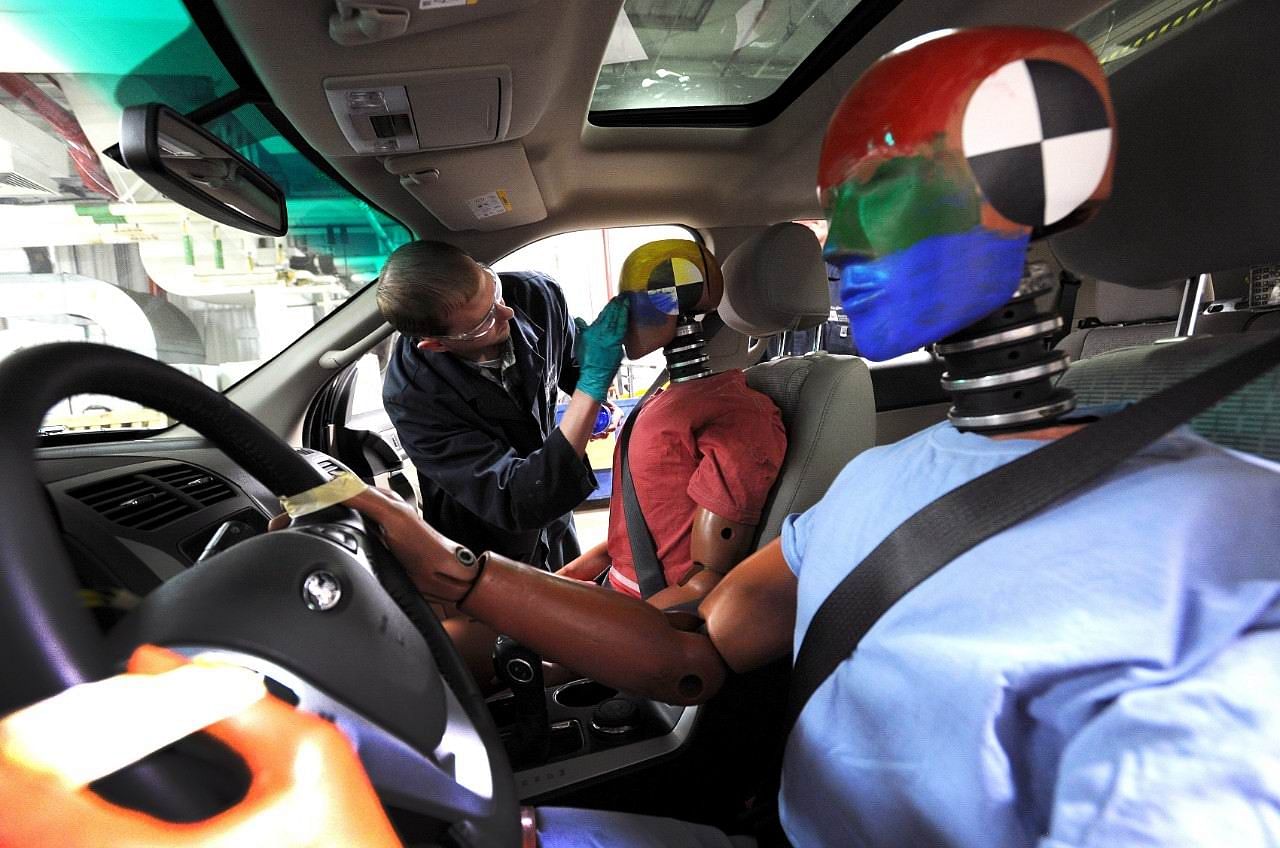
Full-vehicle crash tests
Ford performed its first crash test in 1954. In the 60 years Ford has been conducting crash tests, technology has advanced to allow an increased number of vehicles to be tested. The company’s crash barrier facility can be adapted to perform a wide variety of vehicle crash tests, including frontal, side and rear impact tests where restraints and airbag systems are evaluated. Tests are performed at speeds ranging from less than 20mph (32kph) to more than 55mph (88kph).
Vehicle preparation for these physical tests can take from a few days to a few weeks, depending on test complexity. Vehicles are fitted with special mounts, cameras and sensors. On-board systems capture up to 300 channels of information, including crash forces, displacement and pressure.
After the full-vehicle crash test, the team at the crash facility can provide safety engineers a wide range of crash data in under 30 minutes.
RELATED ARTICLES

Cosmo First diversifies into paint protection film and ceramic coatings
 Autocar Professional Bureau
17 Jul 2025
Autocar Professional Bureau
17 Jul 2025
The Aurangabad, Maharashtra-based packaging materials supplier is leveraging its competencies in plastic films and speci...


JSW MG Motor India confident of selling 1,000 M9 electric MPVs in first year
Autocar Professional Bureau
11 Jul 2025
The 5.2-metre-long, seven-seater luxury electric MPV, which will be locally assembled at the Halol plant in Gujarat, wil...

Modern Automotives targets 25% CAGR in forged components by FY2031, diversifies into e-3Ws
Autocar Professional Bureau
05 Jul 2025
The Tier-1 component supplier of forged components such as connecting rods, crankshafts, tie-rods, and fork bridges to l...