Follow us
JAXA and Toyota reveal plans for manned pressurised lunar rover
Over the course of the three-year joint research period, JAXA and Toyota will manufacture, test and evaluate prototypes, with the goal of developing a manned, pressurised lunar rover
 By Autocar Professional Bureau
 9047 Views


The Japan Aerospace Exploration Agency (JAXA) and Toyota Motor Corporation (Toyota) today signed a three-year joint research agreement, running from the fiscal years 2019 to 2021. On 12 March 2019, the two parties announced their agreement to consider collaboration on joint research into a manned, pressurised lunar rover that uses fuel cell electric vehicle technologies.
The signing of the pact today is significant considering it is exactly 50 years ago (July 16, 1969) that Apollo 11 was launched into orbit and a few days later the first humans walked on the moon.
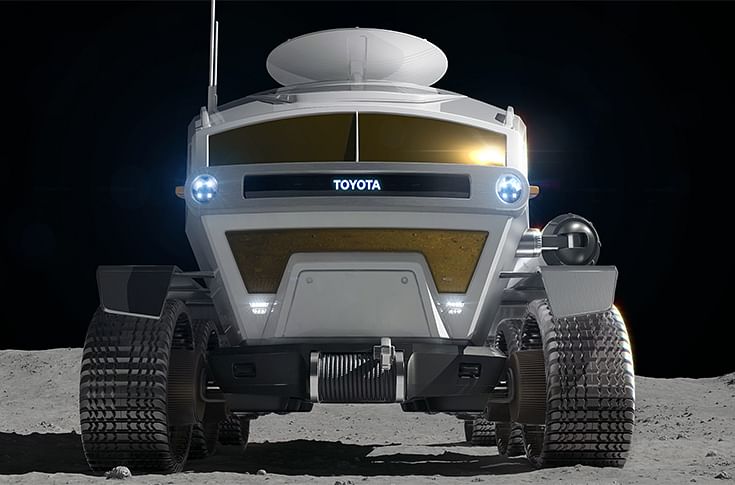
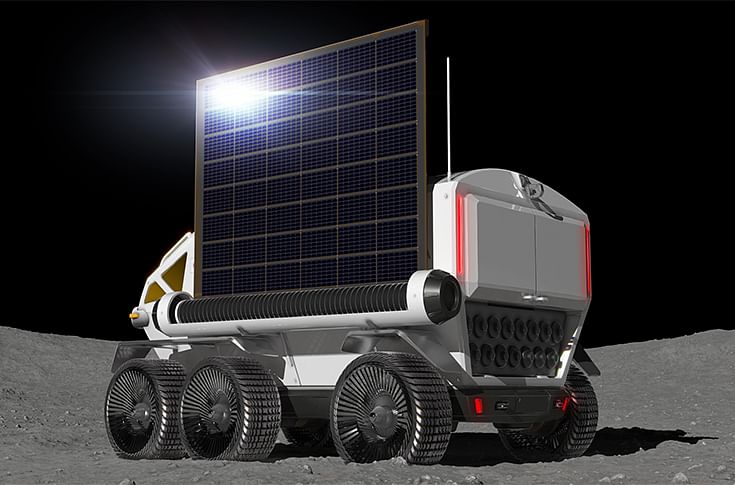
A conceptual rendering of the hydrogen fuel cell manned, pressurised rover.
Over the course of the three-year joint research period, JAXA and Toyota will manufacture, test and evaluate prototypes, with the goal of developing a manned, pressurised lunar rover and exploring the surface of the moon as part of an international project.
JAXA intends to acquire data related to driving technologies in order to develop a manned, pressurised lunar rover. The rover will be used for missions to explore the moon’s polar regions, with the aim both of investigating the possibility of using the moon’s resources – such as frozen water – and acquiring technologies that enable exploration of the surfaces of large planets.
In the fiscal year 2019 the two companies will be identifying technological elements that need to be developed for driving on the surface of the moon; drawing up specifications for a prototype rover (The prototype rover will be a modified version of a standard production vehicle). In the fiscal year 2020, they will be manufacturing the test parts for each technological element; manufacturing a prototype rover and in fiscal year 2021 they will carry out testing and evaluation of both the manufactured test parts and the prototype rover. In 2022 they plan to manufacture and evaluate a 1:1 scale prototype rover; acquisition and verification testing of data on driving systems required to explore the moon’s polar regions. In 2024 they plan to design, manufacture and evaluate an engineering model of the rover; design of the actual flight model. In 2027, the two companies expect to manufacture and test the performance and quality of the flight model. Tentatively, they plan to launch the lunar rover in 2029.
On 1 July 2019, Toyota established a dedicated 'Lunar Exploration Mobility Works'. Toyota plans to extend the department’s workforce to approximately 30 members by the end of the year.
Also read: Toyota and Kenworth unveil fuel cell electric heavy-duty trucks
Toyota develops hydrogen-generating station that uses solar energy
Toyota’s new HD fuel cell e-truck delivers nearly 500km range

RELATED ARTICLES

Horse Powertrain develops ‘all-in-one’ powertrain for hybridizing BEV platforms
 Ajit Dalvi
 20 Apr 2026
X-Range C15 Direct Drive is an ‘all-in-one’ hybrid powertrain that allows BEV platforms to serve as foundations for HEVs...


Autoliv Plans JV for Advanced Safety Electronics With China’s HSAE
Ajit Dalvi
11 Oct 2025
The new joint venture, which is to be located strategically near Shanghai and close to several existing Autoliv sites in...

JLR to Restart Production Over a Month After September Hacking
Ajit Dalvi
07 Oct 2025
Manufacturing operations at the Tata Group-owned British luxury car and SUV manufacturer were shut down following a cybe...