
 Follow us
Bosch shows how it helps make changing lanes safer with mid-range radar sensor
Drivers are taught to assess surrounding traffic before changing lanes by checking their rearview and side mirrors and looking over each shoulder.
 By Autocar Professional Bureau
 9157 Views


Sensors monitor all traffic in the area behind the vehicle.
Drivers are taught to assess surrounding traffic before changing lanes by checking their rearview and side mirrors and looking over each shoulder. But even for those who scrupulously follow this sequence of checks, the vehicle's blind spot – the area alongside and just behind the vehicle – is a constant source of danger and often the cause of serious accidents.
Drivers are not able to see into this area using either the rearview or side mirrors, but it is big enough for even a minivan to disappear from view and be missed by a cursory glance over the shoulder before switching lanes. To help minimize this risk, Bosch has developed the lane-changing assistant, which receives the information it needs from the new mid-range radar sensor for rear-end applications. “The MMR rear means drivers are effectively looking over their shoulders all the time, because it reliably and accurately recognizes other road users in their vehicle's blind spot,” says Gerhard Steiger, president of the Bosch Chassis Systems Control division.
Sensors monitor all traffic in the area behind the vehicle
A leading global car manufacturer is currently putting the Bosch system into series production for one of its high-volume mid-sized vehicles. To make changing lanes safer, this European manufacturer has concealed two sensors in the rear bumper – one on the left, one on the right. These two MRR rear sensors monitor the area alongside and behind the car. Powerful control software collates the sensor information to produce a complete picture of all traffic in the area behind the vehicle. Whenever another vehicle approaches at speed from behind or is already present in the blind spot, a signal such as a warning light in the side mirror alerts the driver to the hazard. Should the driver still activate the turn signal with the intention of changing lanes, the lane-changing assistant issues an additional acoustic and/or haptic warning.
The MRR rear system can do much more than just assist with lane-changing, however. These sensors also form part of Bosch's cross-traffic alert system, which supports drivers reversing out of perpendicular parking spaces when their rear view is obstructed. Able to recognize cars, cyclists, and pedestrians crossing behind the reversing vehicle from the left or right at a distance of up to 50 metres, the system alerts the driver to the imminent danger of collision by issuing a timely audible or visible signal.
Significantly smaller and lighter
Bosch says its mid-range radar sensor has been a great success. And it is just as effective when facing forward and used to provide information for other driver assistance systems. “Both product versions are based on fourth-generation Bosch radar technology,” Steiger says.
The MRR is a bi-static multi-mode radar with four independent receiver channels and digital beam forming (DBF). It operates in the 76-77 GHz frequency band that is standard for automotive radar applications in almost all countries worldwide. Whereas the MMR rear has an aperture angle of up to 150 degrees and a range of up to 90 metres, the forward-facing version looks significantly further: with an aperture angle of up to plus/minus 45 degrees, it can detect objects up to 160 metres away.
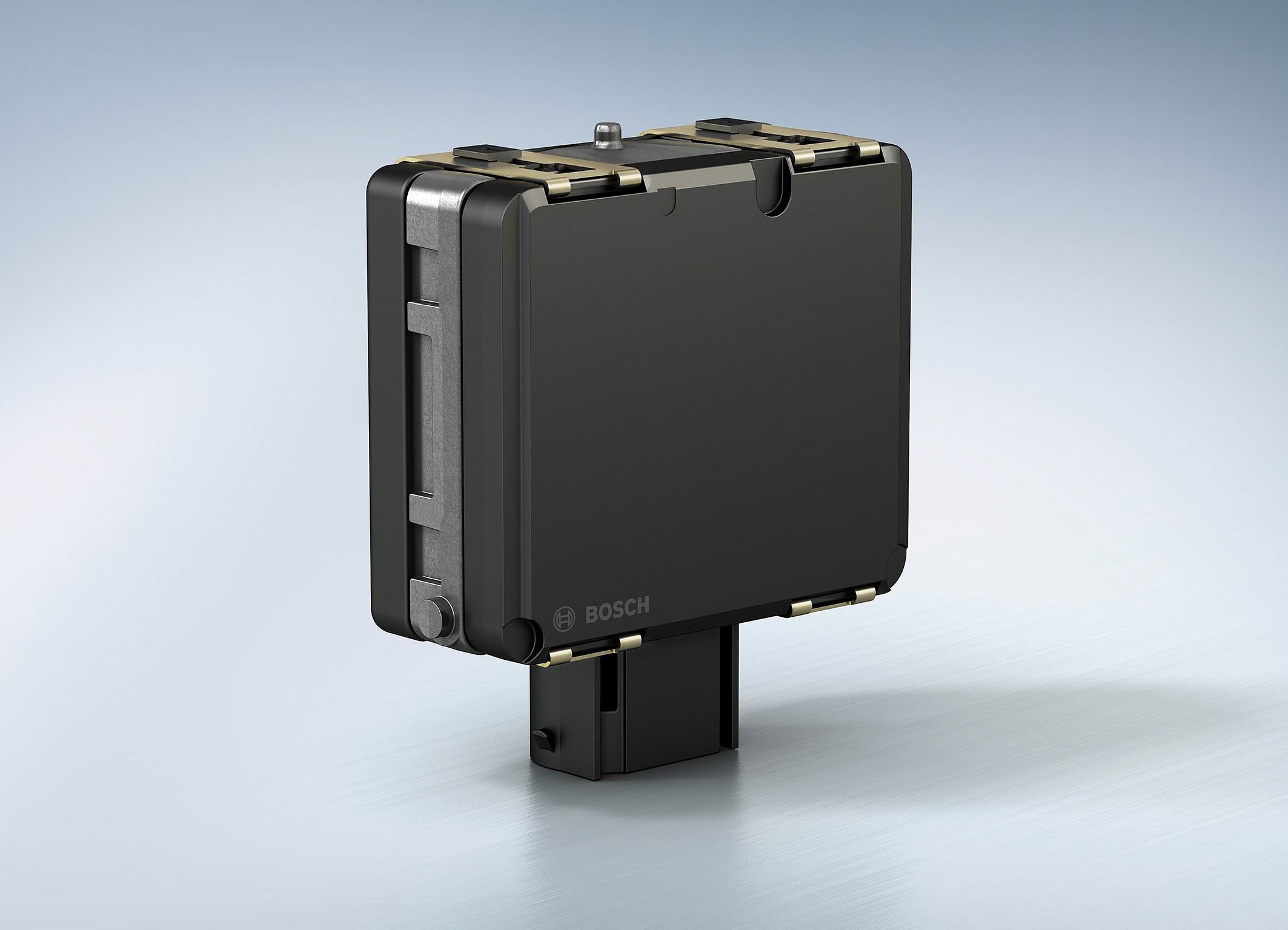
Bosch uses the mid-range radar sensor for front-end application to offer solutions such as ACC adaptive cruise control and predictive emergency braking systems, either alone or in parallel. And it so happens that from 2016 onwards, radar- or camera-based predictive emergency braking systems will be a requirement for vehicles hoping to obtain the highest rating in the Euro NCAP test. The Bosch MRR system's compact design also works in its favour. Significantly smaller and lighter than a 250-gram pack of butter, the radar sensor fits into even the smallest cars. As Gerhard Steiger says: “The Bosch mid-range radar sensor is a customized, cost-effective solution that enables radar sensor technology to be fitted as standard in all vehicle segments.”
RELATED ARTICLES

Horse Powertrain develops ‘all-in-one’ powertrain for hybridizing BEV platforms
 Ajit Dalvi
 20 Apr 2026
X-Range C15 Direct Drive is an ‘all-in-one’ hybrid powertrain that allows BEV platforms to serve as foundations for HEVs...


Autoliv Plans JV for Advanced Safety Electronics With China’s HSAE
Ajit Dalvi
11 Oct 2025
The new joint venture, which is to be located strategically near Shanghai and close to several existing Autoliv sites in...

JLR to Restart Production Over a Month After September Hacking
Ajit Dalvi
07 Oct 2025
Manufacturing operations at the Tata Group-owned British luxury car and SUV manufacturer were shut down following a cybe...