

 Follow us
Benecke-Kaliko to showcase automated production of Decoject surface foil at K 2016
Decoject, which is billed as a cost-efficient alternative solution to injection moulding, allows the appearance and function of car interiors to be upgraded.
 By Autocar Professional Bureau
 7572 Views


Decoject surface material offers an exclusive appearance, enhanced scratch resistance and comfortable feel.
ContiTech's surface specialist Benecke-Kaliko, together with its industrial partners, is to present its innovative Decoject foil solution in a fully automated component production process at K 2016, the world's leading trade fair for the plastic and rubber industry, in Düsseldorf.
Decoject, which is billed as a cost-efficient alternative solution to injection moulding, allows the appearance and function of car interiors to be upgraded. The foil cannot fail to impress with its enhanced scratch resistance, and also offers an exclusive appearance and a comfortable feel. Using paints, printed decor, or effect coatings opens up a wide range of design options. The gloss level and feel can be adjusted as desired, decor can be changed easily and quickly, and the colour can be changed without process waste. With Decoject, Benecke-Kaliko says it offers customers three further advantages: a foil solution with high surface quality, ultra-high flexibility for small batch sizes, and low unit costs.
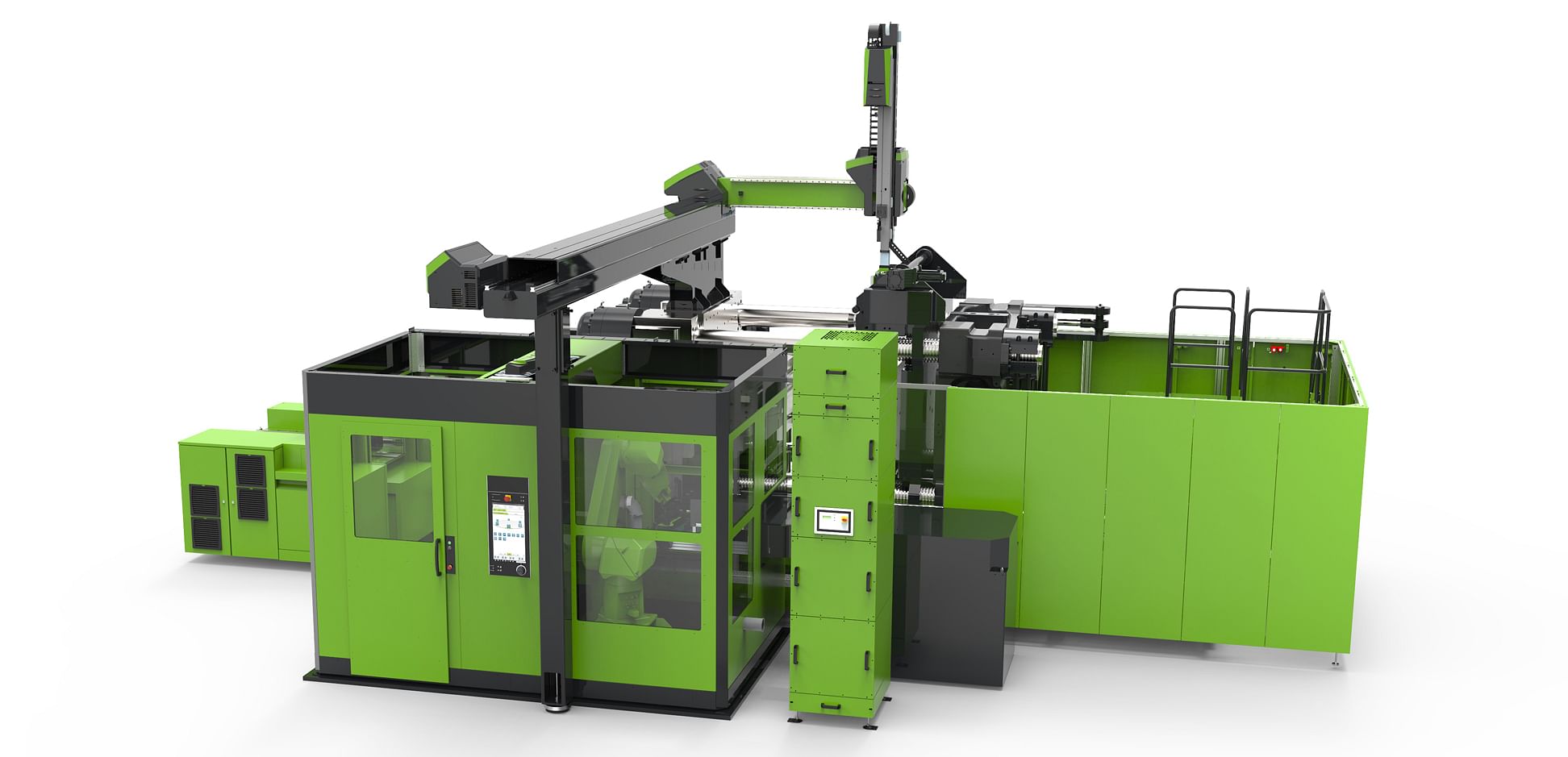
Engel's new system integrates, on a compact surface, robots and all necessary upstream and downstream process units such as a laser cutting cell (easiCell), and thus facilitates the fully automated production of Decoject components
Lowering of unit costs by means of new production process
At the K 2016, the fully automated Decoject processing will be presented on a system for the first time. The machine produces sample parts modeled on large-surface door panels. To highlight the wide range of the new technology, the components have different surface structures, including a sophisticated carbon grain and incorporated decorative elements.
Only 60 sec to produce a ready-to-install component
As soon as the tool opens, the Decoject thin foil is drawn in. It is heated up by the infrared lamp placed in the gripper, and pre-shaped directly in the injection-molding tool by means of a vacuum. Immediately after this, the foil is injection-molded on the back and punched out. The robot then removes the component and transfers it to the integrated laser station for fine cutting. A ready-to-install component leaves the production cell every 60 seconds. If the design has to be changed, it only takes a few minutes to replace the foil roll. As a result, the batch size is no longer reflected in the unit costs. This level of automation makes a decisive contribution to the procedure's high cost-effectiveness and flexibility.
Visitors at K 2016 can experience the advantages of the new technology live from October 19-26 in Hall 15/Booth C58 of the mechanical engineering manufacturer Engel
You may like: Covestro develops cost-efficient production tech for lightweight vehicle interior parts
RELATED ARTICLES

Horse Powertrain develops ‘all-in-one’ powertrain for hybridizing BEV platforms
 Ajit Dalvi
 20 Apr 2026
X-Range C15 Direct Drive is an ‘all-in-one’ hybrid powertrain that allows BEV platforms to serve as foundations for HEVs...


Autoliv Plans JV for Advanced Safety Electronics With China’s HSAE
Ajit Dalvi
11 Oct 2025
The new joint venture, which is to be located strategically near Shanghai and close to several existing Autoliv sites in...

JLR to Restart Production Over a Month After September Hacking
Ajit Dalvi
07 Oct 2025
Manufacturing operations at the Tata Group-owned British luxury car and SUV manufacturer were shut down following a cybe...