Follow us
How Tamil Nadu’s Auto Skills Revolution Is Building India’s EV-Ready Workforce
Tamil Nadu pioneers a collaborative approach to workforce development, weaving together government infrastructure, industry expertise, and youth ambition into transformative career pathways.
 By Yukta Mudgal
 7941 Views


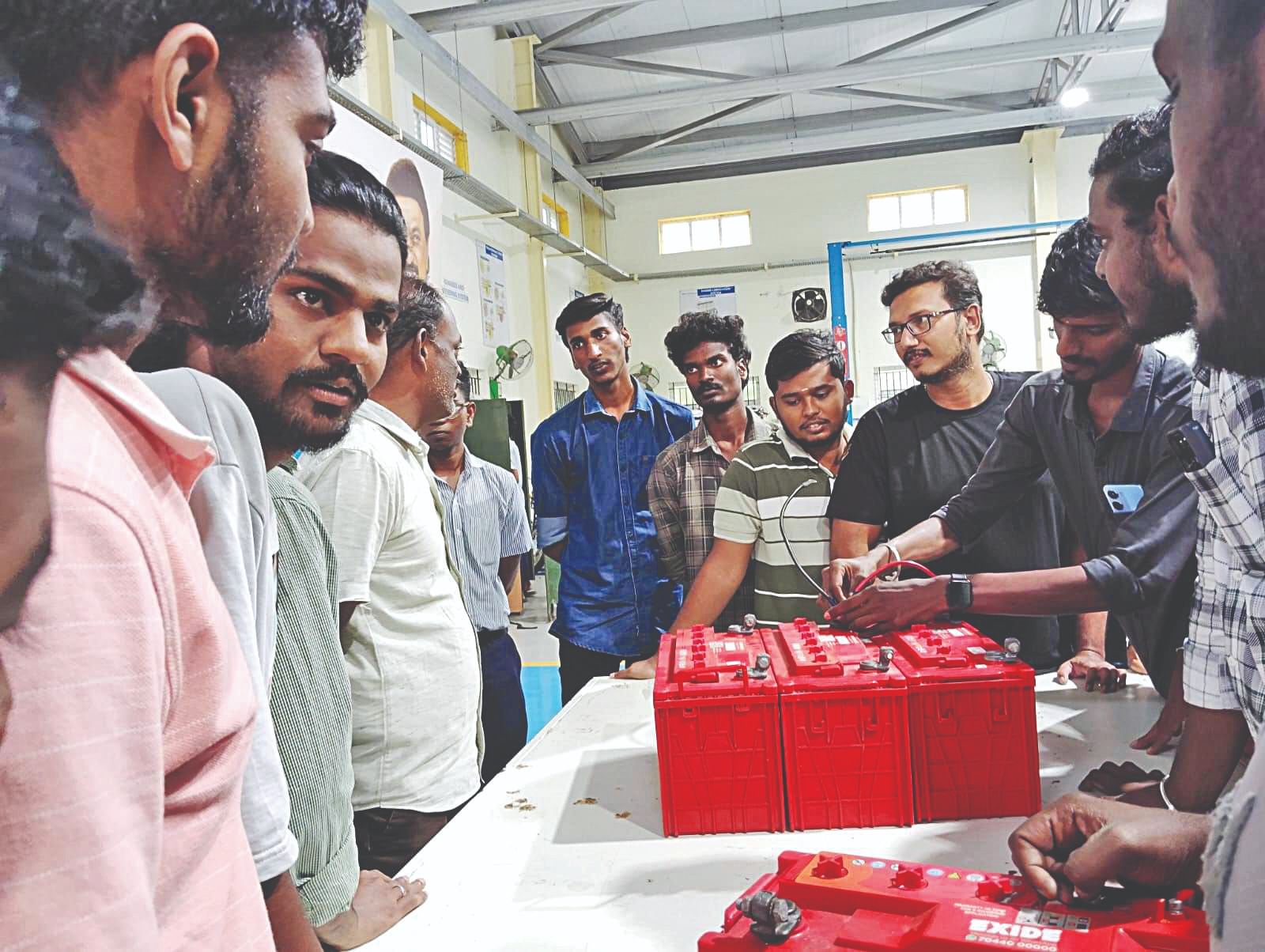
In small training centers across Tamil Nadu, the hum of robotic arms blends with the chatter of trainees learning to repair vehicles. For many of the students, these government and privately-run Industrial Training Institutes (ITIs) offer the first exposure to automation, before any of them step into a factory or workplace.
They are also critical pieces of a quiet skilling revolution taking shape in Tamil Nadu. The so-called “Detroit of Asia", as the state prepares its youth for an electric, connected, and software-defined mobility future. The initiative is designed to enable the automotive industry to make the transition to newer technologies and platforms.
The effort is spearheaded by the Tamil Nadu Apex Skill Development Centre for Automobile (TN AutoSkills) under the Tamil Nadu Skill Development Corporation (TNSDC). The Tamil Nadu program is unique in many respects compared to those in other parts of the country. Rather than treating skilling as a side initiative, the state is embedding it within its industrial ecosystem, aligning ITIs, polytechnics, and training centres with real factory technologies and employer needs.
Acting as a bridge between industry and education, TN AutoSkills has standardised over 150 courses aligned to automotive needs, from electric powertrains to AI diagnostics. Managing Director Kasiviswanathan Panchatsharam, also known as Kasi, has global experience at companies such as Tata Motors, Volvo, Hyundai, BMW, and Tesla.
"Our aim is not to create pockets of excellence but uniform capability across districts," he said. "Every plant, whether in Hosur, Sriperumbudur, or Tuticorin, should have access to equally skilled manpower." Tamil Nadu's technical infrastructure is growing in both scale and design. The state runs 132 government ITIs and 295 private ITIs, along with over 500 polytechnics.
Around 71 of the 132 government ITIs are now equipped with Industry 4.0 labs, where students gain hands-on experience in automation, 3D printing, robotics, and digital manufacturing. These facilities are training the next generation of shop-floor technicians for advanced technologies such as EVs, ADAS, and intelligent production systems.
One of the key aspects of Tamil Nadu's skilling effort is partnerships. For example, Delta Electronics has funded robotics programs in Hosur, while Hyundai is setting up a training academy on seven acres of government-allotted land, while Hyundai Motor Company is designing future skill courses and curriculum.
Changing Lives
For 32-year-old Jeganraj, the opportunity has been transformative. Once a networking engineer stuck in a repetitive job, he enrolled in a battery electric vehicle course under the state's Vetri Nichayam scheme, run by TN AutoSkills. Within months, he was hired by Ather Energy as a service technician.
"Now, I can see a path — first becoming a technician, then a supervisor, and maybe a manager one day," he said. For manufacturers facing rapid technological change, this kind of talent is gold. "Factories cannot digitise without digital-ready technicians," said a senior automotive expert.
"Even if we automate, someone must maintain and recalibrate the machines." The transformation is not only technical but also social. At Ola's electric scooter plant in Krishnagiri, the entire assembly line is run by women. Tamil Nadu leads India in women's participation in the industrial workforce, with the state employing 43% of India's female factory workers.
From Renault Group's Renault Nissan Technology & Business Centre India (RNTBCI), which drives their global engineering and R&D operations, to VinFast's newest manufacturing facility in Tuticorin, women are playing an increasingly vital role in Tamil Nadu's mobility ecosystem. For manufacturers grappling with global ESG targets and talent shortages, this inclusion is not just progressive but practical. "If we do not integrate women in tech-driven shop floors, we are missing half the potential workforce," Kasi noted.
Despite the infrastructure, the challenge lies in awareness and reach. Kasi recalls visiting colleges in Villupuram and Tirunelveli where students had never heard of NVIDIA or Tesla. "People are disciplined and talented, but awareness is very low," he said. Despites roughly 25,000 job vacancies across 38 districts, placement rates still hover around just 10%.
Part of the reason is that participation remains limited beyond flagship partnerships. As Kasi put it, "The factories are ready. The youth are ready. But industry has to step into the classroom." Another issue is related to culture. In a state famous for producing engineers, vocational training has long been viewed as a fallback. But that perception is shifting as factory floors become more digital and data-driven. "The awareness that skilled work equals opportunity—that is what we have to build," Kasi said.
The Path Ahead
TN AutoSkills plans to expand its overall scale of operations by 10-20% by March 2026 and target Rs 100 crore in revenue within five years through training, placements, and international collaborations. Delegations from Denmark, Germany, Japan, and the Middle East have already engaged with the state to recruit skilled technicians. Beyond Tamil Nadu, the hybrid model, where industry funds, the government facilitates, and youth execute, is emerging as a national blueprint.
But scaling it across India will require what Raman calls "collaboration beyond compliance." For OEMs and suppliers, skilling can no longer be treated as CSR; it must become a strategic investment. Finance Minister Nirmala Sitharaman recently highlighted the skill challenge facing the industry. Speaking at an event in September, she said the government is taking a comprehensive approach to skilling, focusing not only on traditional trades but also on emerging technologies like artificial intelligence.
Yet, she warned, a degree alone no longer guarantees readiness. "The degree on paper is there. But the individuals are not groomed adequately enough to be a part of the large multinationals. So I would want private sector participation together with the government, in readying youth to be fit for quick and direct employment."
According to C.V. Raman, former Chief Technology Officer and current executive committee member at Maruti Suzuki India, only 40% of engineering graduates have ever completed internships, and just 3% possess skills aligned with future technologies. "Sixty percent of the engineers are not employable in today's knowledge economy," he said at the Automotive Skills Development Council's Annual Conclave 2025. "Limited practical training, limited industry participation in skilling, and lack of world-class skilling infrastructure and incubation centres remain major obstacles."
This is especially important, given that the automotive industry contributes 7% to India's GDP, 50% to manufacturing output, and employs over 19 million people. Tamil Nadu's story mirrors India's broader manufacturing ambitions. The state has the infrastructure, industrial base, and intent. What it needs now is sustained industry co-ownership.
For automotive companies, the incentive is clear: reduced retraining costs, faster plant ramp-ups, higher localisation efficiency, and a workforce ready for EVs, ADAS, and mechatronics. As India eyes a Rs 30 trillion economy by 2047, Raman believes mobility will be one of the engines driving it. "We are the third-largest automotive market in the world," he said. "If India wants to be a Rs 30 trillion economy in 2047, mobility and energy will be the key drivers."

RELATED ARTICLES

Wired for Growth
 Autocar Professional Bureau
 27 Sep 2026
How a simple, highly personal mark of responsibility forged a legendary alliance with Bajaj Auto and built a multi-billi...


How CAMSO Is Reshaping CEAT’s Specialty Tyre Business
 Darshan Nakhwa
23 Sep 2026
Darshan Nakhwa
23 Sep 2026
The CAMSO acquisition gives CEAT access to construction tyres, tracks and new global customers as its Ambernath plant p...

Inside JK Tyre’s Growth Bet
Autocar Professional Bureau
21 Sep 2026
With capacity constraints limiting export growth, JK Tyre is adding passenger-car and truck radial capacity while pushin...