

 Follow us
“Despite 25% Price Rise, Fundamentals Intact for Future Growth”: Audi’s Dhillon
The indian car buyer’s journey to luxury has got longer, with more stops along the way, says Balbir Singh Dhillon, Head of Audi India.
 By Ketan Thakkar
 1138 Views


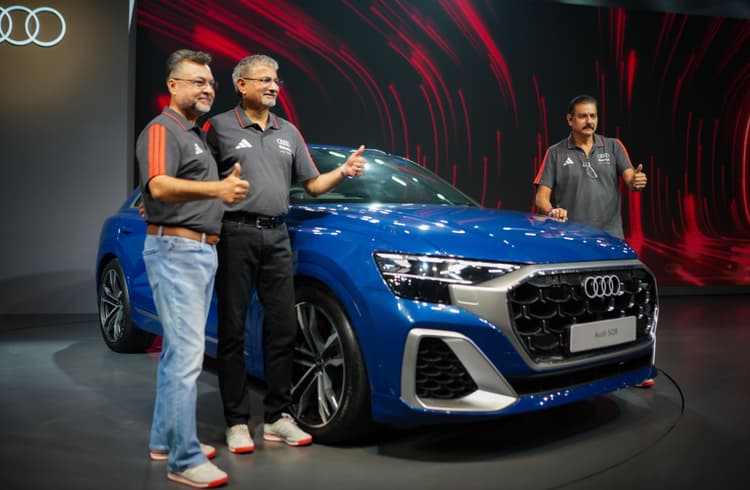
(From left) Balbir Singh Dhillon, Brand Director, Audi India, Piyush Arora, Managing Director & CEO, Skoda Auto Volkswagen India Pvt Ltd, Ravi Shastri, Ex-Indian Cricketer
India's luxury car market should have been in a far stronger place by now. Wealth is rising, aspiration is deepening, and premiumisation is visible across segments. Yet, volumes have stayed stubbornly range-bound.
The segment continues to operate at 50,000–52,000 units annually and 1–1.5% penetration of the overall passenger vehicle market. For a market of India's size, this remains disproportionately small.
For Balbir Singh Dhillon, Head of Audi India, the explanation lies in a fundamental reset. "If you see the last five years, the prices of luxury cars have gone up by about 25%. That's unusual. The starting transaction price has moved significantly higher," he said.
That shift has pushed the average price of a luxury car beyond ₹50–60 lakh, raising the entry threshold and, in turn, slowing the pace at which first-time buyers are stepping into the segment.
Part of the reason has been currency movements. The rupee has seen a sharp 15–20% depreciation against the euro over the past 12–18 months, significantly increasing import and localisation costs for luxury carmakers with euro-linked supply chains. Manufacturers have been able to pass on a significant portion of these increases to customers, supporting higher realisations, though not without tempering volume growth.
A More Staggered Path Into Luxury
The impact is not a collapse in demand, but a shift in how that demand is playing out.
What was once a relatively direct jump from mass-market to luxury has become more staggered. Buyers are increasingly pausing at ₹25–40 lakh premium offerings from mainstream manufacturers, which now deliver higher levels of features and perceived luxury, effectively stretching the upgrade cycle.
The competitive intensity at the top end is also evolving. The growing presence of EVs, along with the entry and expansion of newer players such as MG Motor and BYD, is widening the choice set within the broader premium and luxury space. This is likely to be further bolstered by JSW's upcoming automotive foray under its own brand, adding another layer of competition in the electrified and premium segments.
"Today, customers are evaluating more options before making that move. That's a natural evolution of the market," Dhillon said. However, he sees a positive side to the rising appetite for the premium-mainstream offerings. "Jumping from ₹15 lakh to ₹50 lakh is not easy. But if someone is already at ₹30–35 lakh, we are widening the base of future luxury buyers.”
Higher Prices, Stronger Realisations
Even as volumes have seen moderate expansion, or may be because of that, the per-car realisations have gone up. Buyers are increasingly opting for higher trims, greater personalisation and feature-rich variants, along with a visible shift toward top-end models within the luxury portfolio.
Hence, the top-end of the market continues to sustain strong growth momentum, indicating that demand at higher price points remains resilient even as entry-level luxury sees slower expansion.
Similarly, there is no noticeable drop in loyalty. The luxury car market is increasingly being sustained by existing customers upgrading within the ecosystem, rather than relying solely on first-time buyers. While the top of the funnel may be expanding more gradually, the conversion and retention within the segment are strengthening, improving lifetime value per customer.
"Customer loyalty today is among the highest we have seen. That's a very important indicator for long-term growth," he added. For Dhillon, one in three Audi buyers is a repeat customer. The company now sells one pre-owned car for every new car. "For every new car that we sell, we are also selling one pre-owned car. And once a customer enters luxury, 95% of them don't leave," he noted.
The Next Growth Triggers
Dhillon, nevertheless, is a strong believer in the broader story. "Last year alone, India added around 60 billionaires. In a country with about 360 billionaires, that tells you how fast wealth is getting created," Dhillon said.
Wealth creation, he believes, will get a boost thanks to macroeconomic shifts, including trade agreements such as the India–EU Free Trade Agreement (FTA). "For me, only 20% of the FTA story is about cars. The remaining 80% is about wealth creation," Dhillon said. "When wealth gets created and money comes into people's hands, luxury consumption will grow. That's the real trigger," he said.
Audi's Reset
Audi's recent performance in India cannot be viewed in isolation from its strategic choices. The brand has, over the past few years, slipped down the pecking order, exiting key segments such as diesel and facing gaps in its EV portfolio, even as rivals expanded aggressively across powertrains.
Dhillon pushed back on the idea of underperformance. "We have to look at the segments we are participating in. In those segments, we continue to have a sizable presence," he said.
The absence of diesel and the temporary gap in EV offerings have undoubtedly constrained volumes, but Dhillon framed these as portfolio choices rather than structural weaknesses, pointing to a broader product reset underway globally.
What he did confirm is that 2026 will be a defining year, with a phased rollout of new products and a clearer articulation of strategy expected in the coming months.
"This is going to be a defining year for us. We will start bringing in new products and share more details at the right time," he said. "Our endeavour will be to grow in line with the market, if not faster. The numbers will follow as the right products come in," he said.
For Audi, the path back is likely to be defined not by a single breakthrough, but by a measured rebuild of portfolio depth and market relevance, aligned with a broader industry transition that is still playing out.

RELATED ARTICLES

How CAMSO Is Reshaping CEAT’s Specialty Tyre Business
 Darshan Nakhwa
 23 Sep 2026
The CAMSO acquisition gives CEAT access to construction tyres, tracks and new global customers as its Ambernath plant p...


Inside JK Tyre’s Growth Bet
 Autocar Professional Bureau
21 Sep 2026
Autocar Professional Bureau
21 Sep 2026
With capacity constraints limiting export growth, JK Tyre is adding passenger-car and truck radial capacity while pushin...

The De-Risking Playbook: Inside Gestamp’s Aggressive OEM Diversification in India
 Shahkar Abidi
11 Sep 2026
Shahkar Abidi
11 Sep 2026
The Spanish tier-one opens a Rs 523.7-crore facility in Gujarat, seeking to insulate itself from customer concentration ...