Follow us
German troika and Jeep in BlueTec pact
Brand name will stand for clean, fuel efficient diesel engines.
 By Autocar Pro News Desk
 3321 Views


DaimlerChrysler, Audi and Volkswagen announced that they intend to establish the Bluetec brand name as the designation for clean, highly fuel-efficient passenger cars and SUVs with diesel engines. Under the shared concept of Bluetec, each of the manufacturers involved will be working on their own technical systems for meeting the world’s most stringent emission regulations.
The latest JD Power study, Global Outlook For Diesel, predicts that the share of diesels among first-time registrations in North America will rise to over 15 percent by 2015. It is in the light of this development that the three companies will be systematically expanding their ranges of diesel vehicles.
All three companies are convinced that up-to-date diesel propulsion systems play a major part in efficient and clean mobility. With their high torque, agility, economy and robustness they display all the qualities which American customers, especially, appreciate. With their outstandingly efficient fuel consumption, which lies some 20 to 40 percent lower than that of comparable petrol engines, these particularly clean diesel engines now have the potential to comply with the toughest emission limits in the world. They combine ecology and economy with driving pleasure for the customer.
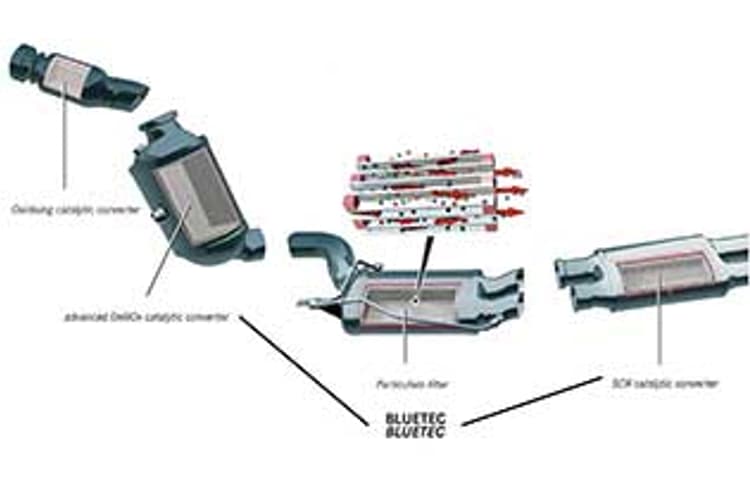
The name Bluetec covers diesel engines with exhaust emission treatment systems which meet even the strictest emission regulations on the US market. The systems employed by this technology serve to reduce nitrogen oxides (NOx) the only constituent part of the exhaust gases which, due to the design of the diesel, inherently lies above the value for petrol engines. Depending on the vehicle class concerned, various NOx treatment systems can be used. In one version, for instance, an oxidising catalytic converter and a particulate filter are combined with a further improved, particularly long-life NOx storage converter.
Another way of cutting NOx emissions is even more effective. In this case for example AdBlue, a water-based additive, is injected into the exhaust gas. This causes ammonia to be released, which in turn reduces the nitrogen oxides almost completely to harmless nitrogen and water in a downstream SCR catalytic converter. Bluetec is a brand of DaimlerChrysler which is already being used by the it’s Mercedes-Benz cars and commercial vehicles.

RELATED ARTICLES

The Man Who Steers Nine Out of Ten Cars
 Autocar Professional Bureau
 19 Oct 2026
How two quiet, fifty-year-old family suppliers, forging fifty million steering yokes a year for nine out of ten cars in ...


Inside India's ₹20-Lakh-Crore Auto Loan Boom
 Anurag Chaturvedi
18 Oct 2026
Anurag Chaturvedi
18 Oct 2026
Delinquencies are at multi-year lows, but there's no visibility on whether borrowers earn enough to service the debt.

Eicher Bets ‘De-Skilling’ Diagnostics Will Hook India’s Small Truck Fleets
 Shahkar Abidi
14 Oct 2026
Shahkar Abidi
14 Oct 2026
Commercial vehicle maker aims to double parts revenue to Rs 5,000 crore by automating diagnostic and warehouse operation...