

 Follow us
The West Dominates, the North Surges: India's Auto Market by State
Maharashtra and Uttar Pradesh emerge as twin engines of India's vehicle market — but the picture across categories, zones, and segments tells a far more nuanced geographic story.
 By Shruti Shiraguppi
 3320 Views


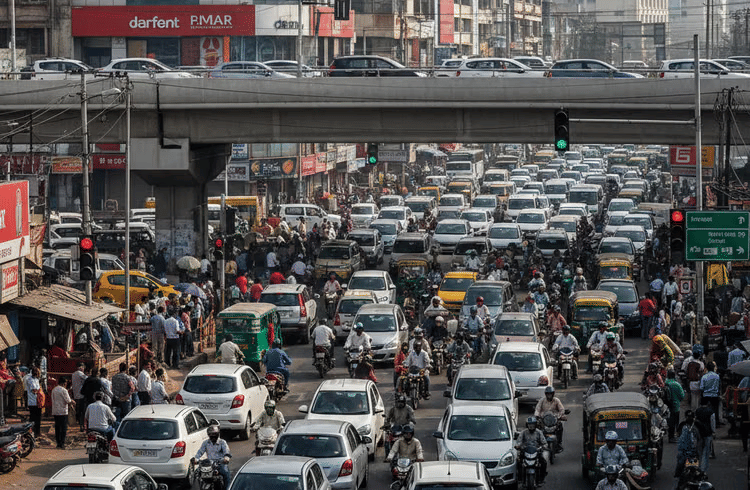
India's automobile market has always been a tale of geography as much as economics. The Society of Indian Automobile Manufacturers' (SIAM) latest state- and union territory-wise data for FY 2025–26 reveals a market shaped by divergent regional priorities.
Passenger Vehicles: Western Zone Leads, Maharashtra Dominates
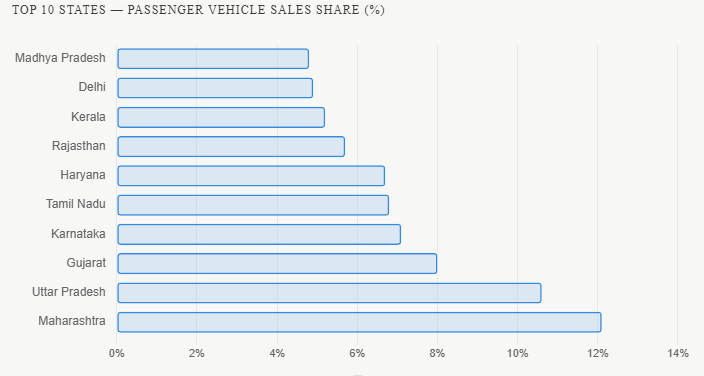 The Western Zone's dominance in passenger vehicles is no surprise — Maharashtra and Gujarat together represent the commercial and industrial heartland, with a large aspirational middle class, dense urban centres, and a well-developed dealer network.
Maharashtra alone contributed 12.1% of the country's total PV sales, outpacing its nearest rival Uttar Pradesh (10.6%) by a considerable margin. Gujarat, at 8%, rounds out the Western zone's supremacy.
Karnataka (7.1%), driven by the Bengaluru tech corridor and its appetite for SUVs and EVs, held its own at rank 4 nationally. Tamil Nadu (6.8%) rounds out the top five — cementing the South's relevance in the premium segment despite ceding the overall zone leadership to the West.
Two-Wheelers: UP Takes the Crown
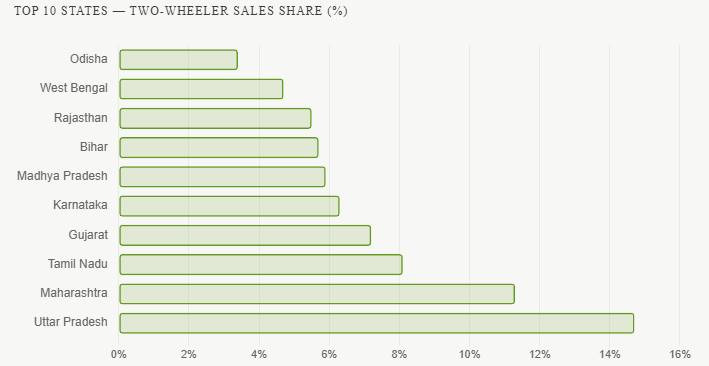 The two-wheeler segment rewrites the hierarchy entirely. Uttar Pradesh — with its vast rural hinterland, dispersed semi-urban geography, and the two-wheeler's role as the primary household mobility tool — claimed 14.7% of national sales, a commanding lead over Maharashtra's 11.3%.
This northern surge reflects structural demand: income growth in smaller towns, agricultural connectivity needs, and the continued relevance of affordable commuter motorcycles over public transport in much of the Indo-Gangetic belt.
The Western Zone still leads regionally, but its advantage narrows sharply when measured against the combined Northern bloc. Bihar (5.7%) and Madhya Pradesh (5.9%) also feature prominently, underlining that the mass two-wheeler market is increasingly a heartland story, not a metropolitan one.
Three-Wheelers: Southern Zone Leads, But the North Rules State Rankings
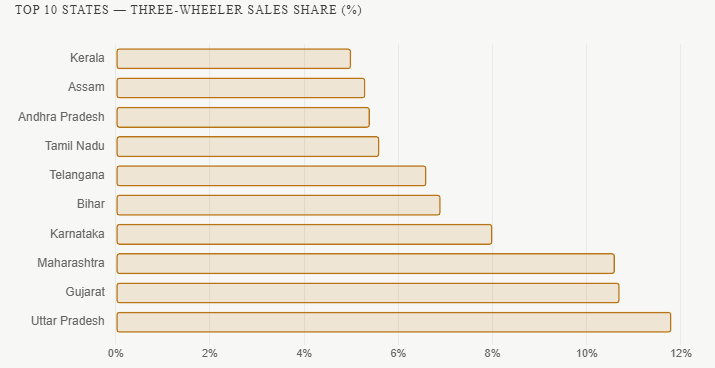 Three-wheelers present the market's most intriguing geographic paradox: the Southern Zone leads at the regional level, yet Uttar Pradesh tops the individual state chart. The explanation lies in the South's distributed strength — with Telangana (6.6%), Tamil Nadu (5.6%), Andhra Pradesh (5.4%), Assam (5.3%), and Kerala (5.0%) all contributing meaningfully — while UP concentrates its demand in a single-state surge driven by commercial auto-rickshaw registrations and last-mile electric three-wheeler adoption.
Gujarat (10.7%) and Maharashtra (10.6%) round out the top three nationally, while Karnataka (8.0%) and Bihar (6.9%) hold the next spots — reflecting both the commercial freight utility of three-wheelers and their passenger-carrying role in tier-2 and tier-3 urban ecosystems.
Commercial Vehicles: Maharashtra's Freight Muscle — Western Zone's Infrastructure Advantage
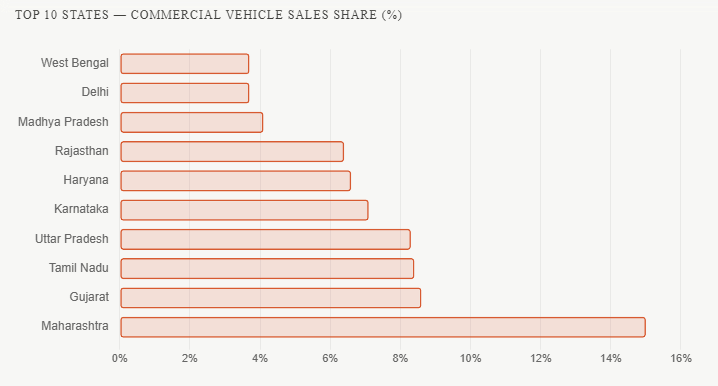 Commercial vehicle geography mirrors industrial and logistics concentration. Maharashtra's 15% share is the largest single-state share across any category in this dataset — a reflection of JNPT-linked freight corridors, Mumbai's distribution hubs, and Pune's manufacturing belts. Gujarat (8.6%) and Tamil Nadu (8.4%) follow closely, both benefiting from port infrastructure and manufacturing export zones.
Uttar Pradesh (8.3%) — which dominates in two-wheelers — ranks only fourth in CVs, pointing to the evolving nature of its logistics and road freight ecosystem. Haryana (6.6%) and Rajasthan (6.4%) punch above their population weight, underscoring the role of highway logistics in driving CV penetration beyond the traditional top markets.
The Big Picture
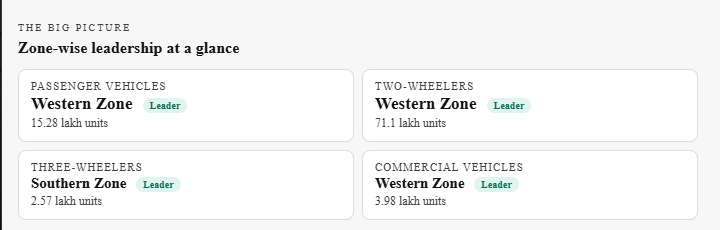
The SIAM FY2025–26 geographic data underlines a market in geographic evolution. The Western Zone's sustained leadership across three of four categories reflects the enduring power of Maharashtra and Gujarat's industrial-commercial complex. Yet the Northern surge — particularly Uttar Pradesh's two-wheeler and three-wheeler relevance — signals where the next wave of volume growth is being seeded.
With infrastructure investment, EV penetration, and rising rural income reshaping demand patterns, India’s state‑wise auto sales map may gradually become more dynamic in the years ahead.

RELATED ARTICLES

TVS NTorq Surpasses 2.5 Million Sales, Last 500,000 Units Sold in 15 Months
 Ajit Dalvi
 07 Oct 2026
The TVS NTorq, launched in February 2018 as the company’s first 125cc scooter and then joined by its feature-laden 150cc...


Mahindra SUV Sales Rise 21% in CY2026 to 541,942 Units, Intense Battle With Tata Continues
Ajit Dalvi
05 Oct 2026
M&M surpasses half-a-million sales in first nine months of this year, benefiting from demand for most of its models as w...

TVS Orbiter Sells 14,641 Units for 25% Share of TVS E-scooter Dispatches in August
Ajit Dalvi
24 Sep 2026
TVS registered its second-highest monthly e-scooter wholesales of 57,523 units in August, with every fourth model sold b...