Follow us
Maruti Suzuki to Increase Share of Rail-Based Vehicle Dispatches to 35% by FY2031
From 65,700 units and a 5% share in FY2015, Maruti Suzuki has increased its railways share of vehicle logistics operations to 518,157 vehicles and 24% in FY2025. Its future green logistics strategy envisages increasing the share of rail to 35% over the next five years.
 4610 Views


Maruti Suzuki India, the pioneer and the country’s No. 1 passenger vehicle OEM to use cargo-transporting trains to optimise its logistics operations to transport its vehicles from its manufacturing plants, is looking to increase the level of its rail-based shipments. The company, which was the first automaker to obtain an AFTO (Automobile Freight Train Operator) license back in 2013, uses a combination of rakes operated by AFTOs and those owned by the Indian Railways.
Maruti Suzuki recently became the first automobile manufacturer to use the services of the Indian Railways to dispatch vehicles to Jammu & Kashmir. On October 3, the maiden train carrying over 100 Maruti Suzuki vehicles like the Brezza, Dzire, Wagon R and S-Presso among others, which had departed from the Manesar in-plant railway siding, reached the Anantnag terminal. The train travelled over 850 kilometres to reach the newly opened Anantnag railway terminal in Jammu & Kashmir. En route to Anantnag, the train crossed the world’s highest railway arch bridge over the river Chenab.
Using ‘common rail’ to up the green logistics quotient
Maruti Suzuki has been at the forefront of using the railways as a sustainable and efficient mode of vehicle transportation as part of an effort to lower the carbon footprint of its logistics operations. Since FY2015, the company has dispatched over 2.6 million vehicles using Indian Railways, significantly reducing carbon emissions and easing road congestion.
In FY2015, the company had dispatched 65,700 vehicles by rail, which made for a 5% share of railways in its vehicle transport logistics. A decade later, in FY2025, Maruti Suzuki dispatched 518,157 vehicles via rail, avoiding about 180,000 metric tonnes of CO2e (carbon dioxide equivalent) emissions and saving more than 630 lakh (63 million) litres of fuel from being consumed on road transport and then released in the air.
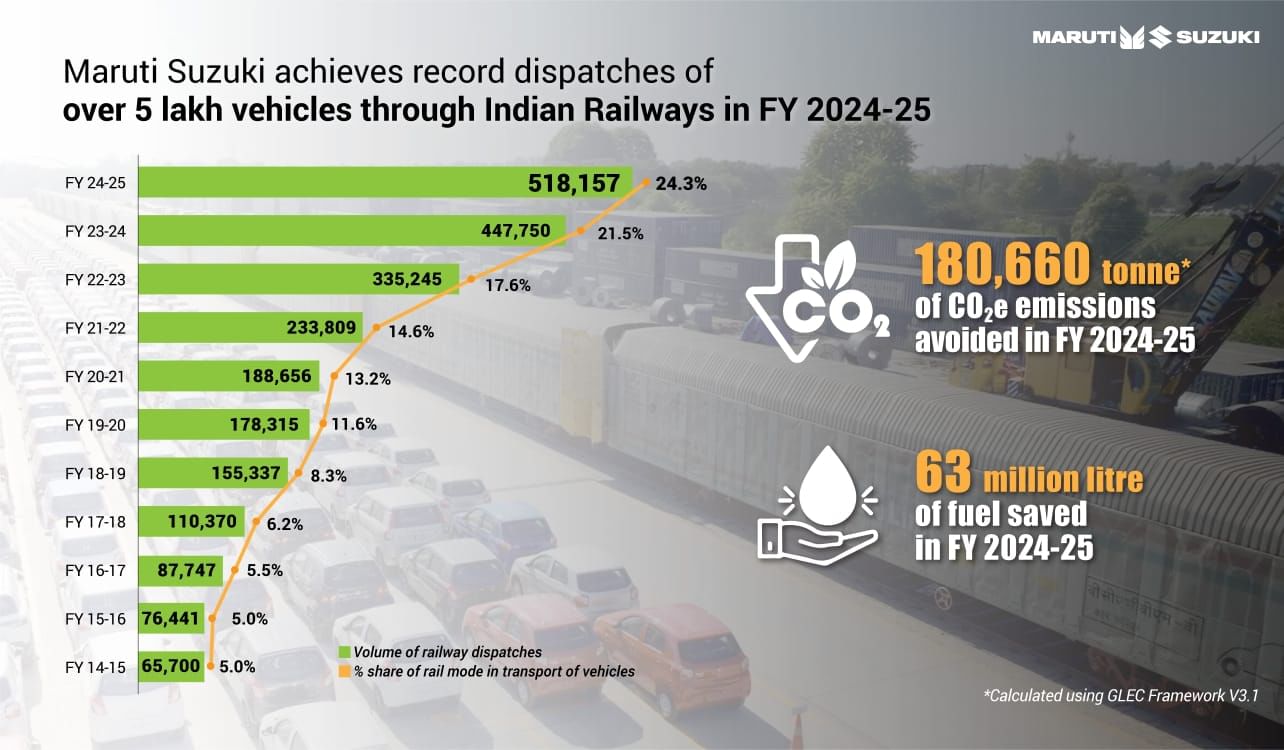 From 65,700 units and a 5% share of its vehicle logistics operations in FY2015, Maruti Suzuki increased its railways share to 518,157 vehicles and 24% in FY2025.
These 518,157 vehicle shipments by rail – its highest ever yet – constituted about one-fourth of Maruti Suzuki’s total dispatches in FY2025 and saw the share of rail in its vehicle transport logistics rise to 24.3 percent. It has outlined plans to progressively increase this use-of-railways percentage share to 35% of total vehicle dispatches by FY2031.
Currently, Maruti Suzuki operates over 40 flexi-deck rakes, each with a capacity of carrying around 300 vehicles per trip, and dispatches vehicles to more than 20 hubs using railways, from where over 600 cities across India are served. The Mundra and Pipavav ports, used by the company for exports, are also served by using the railways.
The company’s railway logistics programme has benefited from having in-plant railway sidings at two of its manufacturing facilities – in Gujarat (March 2023) and Manesar (June 2025) – which now support a dispatch capacity of 750,000 vehicles annually. Plans are underway to set up an in-plant railway siding at the recently inaugurated Kharkhoda facility in Haryana. Since FY2015, the company has dispatched over 2.6 million vehicles using the Indian Railways, significantly reducing carbon emissions and easing road congestion.
Given the growing potential of the domestic market as well as the demand for made-in-India PVs, Maruti Suzuki’s future capacity expansion roadmap envisages scaling up of production to 4 million units per annum by FY2031. This also calls for optimising its vehicle transport logistics in terms of both higher efficiency as well as low-emission systems like the electrified railways.
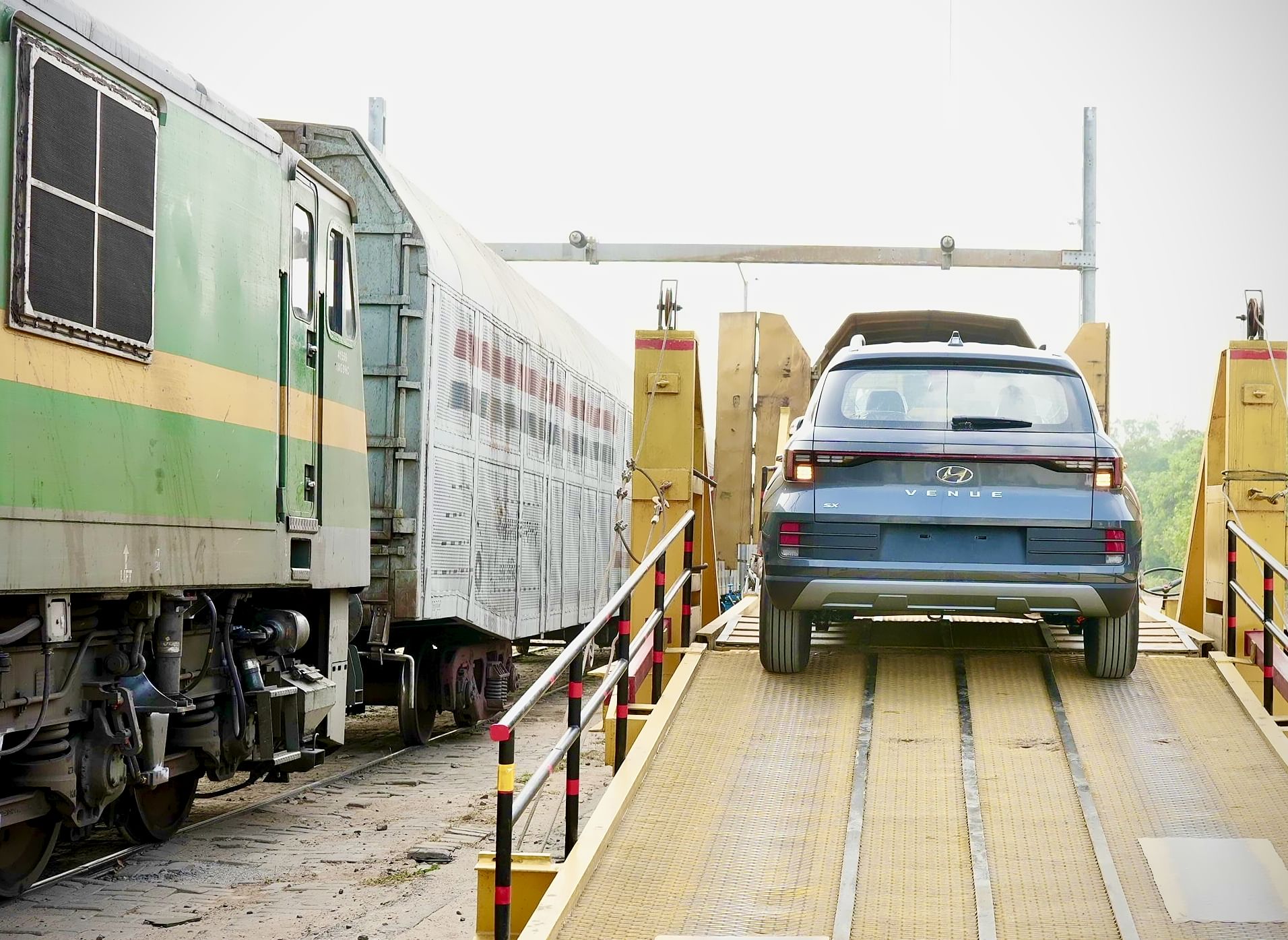
A Hyundai Venue compact SUV being driven inside a vehicle-transporting rake.
Hyundai dispatches 537,399 vehicles by rail over 4 years
Hyundai Motor India too is using the Indian Railways’ extensive network to transport its hatchbacks, sedans and SUVs across the country. In CY2024, the Korean automaker transported 156,724 units by rail freight which accounts for 26% of its total domestic wholesale volume last year, thereby reducing 18,352 tons of CO2 emissions.
According to Hyundai, 100% of all its dispatches to the North-East region were carried out through rail freight in CY2024. And, over four years from CY2021 to CY2024, it has cumulatively dispatched 537,499 units by rail, effectively preventing 63,452 tons of CO2 emissions.
ALSO READ: Maruti Suzuki production to cross 2 million units for second year in a row in CY2025

RELATED ARTICLES

Maruti Ertiga Crosses 1.5 Million Sales Milestone
 Ajit Dalvi
 12 Sep 2026
India’s highest-selling MPV and Maruti Suzuki’s first crack at the people-mover segment has sold 15,13,574 units in the ...


Maruti Suzuki on Track for 2 Million Domestic Market Annual Sales for the First Time in CY2026
Ajit Dalvi
11 Sep 2026
Having sold 1.40 million passenger vehicles with 22% YoY growth in the first eight months of this year, market leader Ma...

World EV Day Special: 10 million EVs sold in India since 2017, EV penetration at 11% in 2026
Ajit Dalvi
09 Sep 2026
Powered by multiple tailwinds, not only has the Indian electric vehicle industry achieved 300,000 sales three months in ...