Follow us
FEATURED: Head-Up Displays- In the Line of Vision
HUDs are fast gaining popularity as a preferred interface for critical information like vehicle speed, warnings and navigation messages - to be displayed as a virtual image directly in the driver’s line of vision.
 15 Sep 2017
 9998 Views
Share -
9998 Views
Share -


Widening the Field of View
Head-up displays (HUDs) is transforming the driving experience from one that is predominantly head-down – reading information on instrument clusters and displays – to one that is head-up, with vital information displayed in the driver's line of sight.
HUDs are fast gaining popularity as a preferred interface for critical information like vehicle speed, warnings and navigation messages - to be displayed as a virtual image directly in the driver’s line of vision.
Having delivered more than 1 million HUD units for production vehicles, Visteon’s scalable HUD solutions target all segments from entry-level to luxury vehicles - ranging from wide field windshield HUDs to a range of combiner HUDs, which project a virtual image in front of the driver using a compact, retractable screen.
Intuitive interaction, Fast Reactions
As the range of connected and assisted driving features increases, HUDs offer an intuitive HMI solution for driver interaction, either complementing or substituting traditional instrument clusters. Due to its larger display area, HUD systems can also provide better environmental representation of assisted driving features than any other display technology –increasing driver reaction time and safety.
Combiner HUDs - Compact Solution for all Segments
Visteon’s combiner HUDs expand HUD technology beyond the luxury segment to mass-market vehicles - including entry-level applications requiring an economical solution, small- to medium-sized vehicles, and high-end segments. The displays offer various levels of kinematics, optical quality, brightness, color definition and display surface sizes to meet different specifications.
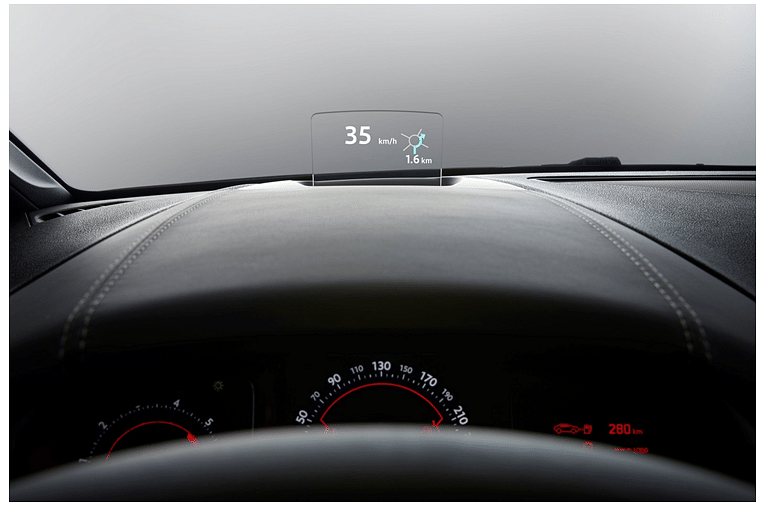
Windshield HUDs - a Wider Field of View
Visteon’s windshield HUD solutions range from 6x2° field-of-view (FoV) applications, where images are projected on the windscreen two meters from the driver’s eyes, to wide-field technology – including an option that offers a 10x4° FoV which is about twice the size of a standard windshield HUD.
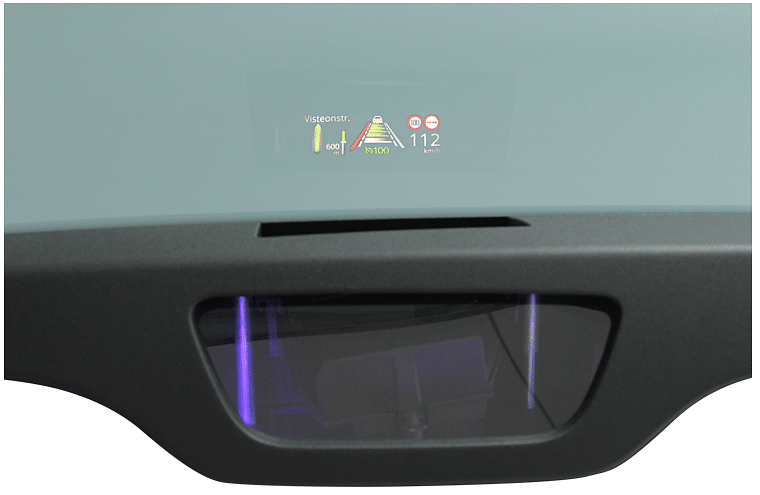
Visteon Strengths
While one of the main challenges in HUD development is the very constrained packaging space available in the driver area, Visteon’s core competencies also help provide efficient customer support to reach the best trade-offs for the design of the surrounding instrument panel. Understanding these constraints enables Visteon to deliver an optimized experience for the end-user - in terms of the size of the virtual image and readability - and act as a key success factor in building strong relationships with vehicle manufacturer’s development teams.

RELATED ARTICLES

Audi Expects India's Luxury Car Sales Set to Hit Record 58,000 Units in 2026
 Darshan Nakhwa
16 Oct 2026
Darshan Nakhwa
16 Oct 2026
The German carmaker plans to expand its showroom network in India from 28 outlets to around 40 by 2027 and more than 50 ...


Audi Launches New Q3 in India at ₹51.99 Lakh
Darshan Nakhwa
16 Oct 2026
Locally assembled luxury SUV gets a 2.0-litre turbo-petrol engine producing 204 PS power and 320 Nm torque.

Hero MotoCorp Launches Updated Xtreme 160R 4V and Xtreme 250R
 Dev Vadchhedia
16 Oct 2026
Dev Vadchhedia
16 Oct 2026
Introductory pricing starts at Rs 1.27 lakh for Xtreme 160R 4V and Rs 1.98 lakh for Xtreme 250R.