


Volkswagen Group ups the ante on EVs, plans 16 production sites by end-2022
The Group currently produces electric vehicles at three locations, and in two years' time a further nine Group plants are scheduled to be equipped for this purpose.
 By Autocar Professional Bureau
 5434 Views


The Volkswagen Group is aggressively driving forward the transformation to e-mobility. Sixteen of its production sites locations worldwide are to produce battery powered vehicles by the end of 2022. This was announced by Matthias Müller, CEO of Volkswagen AG, at the Group's Annual Media Conference in Berlin.
The Group currently produces electric vehicles at three locations, and in two years' time a further nine Group plants are scheduled to be equipped for this purpose. To ensure adequate battery capacity for the massive expansion of environmentally-friendly electric mobility, partnerships with battery manufacturers for Europe and China have already been agreed. The contracts already awarded have a total volume of around 20 billion euros (Rs 152,880 crore). A supplier decision for North America will be taken shortly.
"Over the last few months, we have pulled out all the stops to implement ‘Roadmap E' with the necessary speed and determination," CEO Müller explained in Berlin. When Roadmap E was launched last fall, Volkswagen announced plans to build up to three million electric vehicles annually by 2025 and market 80 new electric Group models. This year, another nine new vehicles, three of which will be purely electric-powered, will be added to the Group's electric portfolio of eight e-cars and plug-in hybrids.
A number of innovations from the Group were presented last week at the Geneva International Motor Show, among them the Audi e-tron, the Porsche Mission E and the I.D. VIZZION, another member of the Volkswagen I.D. family. From 2019, there will be a new electric vehicle "virtually every month", Müller said: "This is how we intend to offer the largest fleet of electric vehicles in the world, across all brands and regions, in just a few years."
Conventional drive systems still on
The CEO emphasised that this did not mean Volkswagen is turning its back on conventional drive systems. Modern diesel drives were part of the solution, not part of the problem, he stressed – also with regard to climate change. "We are making massive investments in the mobility of tomorrow, but without neglecting current technologies and vehicles that will continue to play an important role for decades to come," said Müller. "We are putting almost 20 billion euros into our conventional vehicle and drive portfolio in 2018, with a total of more than 90 billion euros (Rs 687,968 crore) scheduled over the next five years."
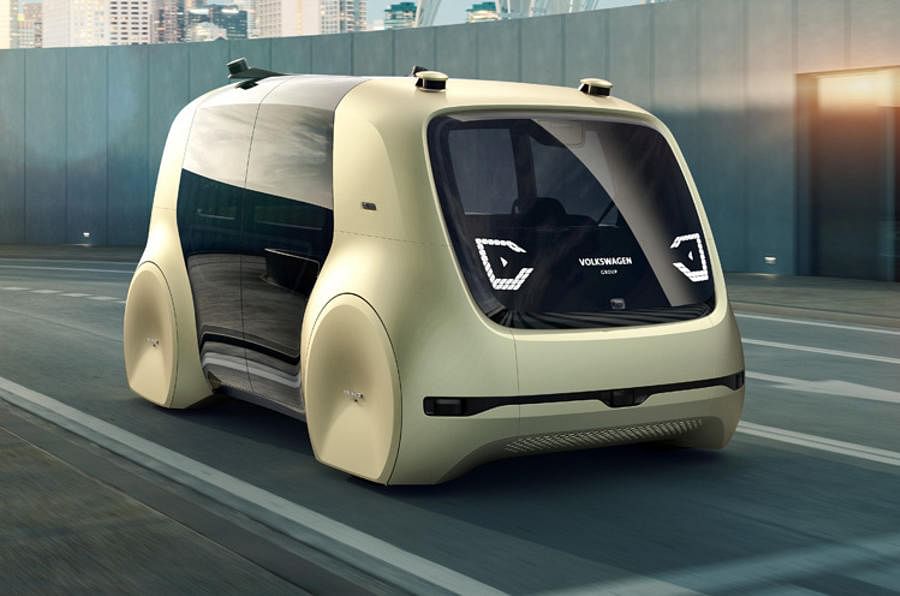
A separate committee chaired by CEO Müller is advancing digitalisation in the Group, a key issue for the future. "The future of mobility is gradually taking shape, as is the future of the Volkswagen Group," Müller said. The best example of this is Sedric, which has enabled the Volkswagen Group to demonstrate the potential of fully autonomous driving for the first time. Sedric was designed in the Group, but will soon be "leaving the Group for refinement into a series product at one of our brands," Müller announced.
The transformation of the entire Group that got off the ground in 2016 is becoming "more concrete, tangible and discernible with every passing day," said Müller. Together – Strategy 2025 brought precisely the shake-up that Volkswagen needed. "2017 was an excellent year for the Volkswagen Group and its brands. We're back on the offensive– and we intend to remain there," the CEO stressed, adding that this was true for electric mobility in particular. "With Roadmap E, we have sent a powerful message of our resolve," Müller stated. The Volkswagen Group kicked off "Roadmap E", the most comprehensive electrification drive in the automotive industry, last year.
The Volkswagen Group has the financial resources for the transformation. In spite of the billions in cash outflows from the diesel crisis, net liquidity at the end of 2017 remained at a very solid 22.4 billion euros ((Rs 171,225 crore).
RELATED ARTICLES

Autoliv Plans JV for Advanced Safety Electronics With China’s HSAE
 Ajit Dalvi
 11 Oct 2025
The new joint venture, which is to be located strategically near Shanghai and close to several existing Autoliv sites in...


JLR to Restart Production Over a Month After September Hacking
Ajit Dalvi
07 Oct 2025
Manufacturing operations at the Tata Group-owned British luxury car and SUV manufacturer were shut down following a cybe...

BYD UK Sales Jump 880% in September to 11,271 units
Ajit Dalvi
07 Oct 2025
Sales record sets the UK apart as the largest international market for BYD outside of China for the first time. The Seal...