

 Follow us
US Imposes 50% Tariffs on Indian Imports, Making India Most Heavily Tariffed Nation Globally
Credit rating agency ICRA reports widespread impact across sectors, with companies adopting various mitigation strategies to manage increased costs and maintain competitiveness.
 By Angitha Suresh
 2696 Views


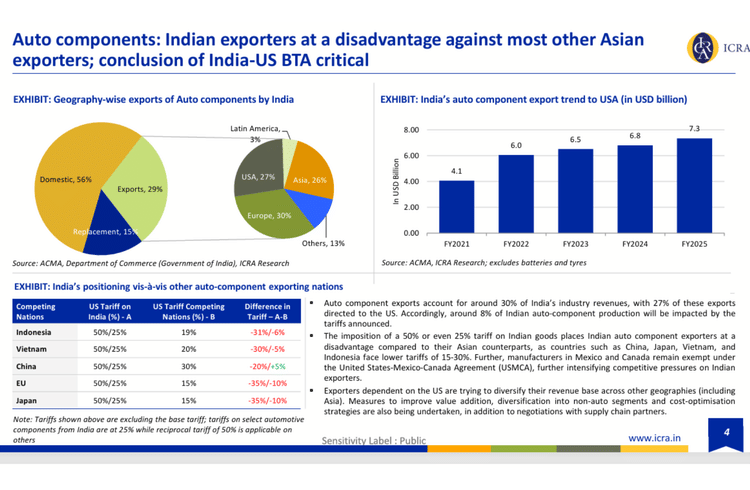
The United States has imposed a combined 50% tariff on most Indian imports following two separate announcements in 2025, according to a September report by Indian credit rating agency ICRA.
The tariff structure positions India as the most heavily tariffed country globally, surpassing rates applied to China and other major trading partners.
The tariff implementation occurred in two phases. In July 2025, the US announced a 25% reciprocal tariff on Indian imports, which took effect on August 7, 2025. An additional 25% penalty tariff was imposed on August 27, 2025, in response to India's continued engagement with Russia in oil and defense sectors despite ongoing Western sanctions.
ICRA's analysis shows the tariffs affect Indian exports across more than 140 product categories. The US accounts for significant portions of India's exports in several key sectors, including 37% of cut and polished diamonds, 36% of seafood, 31% of steel, 25-35% of textiles, and 22% of auto components.
These sectors face varying degrees of impact based on their ability to pass increased costs to customers or find alternative markets.
The credit rating agency conducted surveys with companies across affected sectors to assess business responses. Auto component manufacturers report minimal immediate impact due to limited alternative suppliers and successful cost pass-through strategies. Many companies have negotiated arrangements where customers absorb tariff costs, particularly for components with few substitutes.
In contrast, textile and seafood exporters face more substantial challenges. ICRA projects margin contractions of 200-300 basis points for apparel exporters and expects a 6-9% decline in revenues for the sector in fiscal year 2026.
The textile industry's exposure is particularly significant given that the US represents the top destination for Indian apparel exports.
Companies in the cut and polished diamond sector are implementing re-routing strategies through countries such as Belgium, Israel, and the UAE to avoid direct US tariffs. The diamond industry, where India accounts for 90% of global polishing, expects revenue declines of 15-20% due to reduced US demand.
Metal exporters, despite high US exposure, report stable shipment volumes as they successfully pass the entire tariff burden to end customers. This reflects the US market's heavy reliance on specialized imports where domestic alternatives remain limited.
The tariff rates applied to India exceed those imposed on other major Asian exporters. China faces 30% tariffs, while countries including Vietnam (20%), Bangladesh (20%), Indonesia (19%), and Japan (15%) encounter lower rates. This differential potentially undermines India's position as a preferred sourcing destination for US importers.
ICRA initially revised India's GDP growth projection for fiscal year 2026 downward to 6.0% from 6.5% following the tariff implementation. However, the agency subsequently raised the projection back to 6.5%, citing expected benefits from goods and services tax rationalization that could offset some tariff-related economic drag.
The trade relationship between India and the US spans multiple sectors, with Indian exports ranging from agricultural products and textiles to pharmaceuticals and technology services.
The US has historically been one of India's largest trading partners, making the tariff imposition particularly significant for Indian economic growth and export competitiveness.
The timing of these measures coincides with broader US trade policy adjustments under the current administration, which has emphasized reciprocal trade arrangements and sanctions enforcement as key policy priorities.

RELATED ARTICLES

Auto LPG seeks inclusion in 5-year national permit extension
 Eshisha Java
 24 Aug 2026
IAC has called for Auto LPG vehicles to be included in MoRTH’s proposed five-year national permit age extension for clea...


Zoomcar, Uber partner to offer self-drive, Intercity rides
Eshisha Java
24 Aug 2026
Zoomcar and Uber partner to add Uber Intercity booking on Zoomcar, letting users compare self-drive and chauffeur-driven...

Spinny partners Nissan, MG Motor India and Tesla on exchanges
Eshisha Java
24 Aug 2026
Spinny partnerships with Nissan, JSW MG Motor India and Tesla cover vehicle exchange, pre-owned cars and EVs across key ...