Follow us
Tractors Cross 10 Lakh Retail For The First Time
A record 10‑lakh tractors retailed in FY26, powered by strong monsoon, robust rabi sowing and rising farm incomes.
 By Shruti Shiraguppi
 1776 Views


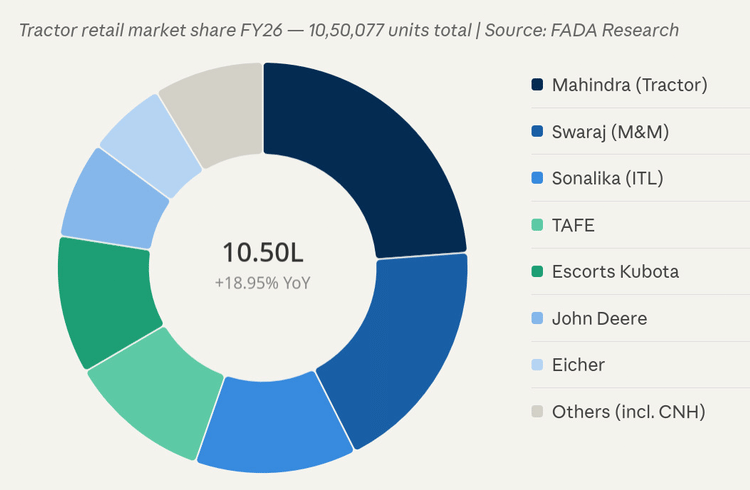
India's tractor market crossed a historic threshold in FY 2025-26 — 10,50,077 units retailed, the first time the segment has breached the 10-lakh mark. The 18.95 per cent YoY growth from 8,82,825 units in FY25 made tractors the fastest-growing vehicle category in the FADA universe, outpacing even two-wheelers and passenger vehicles.
March 2026 capped the year with 82,080 units (+10.87 per cent YoY), a healthy if unremarkable monthly reading that underscored the point: the growth was not a year-end spike but a sustained full-year story, built on the foundations of a strong south-west monsoon, robust rabi sowing season and improving farm economics.
The Mahindra Duopoly
The competitive landscape remains dominated by one group. Mahindra & Mahindra's tractor division (including the Swaraj brand) retailed a combined 4,46,948 units in FY26 — a commanding 42.57 per cent of the market. The Mahindra tractor brand alone held 23.81 per cent share (2,49,973 units), while the Swaraj division contributed 18.76 per cent (1,96,975 units). Both divisions gained marginal share: Mahindra tractor from 23.57 per cent and Swaraj from 18.75 per cent.
The combined Mahindra tractor franchise is, in absolute terms, larger than many PV manufacturers. Its 4.47 lakh units exceed Hyundai's domestic PV volumes (5.85 lakh) by a thinner margin than one might expect — a reminder of the economic weight of farm mechanisation in India.
The Challengers
International Tractors Limited (Sonalika) held third position at 12.76 per cent share (1,34,030 units), down marginally from 13.04 per cent. TAFE Limited edged up to 11.27 per cent (1,18,326 units) from 11.24 per cent.
The more interesting movement was at Escorts Kubota, which climbed to 10.90 per cent share (1,14,468 units) from 9.93 per cent — the biggest share gain among the top five. The 30.6 per cent volume growth suggests the global Kubota partnership is beginning to pay dividends in the domestic market, with technology transfer, product upgrades and a wider dealer footprint contributing to the acceleration.
John Deere held steady at 7.63 per cent (80,086 units), Eicher Tractors slipped marginally to 6.21 per cent (65,215 units), while CNH Industrial gained at 4.49 per cent (47,122 units, up from 4.05 per cent) — another sign that global tractor partnerships are reshaping the competitive order.
In March specifically, the share picture was broadly similar: Mahindra at 23.94 per cent, Swaraj at 19.50 per cent, Sonalika at 12.42 per cent, Escorts Kubota at 10.87 per cent and TAFE at 10.34 per cent.
What drove the 10-lakh milestone
The tractor market's performance is intrinsically tied to the agricultural economy, and FY26 delivered a near-ideal confluence of positive factors. The 2025 south-west monsoon was the best in several years, with cumulative rainfall marginally above the long-period average. This translated into strong kharif crop production, healthy reservoir levels heading into the rabi season, and improving rural cash flows from October onwards — precisely the period when tractor demand traditionally peaks.
The rabi sowing season was equally robust, with acreage for wheat, mustard and pulses expanding. Government MSP increases, direct benefit transfers and improving terms of trade for agriculture all contributed to an environment where farm incomes were rising and confidence was high.
The rural-urban dynamic in the tractor segment is distinctive. Tractors are overwhelmingly rural: 81 per cent of tractor retail in FY26 came from rural RTOs, a ratio that has been remarkably stable (it was 81.5 per cent in FY25). Urban tractor demand (19 per cent), which includes peri-urban construction and haulage applications, grew 22.37 per cent — faster than rural's 18.17 per cent — suggesting expanding non-agricultural uses.
The Mechanisation Thesis
India's farm mechanisation levels remain low by global standards — approximately 47 per cent compared to over 90 per cent in developed markets. The 10-lakh retail milestone, while historic, represents penetration that still has significant headroom. The average Indian farm holding (1.08 hectares according to the Agricultural Census) is too small for most tractors, which means the market is driven by medium and large farmers, custom hiring centres and institutional buyers. As farm consolidation proceeds — slowly but perceptibly — and as custom hiring models proliferate, the addressable market should continue to expand.
The FY27 outlook hinges on monsoon performance (the IMD's initial forecasts, when they arrive, will be the single most important data point for the segment) and the continuation of supportive agricultural policy. If the monsoon delivers a third consecutive normal-to-good year, tractors could well sustain double-digit growth and potentially approach 11.5 lakh units

RELATED ARTICLES

Maruti Suzuki Projects Double-Digit Retail Growth Through Festive Season
 Autocar Professional Bureau
 21 Oct 2026
The carmaker reported a 35% increase in retail sales between Ganesh Chaturthi and Dussehra.


Valeo to Build NVIDIA Hyperion Compute Platforms for SDVs
 Dev Vadchhedia
21 Oct 2026
Dev Vadchhedia
21 Oct 2026
Valeo integrates dual NVIDIA DRIVE AGX Thor processors to produce Level 4 compute hardware for passenger cars, robotaxis...

Delhi CM Rekha Gupta Announces Anti-Pollution Measures: Non-BS VI Entry Ban, Mandatory Fuel Station PUC Checks
Autocar Professional Bureau
21 Oct 2026
Delhi mandates No PUC No Fuel policy, bars entry of non-BS VI vehicles, and implements staggered office hours and 50 per...