Follow us
Three-Wheeler Retail Sales Rise 24% in February 2026
India's three-wheeler segment recorded its highest-ever February sales volume, driven by broad-based growth across passenger, goods, and personal sub-categories year-on-year.
 By Angitha Suresh
 933 Views


Three-wheeler retail sales in India reached 1,17,130 units in February 2026, a 24.39% increase from 94,162 units in February 2025, according to data released by the Federation of Automobile Dealers Associations (FADA) on March 5, 2026. The result marks the best-ever February performance for the segment, continuing a run of strong monthly figures seen across most vehicle categories in the early part of calendar year 2026.
The passenger sub-segment led growth within the category, with 60,572 units retailed — up 36.01% year-on-year. E-rickshaws configured for passenger use accounted for 34,848 units, a more modest 7.75% rise compared to February 2025. Goods-carrying three-wheelers posted 14,335 units, reflecting a 32.34% increase, while e-rickshaws with cart (goods) came in at 7,268 units, up 13.90%. The personal-use sub-category, though small in absolute volume at 107 units, recorded the sharpest year-on-year growth in the segment at 50.70%.
On a month-on-month basis, overall three-wheeler sales declined 7.87% from January 2026's 1,27,134 units. This is consistent with the broader market pattern observed in February, which is a shorter calendar month and historically sees lower volumes across vehicle segments compared to January.
Rural markets continued to outpace their urban counterparts in the three-wheeler segment. Rural registrations rose 35.28% year-on-year, significantly ahead of the 13.20% growth recorded in urban areas. This pattern aligns with the broader rural demand story observed across multiple vehicle categories in February 2026, supported by improved agricultural incomes following favorable crop outcomes and greater rural liquidity.
In terms of OEM market share, Bajaj Auto retained its dominant position with 44,556 units sold and a 38.04% share of the segment, improving from 36.81% in February 2025. Piaggio Vehicles followed with 8,812 units and a 7.52% share. Mahindra & Mahindra sold 8,637 units (7.37%), while its subsidiary Mahindra Last Mile Mobility retailed 8,514 units (7.27%).
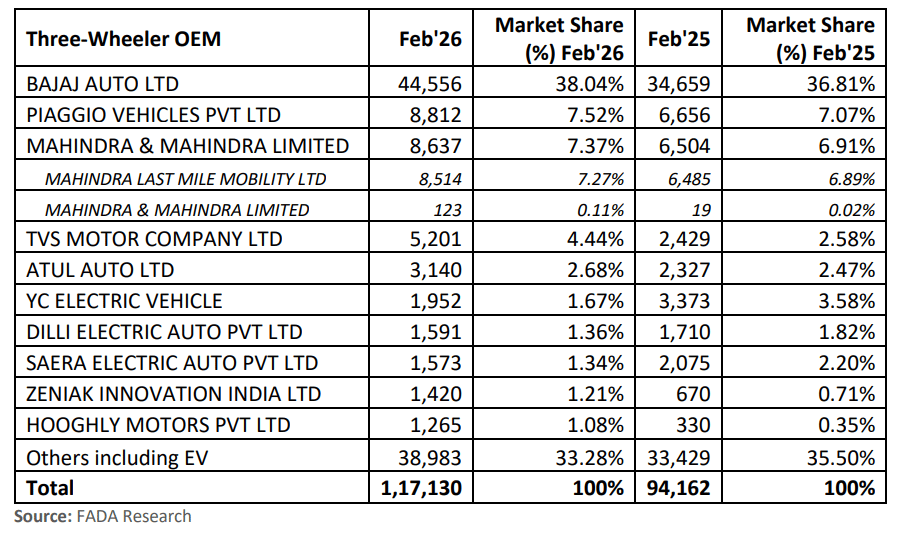 TVS Motor Company showed notable momentum, more than doubling its volume to 5,201 units from 2,429 units a year earlier, raising its market share from 2.58% to 4.44%. Smaller players such as Zeniak Innovation India and Hooghly Motors also recorded significant growth, though from a low base. On the other hand, YC Electric Vehicle and Saera Electric Auto saw their market shares decline year-on-year.
From a fuel-mix perspective, electric vehicles continued to dominate the three-wheeler segment. EVs accounted for 56.70% of three-wheeler retail sales in February 2026, compared to 56.37% in February 2025, reflecting the segment's well-established shift toward electric mobility, particularly in the passenger and last-mile delivery sub-categories. CNG and LPG-powered vehicles held a 28.28% share, while diesel accounted for 14.64%, an increase from 12.24% a year earlier. Petrol and ethanol variants remained marginal at 0.39%.
For the financial year to date, covering April 2025 through February 2026, cumulative three-wheeler retail stood at 12,53,658 units, representing 11.78% growth over the 11,21,513 units retailed in the same period of FY25. The segment's performance through the year has been supported by rising urban last-mile logistics demand, growing e-commerce activity, and expanding rural connectivity needs.
FADA collects vehicle retail data in collaboration with the Ministry of Road Transport and Highways, Government of India. The February 2026 figures were gathered from 1,459 out of 1,464 RTOs across the country and do not include figures from Telangana.

RELATED ARTICLES

Tsuyo Partners With China's LvKON to Produce Electric CV Powertrains in India
 Dev Vadchhedia
 23 Oct 2026
Tsuyo plans 24-acre greenfield plant as five-year technical association expands into heavy-duty commercial drive systems...


JK Tyre Reports Rs 60 Cr Profit on Revenue of Rs 4,850 Cr in Q2 FY27
Dev Vadchhedia
23 Oct 2026
The tyre maker posts 20 percent year-on-year revenue growth driven by OEM demand and domestic sales momentum.

Youdha Launches ePod G Electric Three-Wheeler Cargo Vehicle
Dev Vadchhedia
23 Oct 2026
The E-CV maker expands its ePod platform into goods transportation with 545 kg payload and 180 km range.