Follow us
Tata Motors Targets Up to 4x EV Sales Growth by FY31 As Sierra.ev, Safari.ev and Avinya Shape Next Phase
Automaker pegs EV market to cross 1.1 million by FY-31penetration in India’s PV market at 15%-20% by FY31; targets 30% EV mix in own portfolio as adoption gathers pace.
 23 Jun 2026
 4897 Views
Share -
4897 Views
Share -


Tata Motors, India’s largest electric car maker, expects the country’s electric passenger vehicle market to scale up to 1 million-1.1 million units by FY31, and is positioning itself for a 3-4x increase in its own EV sales over the next five years as the category moves closer to the mainstream.
At its investor day on Tuesday, the company said EV penetration in the domestic passenger vehicle industry could rise to 15%-20% by FY31, driven by improving customer acceptance, wider charging infrastructure, stronger product economics and a maturing ecosystem.
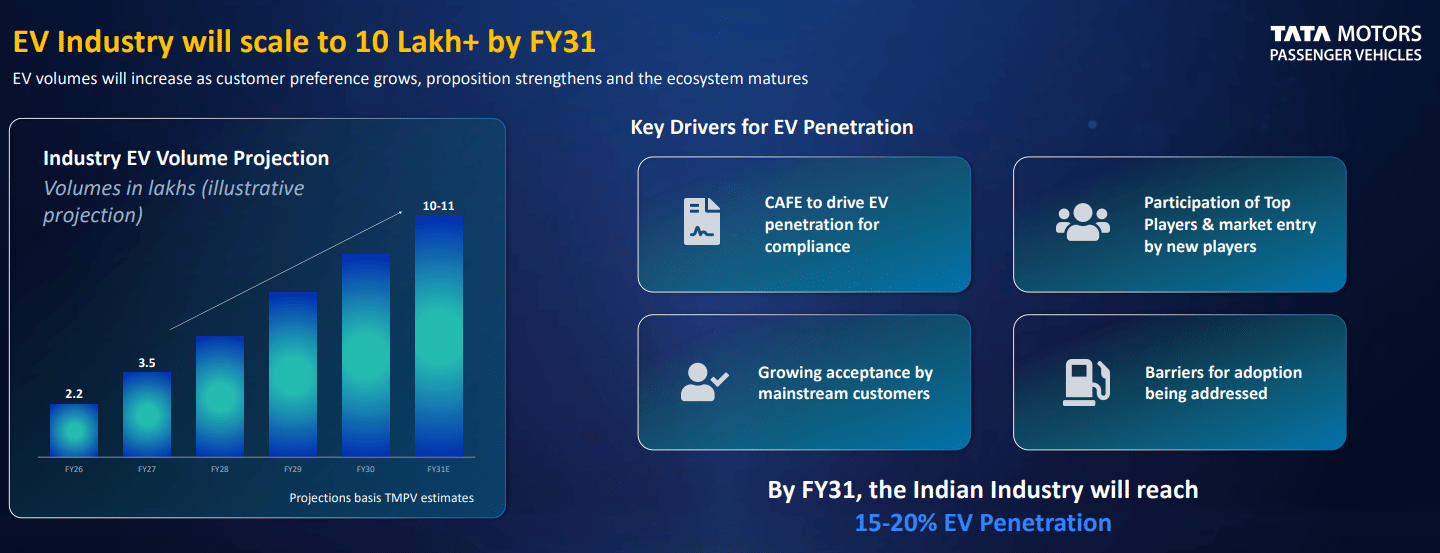
For Tata Motors, the opportunity is central to its next phase of growth. The company is targeting 30% EV penetration within its own passenger vehicle portfolio by FY31, which, based on its wider volume ambitions, translates into annual EV sales of around 350,000-400,000 units.
With the company on course to cross 100,000 EV units this year, the target implies a steep scale-up in volumes from current levels as Tata Motors looks to consolidate its lead in the segment. The sales ambition also underlines the scale of execution the automaker is betting on as competition in electric cars begins to widen across price points and body styles.
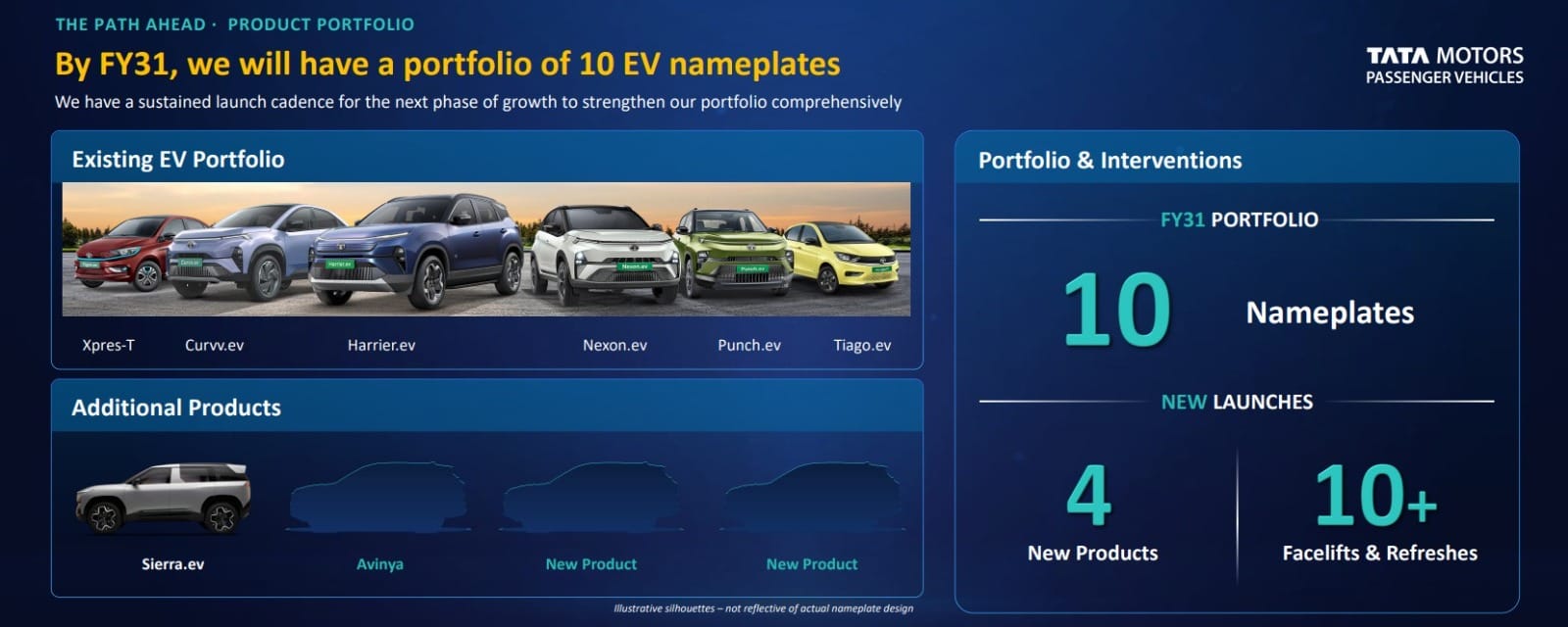
Tata Motors’ EV journey in the mass market got a major push with the launch of the Tiago.ev, which helped broaden access to electric mobility beyond early premium adopters. The company is now set to launch the Sierra.ev on June 30, plans to bring in the Safari.ev in September, and is expected to introduce the Avinya premium EV within the next one year, indicating a sharper push into both lifestyle and higher-end electric segments.
That product cadence is significant because Tata’s early advantage has come from building a wider EV lineup than most rivals, spanning hatchbacks and SUVs across multiple price bands. The addition of newer nameplates is expected to help the company strengthen volumes while also improve its presence in premium and fast-growing segments of the market.
The company also said electric and CNG vehicles together are expected to account for 45% of the overall passenger vehicle market by FY31, underlining its view that the industry’s next growth cycle will be driven by multiple alternative powertrains rather than a single-technology transition.
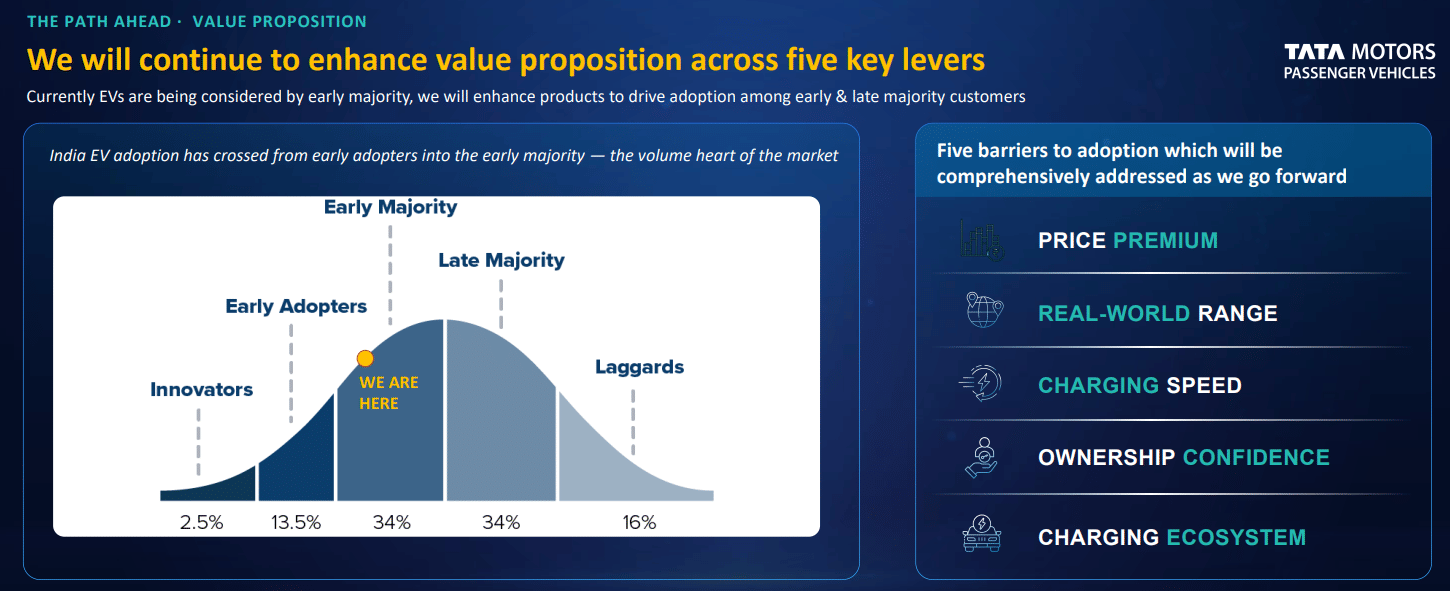
Tata Motors expects EVs to contribute nearly half of incremental passenger vehicle industry growth through FY31, supported by regulatory pressure, increasing participation from mainstream buyers and continued improvements in charging access and ownership confidence. As volumes rise, scale and localisation will also become more important in supporting cost competitiveness and margins.
The EV push forms a key part of Tata Motors’ broader ambition to grow passenger vehicle sales to 1.2 million units by FY31 from 640,000 units in FY26, with electric mobility expected to emerge as one of the biggest drivers of that expansion.

RELATED ARTICLES

Renault India Sees Hybrids As Major Volume-Generating Powertrain In Medium Term
 Kiran Murali
28 Sep 2026
Kiran Murali
28 Sep 2026
The automaker is betting on strong hybrids as it expands its product portfolio and prepares for a shift in India's power...


Renault India Eyes 500 Showrooms By End Of 2027
Kiran Murali
28 Sep 2026
The automaker is planning to expand its retail footprint as it looks at a product portfolio of seven models by the end o...

SWITCH Mobility Secures 840 Electric Bus Order Under PM E-Drive
Eshisha Java
28 Sep 2026
SWITCH Mobility has secured an order for 840 electric buses under PM E-Drive, comprising 420 each of 9-metre and 12-metr...