Follow us
Tata Motors Readies Flexible Manufacturing Network for Next Phase of PV Growth
Automaker to make multiple products across multiple factories, expand Sanand plant and debottleneck existing facilities to improve utilisation and respond faster to demand shifts.
 25 Jun 2026
 2109 Views
Share -
2109 Views
Share -


Tata Motors is reconfiguring its passenger vehicle manufacturing footprint to allow multiple products to be built across multiple plants, a strategy aimed at improving capacity utilisation and responding more quickly to shifts in consumer demand as it prepares for its next phase of growth.
The manufacturing overhaul forms a key pillar of the company's ambition to more than double passenger vehicle volumes by FY31, rather than relying solely on new factories.
"We want multiple products to be made in multiple factories so that if the demand goes down for one product, we are able to fill that capacity with product which is going in high demand. So, we are trying to bring this fungibility," the company’s Managing Director and CEO Shailesh Chandra said during the Investor Day.
The strategy marks a shift from dedicated manufacturing lines towards a more agile production system that can accommodate a wider mix of internal combustion engine (ICE), electric vehicle (EV) and CNG models while improving plant utilisation.
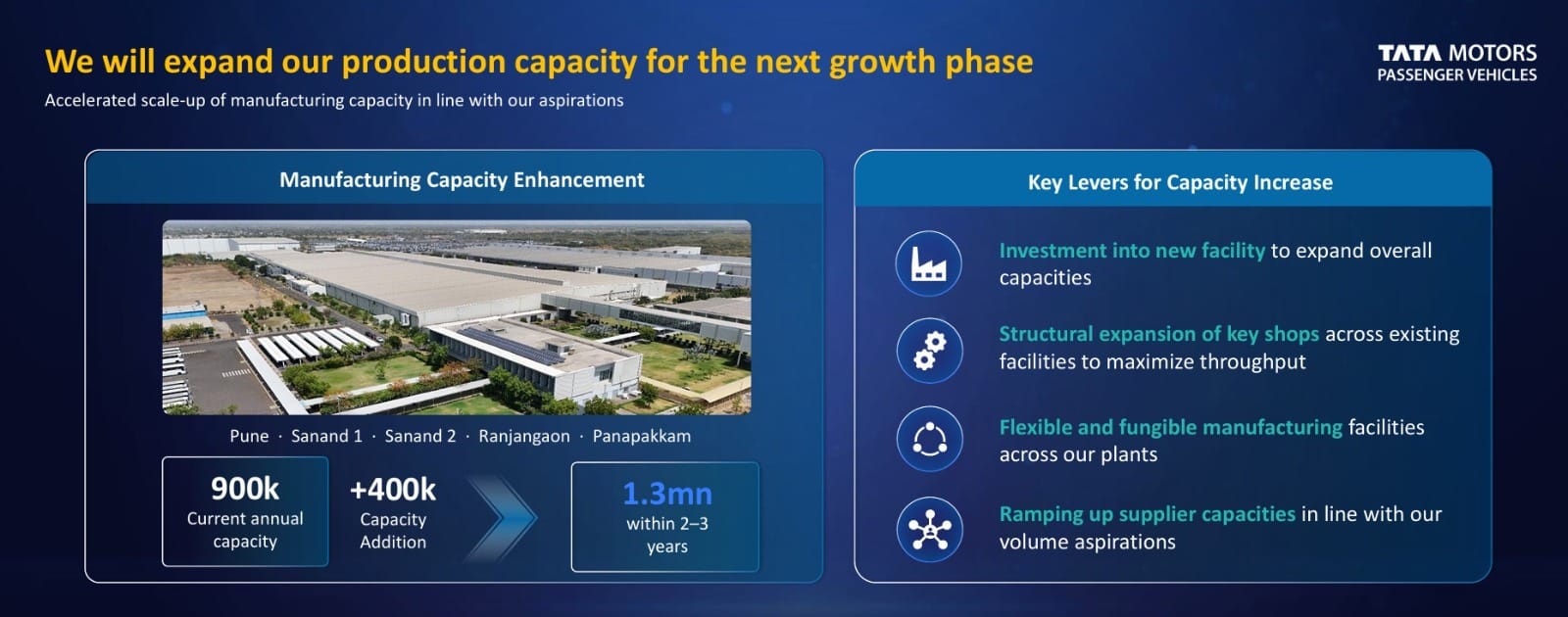
The manufacturing flexibility will be supported by a significant expansion in production capacity. Tata Motors currently has around 0.9 million units of annual installed passenger vehicle manufacturing capacity and plans to increase it by another 400,000 units over the next two to three years, creating headroom for its long-term volume aspirations.
A major part of the expansion will come through a brownfield expansion at its Sanand facility in Gujarat, according to Chandra. Alongside the Sanand project, Tata Motors will undertake structural expansion of critical manufacturing shops across its existing plants to remove bottlenecks and unlock additional production capacity.
"There will also be structural expansion of some key shops in all the five plants so that we can de-bottleneck and release additional capacity in these plants," Chandra said.
The strategy also extends beyond factory floors. Tata Motors said supplier capacities will be expanded in tandem with its production plans to ensure the supply chain remains aligned with higher output levels.
The company currently operates five plants in Pune, two facilities in Sanand and a manufacturing unit in Ranjangaon through its joint venture with Stellantis. It has also recently acquired land at Panapakkam, where it has begun completely knocked down (CKD) operations for Jaguar Land Rover vehicles, providing an additional manufacturing footprint for future expansion.
The manufacturing revamp complements Tata Motors' broader strategy of building resilience across its operations. In its Investor Day presentation, the company highlighted manufacturing flexibility, localisation, supply-chain resilience and technology integration as key enablers of its long-term growth strategy.
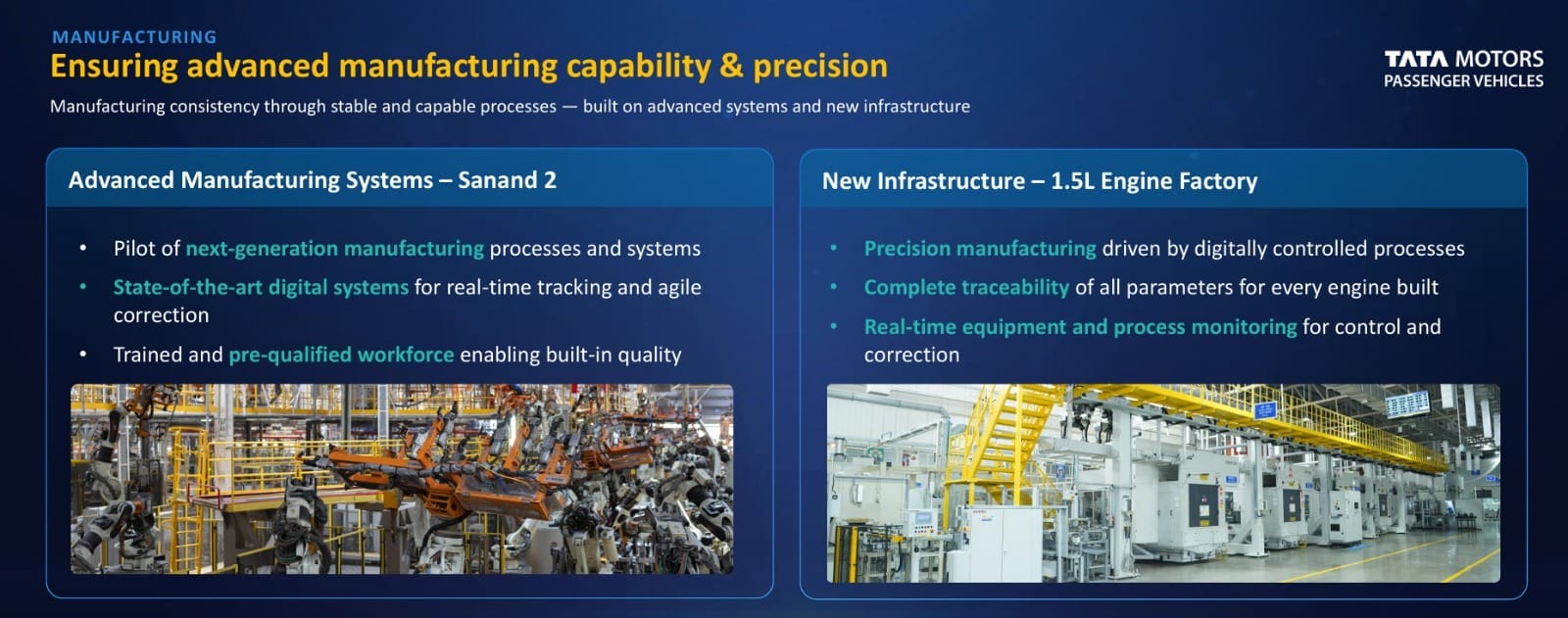
Beyond manufacturing, the company is also investing in digital engineering tools, including system-level simulations, digital twins, AI-led quality monitoring and predictive analytics to support faster product development and improve manufacturing quality as vehicle software content increases.

RELATED ARTICLES

GARC Upgrades Automotive Testing Infrastructure Under PM E-DRIVE
 Eshisha Java
28 Sep 2026
Eshisha Java
28 Sep 2026
The Chennai-based testing agency is adding EV, battery, ADAS, crash safety and heavy commercial vehicle testing capabili...


Renault India Sees Hybrids As Major Volume-Generating Powertrain In Medium Term
Kiran Murali
28 Sep 2026
The automaker is betting on strong hybrids as it expands its product portfolio and prepares for a shift in India's power...

Renault India Eyes 500 Showrooms By End Of 2027
Kiran Murali
28 Sep 2026
The automaker is planning to expand its retail footprint as it looks at a product portfolio of seven models by the end o...