Follow us
Tata Motors PV Targets ₹6 Lakh Crore Revenue, 10% EBIT Margin by FY31
The group, comprising the India passenger-vehicle business and JLR, targets a net debt-free position by FY29 and significant free cash flow by FY31.
 23 Jun 2026
 2137 Views
Share -
2137 Views
Share -


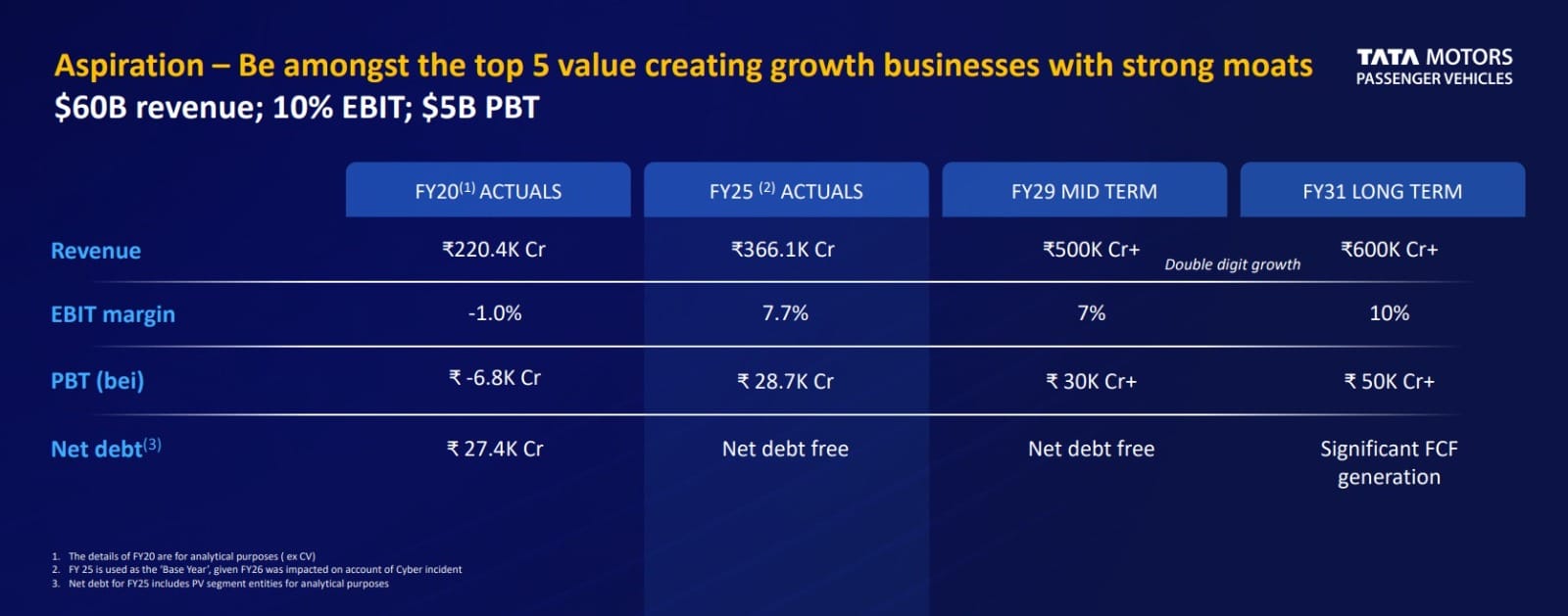
Tata Motors Passenger Vehicles has set a target of increasing consolidated revenue to more than ₹6 lakh crore by FY31, as it seeks to scale its Jaguar Land Rover and India passenger-vehicle businesses.
The group is also targeting an earnings before interest and tax (EBIT) margin of 10% and profit before tax and exceptional items of over ₹50,000 crore by FY31, according to the automaker's investor day presentation. It also expects to generate significant free cash flow by then.
As an intermediate target, consolidated revenue is expected to cross ₹5 lakh crore by FY29. The group has set an EBIT margin target of 7% and a profit before tax and exceptional items target of more than ₹30,000 crore for that year. It also aims to be net debt-free by FY29.
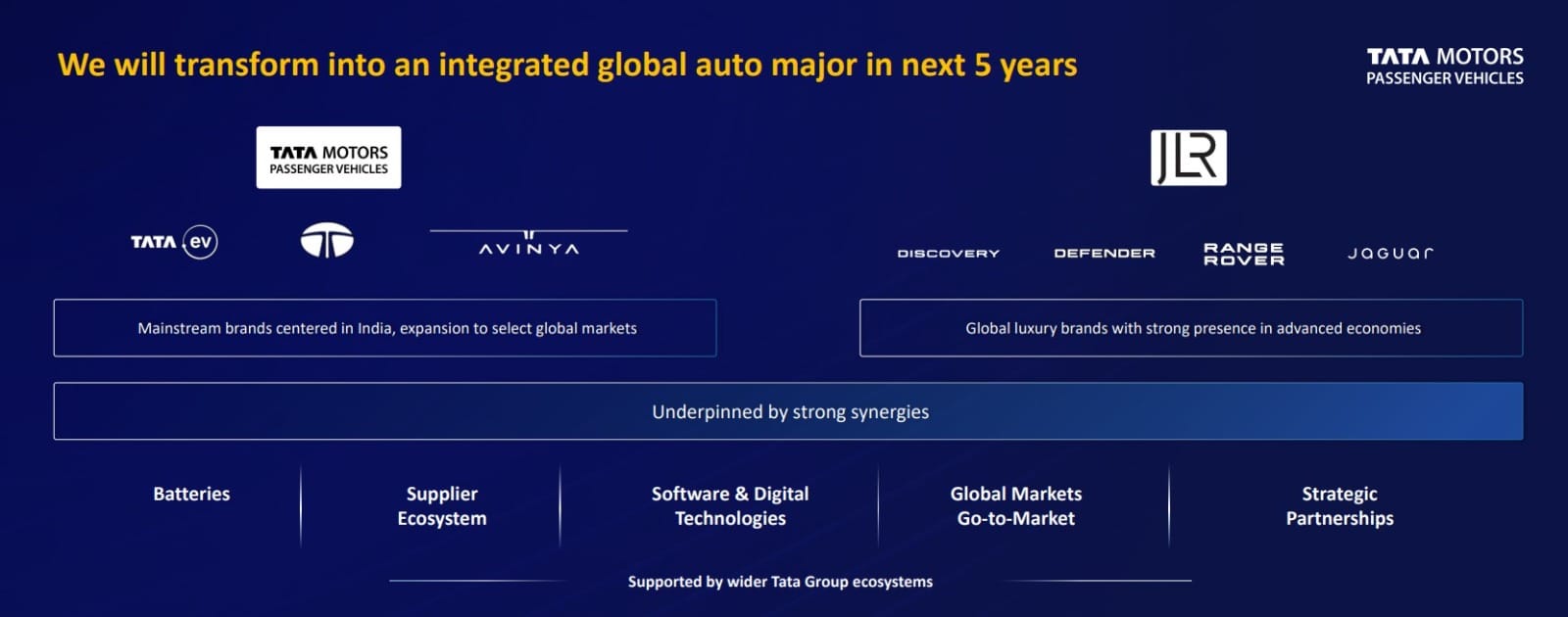
The targets cover Tata Motors PV’s India passenger-vehicle operations and JLR. The group said its wider aspiration was to become one of the five leading value-creating growth businesses with strong competitive advantages.
Tata Motors PV used FY25 as the base year for the five-year roadmap because FY26 was affected by a cyberattack and production disruption at JLR.
In FY25, the group reported consolidated revenue of about ₹3.66 lakh crore, an EBIT margin of 7.7% and profit before tax and exceptional items of ₹28,700 crore, according to the investor presentation.
FY26 Hit By JLR Disruption
The group’s consolidated revenue declined to ₹3.36 lakh crore in FY26, while profit before tax and exceptional items fell to ₹2,519 crore.
The performance was affected by several headwinds at JLR, including higher US tariffs, weak luxury demand in China, the end of production of older Jaguar models, and a cyberattack that forced the company to pause manufacturing for five weeks.
JLR’s revenue declined 20.9% to £22.9 billion during FY26. Its wholesale volumes, excluding the China joint venture, fell to 307,915 vehicles from 400,898 units in the previous year.
The India passenger-vehicle business, however, recorded its highest annual volume and revenue.
Tata Motors PV sold 6,41,586 vehicles, an increase of 15% from FY25. Revenue rose 20.7% to ₹58,465 crore, while profit before tax and exceptional items increased 32.6% to ₹1,436 crore.
The India business reported an EBITDA margin of 6.9% and ended the year with net cash of ₹6,710 crore.
The consolidated group also recovered during the fourth quarter as JLR resumed normal production and delayed vehicles were delivered to customers.
Consolidated revenue stood at ₹1.05 lakh crore in the fourth quarter, while profit before tax and exceptional items rose to ₹7,167 crore.
India Business to Provide Scale
The India passenger-vehicle business will be one of the main contributors to the consolidated growth target.
It plans to increase revenue to more than ₹1.15 lakh crore by FY29 and ₹1.4 lakh crore by FY31, compared with ₹58,500 crore in FY26.
The business is targeting an EBITDA margin of 8% by FY29 and 10% by FY31. Its EBIT margin is expected to increase from 1.4% in FY26 to 4% by FY29 and more than 5% by FY31.
Annual volumes are expected to more than double to over 12 lakh vehicles by FY31 from about 6.4 lakh units in FY26.
The company expects electric and CNG vehicles to contribute most of the incremental growth. It has set a target of increasing EVs to over 30% of its volumes and expanding its electric portfolio from six models to 10 by FY31.
Tata Motors PV also plans to introduce new nameplates, refresh existing vehicles and offer more powertrain choices across petrol, diesel, CNG and electric vehicles.
It plans to invest ₹37,500-40,000 crore through FY29 in products, technology and manufacturing capacity. Despite this investment, the India business expects to generate cumulative free cash flow of more than ₹10,000 crore by FY29.
Cost Reduction and Capital Discipline
Improving profitability will be important to achieving the consolidated targets.
The India passenger-vehicle business plans structural cost reductions of 5-6%, with higher savings expected from EV-specific components. It will focus on localisation, value engineering, supplier collaboration and lower fixed costs. The company also plans to improve the use of its manufacturing capacity as volumes rise.
At the group level, capital efficiency will be driven by decisions on whether to develop technologies internally, purchase them or work with partners. This approach is expected to reduce investment requirements and shorten product-development timelines.
The group said that it will also seek to improve the profitability of its sales and service network while using better product quality and customer experience to support growth.
Five Priorities For The Group
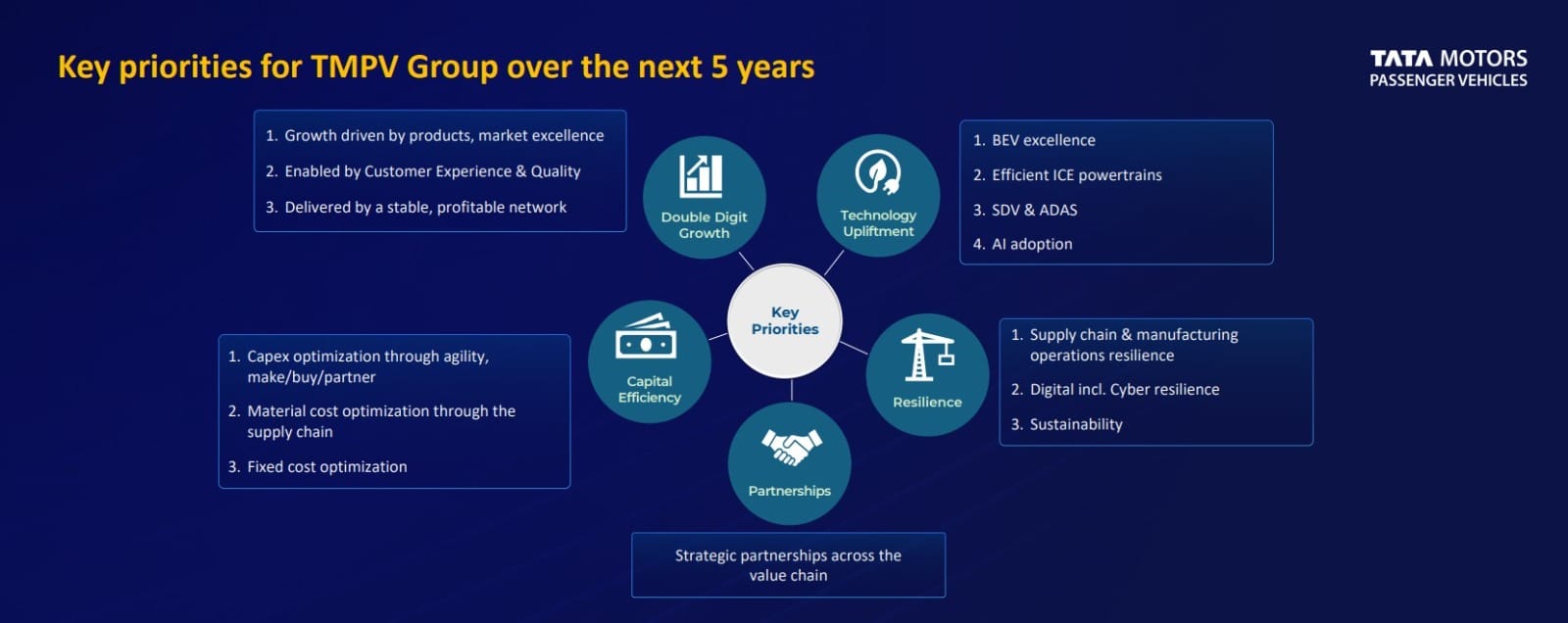
Tata Motors PV Group has identified five priorities for the next five years: double-digit growth, capital efficiency, technology development, resilience and strategic partnerships.
Growth will be driven by new products, stronger market execution and a stable and profitable retail network.
The group’s technology priorities include battery-electric vehicles, efficient internal-combustion engines, software-defined vehicles, advanced driver-assistance systems and the use of artificial intelligence.
It also plans to strengthen the resilience of its supply chain and manufacturing operations. Cybersecurity, digital systems and sustainability will form part of this programme.
Strategic partnerships will be used across the value chain, including products, technologies, components and manufacturing.

RELATED ARTICLES

GARC Upgrades Automotive Testing Infrastructure Under PM E-DRIVE
 Eshisha Java
28 Sep 2026
Eshisha Java
28 Sep 2026
The Chennai-based testing agency is adding EV, battery, ADAS, crash safety and heavy commercial vehicle testing capabili...


Renault India Sees Hybrids As Major Volume-Generating Powertrain In Medium Term
Kiran Murali
28 Sep 2026
The automaker is betting on strong hybrids as it expands its product portfolio and prepares for a shift in India's power...

Renault India Eyes 500 Showrooms By End Of 2027
Kiran Murali
28 Sep 2026
The automaker is planning to expand its retail footprint as it looks at a product portfolio of seven models by the end o...